Snooker vs Pool at a Glance
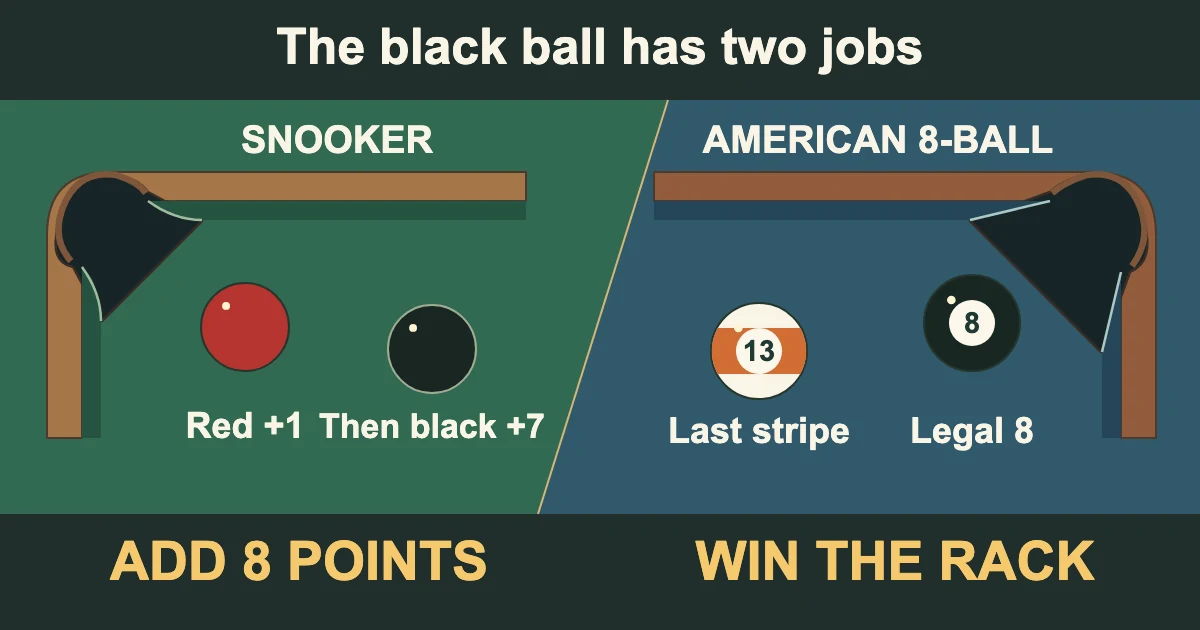
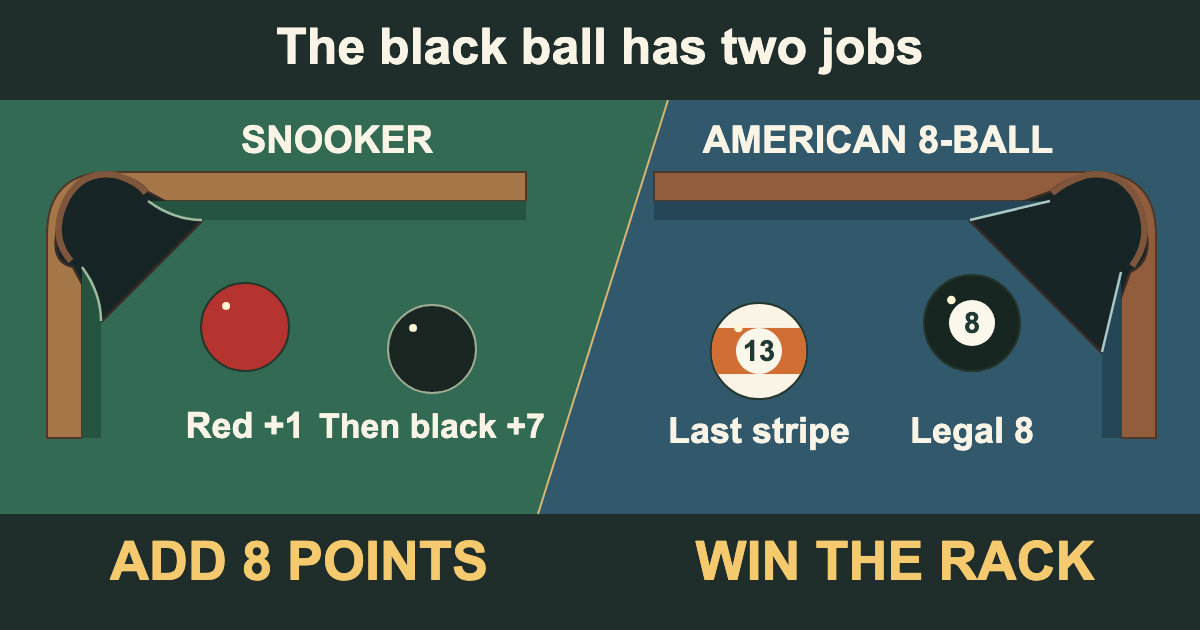
In snooker, every legal pot adds to your score. In American 8-ball, pocketing the balls in your group gets you closer to the shot that wins the rack. Each game uses a cue ball and six pockets, but the set of balls and the shot you’re trying to set up tell you which game you’re playing.
| What to compare | Snooker | American 8-ball |
|---|---|---|
| What wins | More points at the end of the frame | Legally pocketing the 8 after clearing your group |
| Balls, including the white | 22 | 16 |
| Standard ball diameter | About 2.07 in (52.5 mm) | 2¼ in |
| Playing surface, inside cushions | 140½ × 70 in | 100 × 50 in |
| First shot | Play the cue ball from the D (the marked semicircle at one short end) and hit a red first | Break the triangle of 15 object balls |
| Common equipment | Rounded cushion ends and directional napped cloth | Angled cushion faces and worsted cloth options |
The dimensions come from the World Professional Billiards and Snooker Association rules and the World Pool Association equipment specifications. The playing surface is the space between the cushion faces. Home tables come in other sizes, and rules for pool change with the game. In 9-ball, for instance, the rack starts with nine object balls.
What Wins in Each Game?
Snooker keeps a score through the frame. American 8-ball and 9-ball each end with a particular ball legally pocketed. The fastest way to understand the difference is to see what you would shoot after pocketing your first target.
Snooker Builds a Score
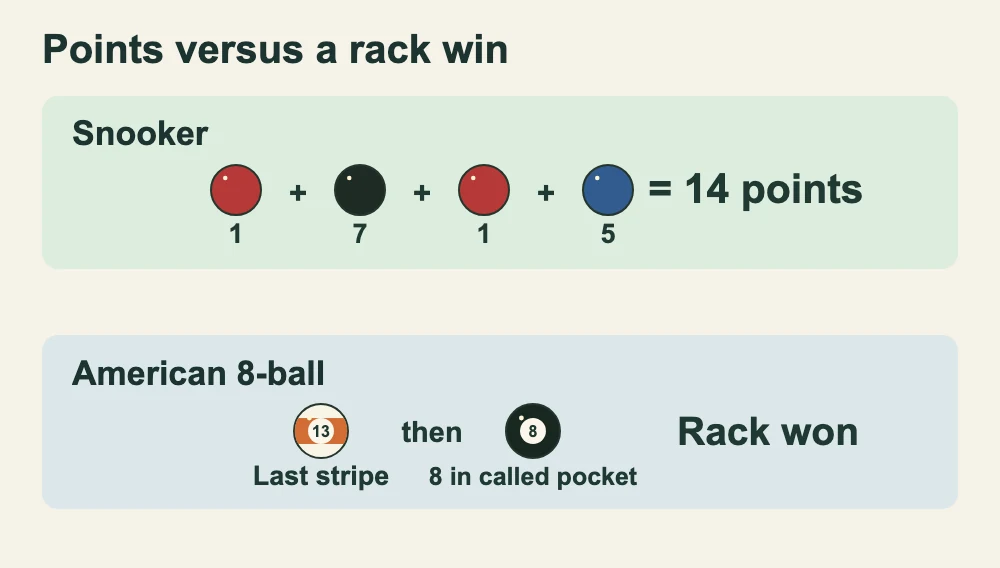
Pot a red for one point, then choose one of the colors. Yellow is worth two, green three, brown four, blue five, pink six and black seven. A red followed by black earns eight points on two shots. The red stays down. The black goes back on its spot, or on the highest free spot if its own is occupied. Continue alternating while the reds remain. If your next red is followed by blue, those two shots add six more points. You now have 14 points from four pots.
If you pot the last red, play a color of your choice next. After that shot, the game moves to yellow through black in increasing point order. In that final sequence, legally potted colors stay down. A player can win the frame with a higher score even if the other player pots the last black. A tie after the last black leads to a re-spotted black. The snooker rules guide shows how to set up, handle fouls and finish the frame.
A standard 147 break combines all 15 red-black pairs with the six colors in order. That is 120 points from the pairs and 27 from the colors. An early free ball can allow a higher break. A beginner can focus on the first pair of shots before trying to build a long visit.
8-Ball Clears a Group
On an open table after the break, your first legal called pot normally assigns your group, solids or stripes. Pocket your last stripe and you can shoot at the 8 on the next shot if the stripe went in legally. Under the WPA rules of play, the legal 8 has to go in the called pocket, with no foul. Potting more balls than your opponent earlier in the rack does not give you a score to protect.
Agree on break and call rules before starting. Pocketing the 8 on a legal break does not automatically win under WPA rules. The 8-ball rules guide covers when groups are assigned and how to handle scratches, wrong-pocket shots and an early 8.
9-Ball Changes the First Target
On a normal 9-ball shot, the cue ball has to contact the lowest-numbered ball on the table first. It can send a different ball into a pocket after that contact. For example, if the 3 is lowest and you hit it first, a legal combination that pockets the 9 can win while other balls remain. Check the break rules of the event or room.
When several balls are left, that rule helps you read the next shot. Look for the lowest number before you decide what you can pocket or how to play safe. The one optional push-out immediately after a legal break has different contact rules. The 9-ball guide explains how to break, continue the rack and handle a foul.
Why the Same Shot Feels Different
Playing length, ball size, cushion shape and cloth all affect what you see and how far the ball travels. A setup that looks familiar can still call for a different amount of pace. Pay attention to the bed and balls in front of you when you switch games.
Smaller Balls and Cue Tips
The standard snooker ball set has fifteen reds, six colors and the white. The balls are about 2.07 inches in diameter. Standard American pool balls measure 2¼ inches. A numbered pool set has objects for several games. An 8-ball rack uses all 15 of them, while a 9-ball rack uses 1 through 9.
Cue makers offer different tip sizes. A 58-inch snooker cue from Peradon has a 9½ to 10 mm tip. Cuetec pool shaft examples include 11.8 and 12.5 mm. Those are examples. Fit and feel vary with the shaft and tip. If you’re borrowing a cue for your first session, try a few straight shots on the actual table before judging how it plays.
Rounded and Angled Pocket Jaws
Look at the cushion ends where they meet the pocket. Snooker pockets are commonly shaped with rounded jaws. A WPA-spec American pool corner has angled facings, with a mouth of 4½ to 4⅝ inches between the opposing cushion noses.
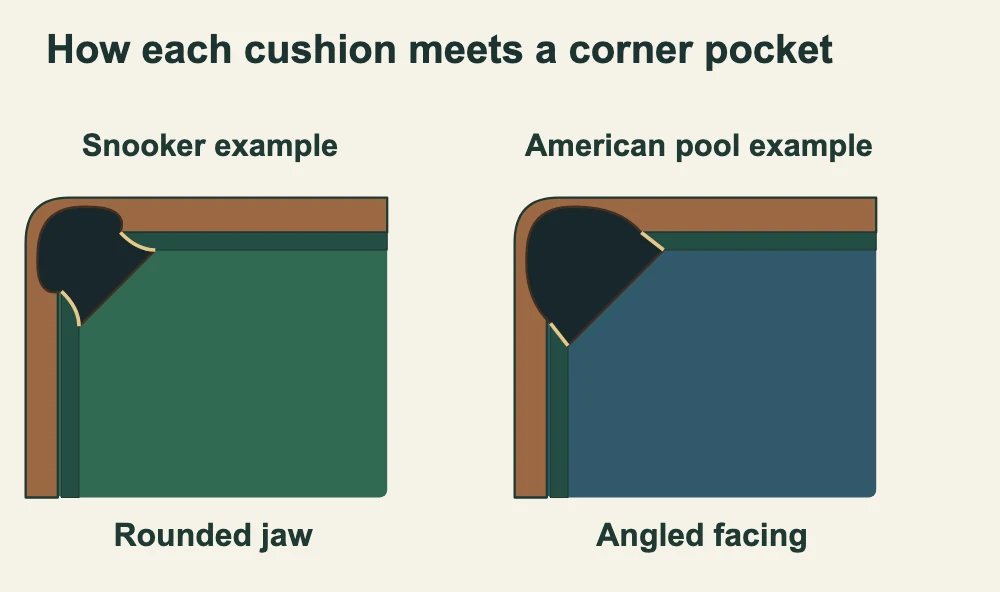
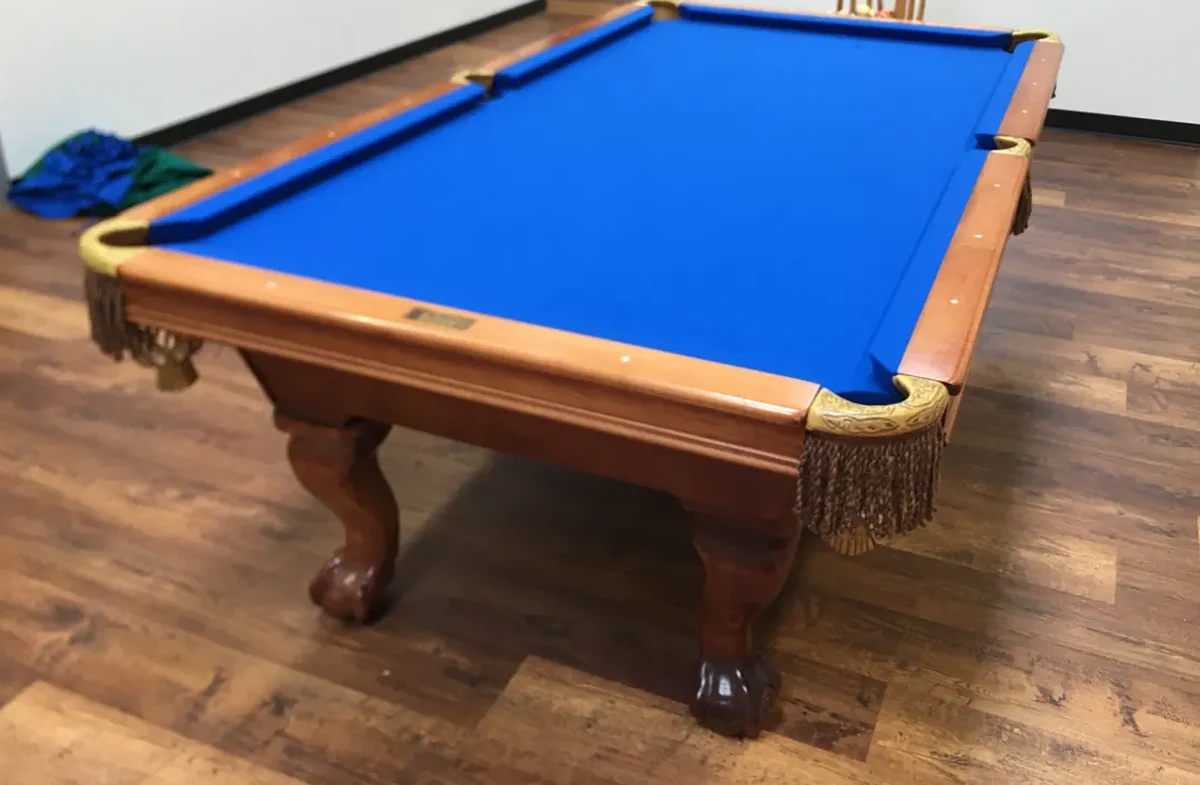
Myth. Pocket width by itself tells you how easily a ball will drop. Reality. Pocket depth and the approach angle matter too. A ball moving near a rail can catch the jaw even when it reaches the mouth.
Take a few shots near a rail at your next table. See how the ball responds when the angle or pace changes before you plan the same shot in a game.
Napped and Worsted Cloth
A napped cloth has raised fibers that lie in a direction. On a snooker table with such cloth, the rulebook specifies that the smooth grain runs from the baulk end, where the D is marked, to the opposite short cushion. Strachan’s snooker cloth is a real example. Simonis worsted pool cloth has a different construction without the same directional nap.
You can find different playing speeds within each type of cloth. Try a gentle roll on the table you’ll be playing and see how far it travels. If you look after the table, follow its cloth maker’s care directions. The pool table cloth guide explains how to identify the construction and why the trade name by itself may leave questions.
Which Table Will Fit Your Room?
With the same 58-inch cue, a standard 9-foot pool table takes less room than a full-size snooker table. Measure at cue height from the inside cushion face to the nearest wall, post or piece of furniture. The outside cabinet dimensions help you plan where the table sits. The inside face is where you start the cue measurement.
For a centered table in a rectangular room, the playing length plus two cue lengths gives the end-to-end span of stationary cues. Do the same across the width. The starting figures are 18 ft by 13 ft 10 in for the 9-foot pool bed and 21 ft 4½ in by 15 ft 6 in for the full-size snooker bed. Add enough space for your actual backswing and stance.
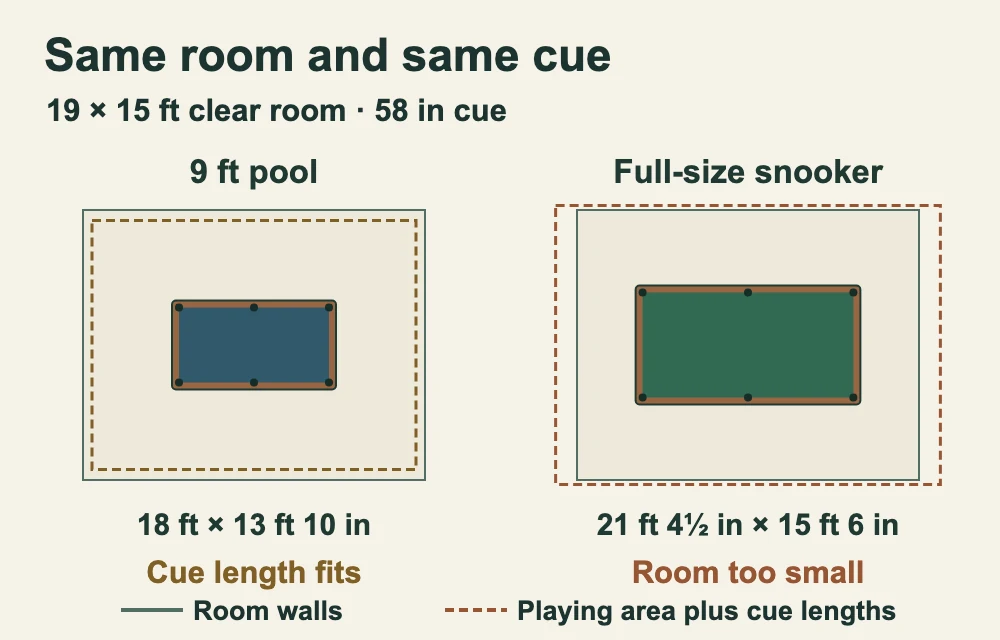
In a clear 19 × 15 ft room, a 9-foot pool bed leaves six inches behind the cue at each end and seven inches at each side. Full-size snooker with the same cue needs an extra 28½ inches of room length and six inches of width just to clear. A post, bench or door in the cue’s path can change either result. Read the snooker size and room chart if you want to see which smaller size might work.
Try table placement and furniture together in the Game Room Layout Planner. It lets you place either game. Confirm the actual cabinet and cushion dimensions before using any preset to decide whether to buy. Also ask the seller which parts arrive separately and check the delivery route, especially if the game room is upstairs or around a turn.
What Carries Over Between Games?
Pocketing and cue-ball control carry over. The next-ball choice changes. In snooker, a red can leave you a choice of colors, with each color worth a different amount. In 8-ball, check whether any of your group is blocked before planning a route to the 8. In 9-ball, you start a normal shot by looking for the lowest ball.
Defense matters in each game. In snooker, you might leave the cue ball behind balls your opponent cannot hit first. They are snookered if those blocking balls cut off a straight path to at least one edge of every legal target. In 8-ball, you can call a safety and end your turn even if you pocket your own ball. Plan where the cue ball will stop and what shot it leaves the other player.
Watch what happens after the cue ball falls into a pocket. On an ordinary 8-ball shot, the incoming player generally gets the white in hand anywhere on the bed. The break and a foul while potting the 8 have their own outcomes. In snooker, the foul gives the other player points. If they take the next shot with the white in hand, they play it from on or within the D.
When you switch tables, try three simple layouts on the new cloth. Start with a straight shot to a corner. Try one close to a long cushion. Then play a gentle shot where you can watch how far the cue ball rolls after contact. The idea is to give yourself a reference for the pocket and the pace before you worry about the full rules.
Can You Play Both on One Table?
You can play adapted snooker on some pool tables with balls suited to their cushions and pockets. Ask the maker for the diameter before buying a set. Two tables with the same outside length can have different playing dimensions and pocket shapes. The goal is to get the right fit for that table.
If you use fewer reds to make room on a smaller bed, agree on the set and spotting positions before play. A fitter’s shared-table marking guide shows how the baulk line, D and spots can be laid out for different playing surfaces. Keep the arrangement consistent so each player has the same game. For full-length shots and competition practice, use the format you will compete on.
What Does Billiards Mean?
Billiards can mean the family of cue sports or refer to a specific game such as carom billiards or English billiards. In the U.S., pool usually refers to pocket games such as 8-ball and 9-ball. Snooker has its own equipment and scoring. Ask which game the room offers if the name on the sign is all you know.
Blackball, a pool game, can use two groups of seven in solid colors. The black wins if it drops legally and none of your group’s balls remain after the shot. In the WPA version, shots are uncalled and foul options differ from American 8-ball. A set of unnumbered balls can therefore belong to a pool game as well. Look for two equal groups or for the 15 matching reds and separate colors of full-size snooker.
The WPBSA’s history of snooker credits Lieutenant Neville Chamberlain and traces the sport to British Army officers in Jabalpur, India, in 1875. The game grew out of other table games played there. Its scoring and table setup have their own rules today.
Which Game Should You Learn First?
Start with the game you can play regularly. American 8-ball is easy to recognize from its numbered solids and stripes, and a friend can teach you one group's goal in a rack. If a room near you offers snooker and you enjoy building a score across a frame, try it there before you choose equipment.
- Ask which table the room has. A venue that lists billiards could have several kinds of table. The U.S. Snooker Association’s room and club links can help you find a snooker table. Call to check access and whether the venue lends cues and balls.
- Agree on the game. Ask whether you are playing 8-ball, 9-ball or another local format. At a snooker table, clarify whether it’s a full 15-red frame or a shorter agreed game.
- Know the first target. In 8-ball, ask whether the table is open. On a normal open table, call a solid or stripe. If you already have a group, call a ball from that group. In snooker, start by going from one red to one color, then check where the cue ball finished for the next red. Let a regular game show you which skill you want to practice.
Snooker can make long pots feel demanding because the bed lets the balls get farther apart. Pool presents its own issues, such as reaching a particular group ball through a cluster or getting from the lowest ball to the next one in 9-ball. Which feels harder depends on the layout and your experience. Play both where you have the option.