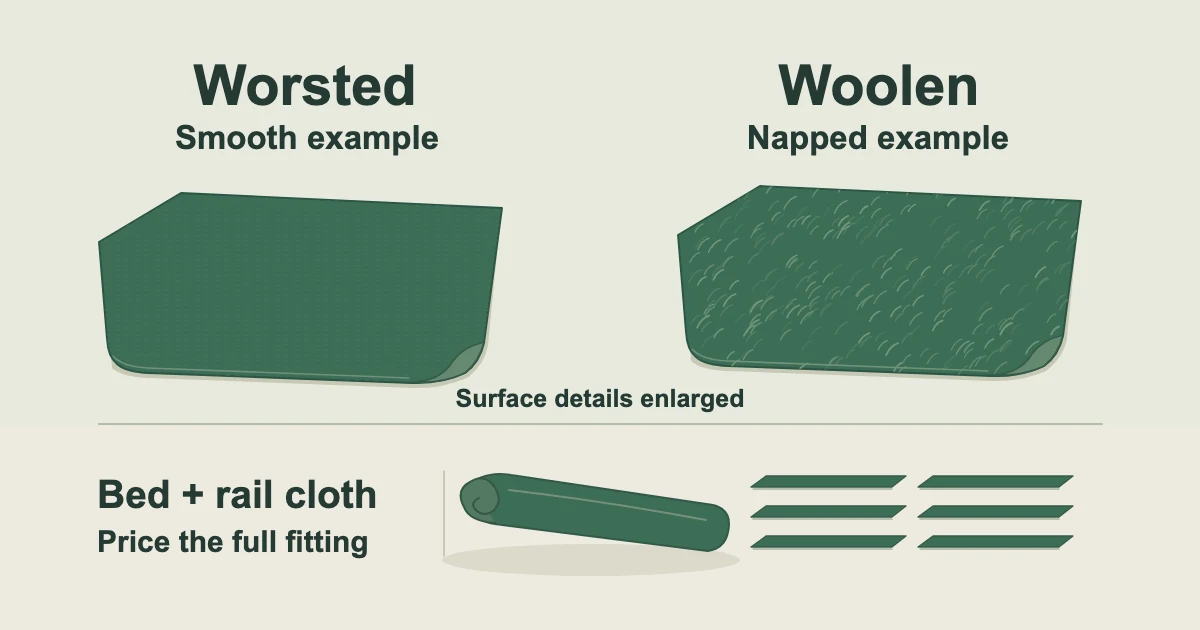
What changes between worsted and woolen?
The main pool table felt types are worsted and woolen. Both are woven cloth. The names describe how the wool is prepared before it is spun into yarn. Worsted yarn uses combed wool, with the longer fibers aligned and shorter ones removed. Woolen yarn uses carded wool, with the fibers separated and blended before spinning. It skips the combing step. The first thing you’ll notice on the table is the finished surface. The International Wool Textile Organisation explains both yarn processes. On cloth with a nap, you can see or feel fibers that rise from the weave and lie in one direction.
Compare Hainsworth Elite Pro and Hainsworth Smart. Elite Pro is a smooth, napless worsted. Smart has a directional nap. Both contain wool. If a label says only “wool blend,” ask which cloth it is before assuming that either description fits.
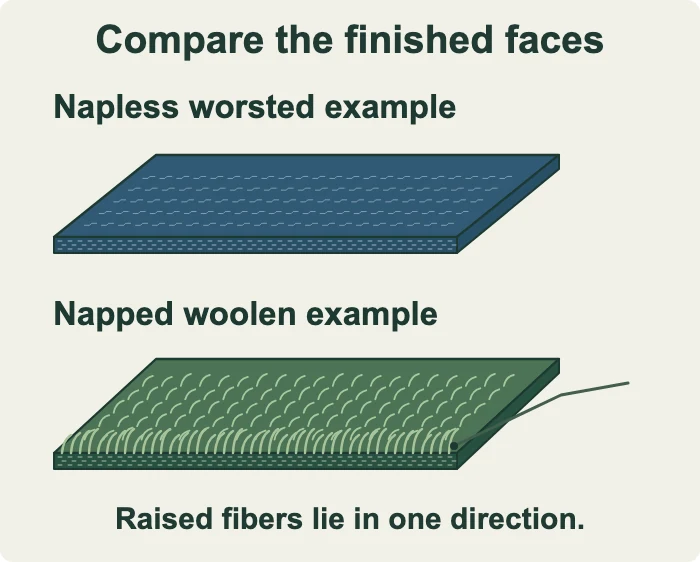
| What to check | Worsted | Woolen |
|---|---|---|
| Playing face | Usually smooth, with no raised directional nap. | Some cloths have a raised nap. Others are finished smoother. |
| Game and pace | Common in American pool. Check which line gives you the pace you want. | Includes cloth for American pool, English pool and snooker. Ask what game the line is made for. |
| Wear and spills | Check the exact model’s wear guidance and any spill treatment. | Ask the same questions and check how the maker tells you to care for the nap if there is one. |
| What fits | Confirm cloth for the bed, the flat playing area, and all the cushions. | Confirm the same cuts. On directional cloth, have the fitter follow the maker’s nap layout. |
Which cloth suits the game you play?
If you play American 8-ball or 9-ball, think about a shot you use all the time. Try a gentle, straight roll on a familiar level table. Does the ball travel farther than you expect from that stroke? If you can try the cloths you’re considering on similar tables, use the same ball and pace and watch where it stops. A damp room, dirty ball or worn playing surface can change what you see. Use the roll to judge what feels right to you.
A compatible worsted is a sensible starting point if you like a smooth, quick table. A compatible woolen is worth pricing if you like its pace and want to spend less. For English pool, look at a cloth made for it, such as the napped Strachan 777 Pool. For snooker, one directional example is the Strachan 6811 English Snooker cloth. On a napped snooker table, a gentle roll with the nap usually meets less resistance than a roll against it. The Surrey Snooker Academy shows the difference. Give the fitter your game and table model so they can suggest a compatible cloth.
If you play to an event or league specification, check the rules you actually play under. The WPA equipment specifications call for a nap-free playing face for the pool events they cover. That requirement is specific to those events.
How do speed and durability differ?
Compare cloths within the same maker’s range before drawing conclusions from weight or wool percentage. Simonis describes 760 as a higher-speed worsted and 860 as slightly slower than 760. Its US specification for 860 HR describes it as heavier than 760 and designed for wear resistance. The weight comparison gives you no speed ranking for 860 HR or a date to expect it to wear out.
Separate rolling speed from how soon a sliding ball starts to roll. A rolling ball can carry on farther on one cloth. On a draw attempt, the cloth can wear off backspin while the cue ball slides toward the object ball. How much spin the ball has left at impact affects how far it can come back. Dr. Dave’s cloth-friction examples explain both effects and why humidity and wear can matter. Before ordering for a room that gets damp, tell the fitter what changes through the year.
What do hybrid and spill-resistant labels mean?
Ask what the maker means by “hybrid” for the exact cloth. Simonis calls its 860 HR a hybrid worsted. Championship’s cloth specifications describe Valley Teflon Ultra and Mercury Ultra as hybrid woolens finished more like worsted. The finish can make the cloth feel smoother without changing the yarn family.
Myth. Hybrid is a third cloth family.
Reality. Makers use the label on both worsted and woolen cloth. Get the exact product number if two listings describe a cloth differently.
The spill treatment is a separate question. Championship makes Invitational #4066 with a Teflon treatment. The maker also lists Invitational versions without that treatment. Ask how your chosen cloth should be handled after a spill. Keep drinks off the table and use only treatments the cloth maker approves.
Predator sells two worsted cloths with different blends, Arcadia Reserve and Arcadia Select. If a listing offers only “premium cloth,” ask the seller to write the model name on the order.
How do you identify the fitted cloth?
- Find the last fitting record. Check the invoice or packaging for the cloth maker and model. If you bought the table used, ask who last recovered it.
- Check a spare offcut. Use a leftover piece from the current fitting. On Simonis cloth, the grade is printed near the edge on the smoother playing face. The back is fuzzier. If the spare piece came from the middle of the roll, it may have no printing.
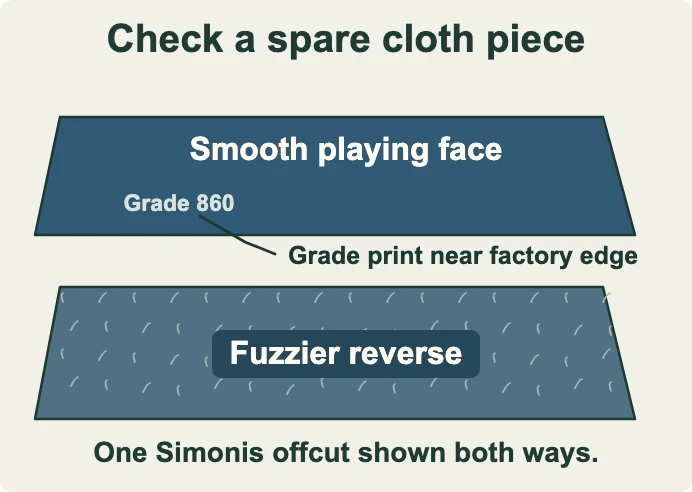
Look near the factory edge of a spare Simonis piece, on the smooth side, for the grade. The reverse can feel fuzzy even on a worsted. - Photograph the playing surface. Leave the rails and cloth in place. Take a photo from a corner that shows the whole bed and the cushions. Add a close-up of any wear or damage you find. If the fitter needs the table maker, send a separate photo of the badge. Confirm the cloth with the last installer or the fitting record.
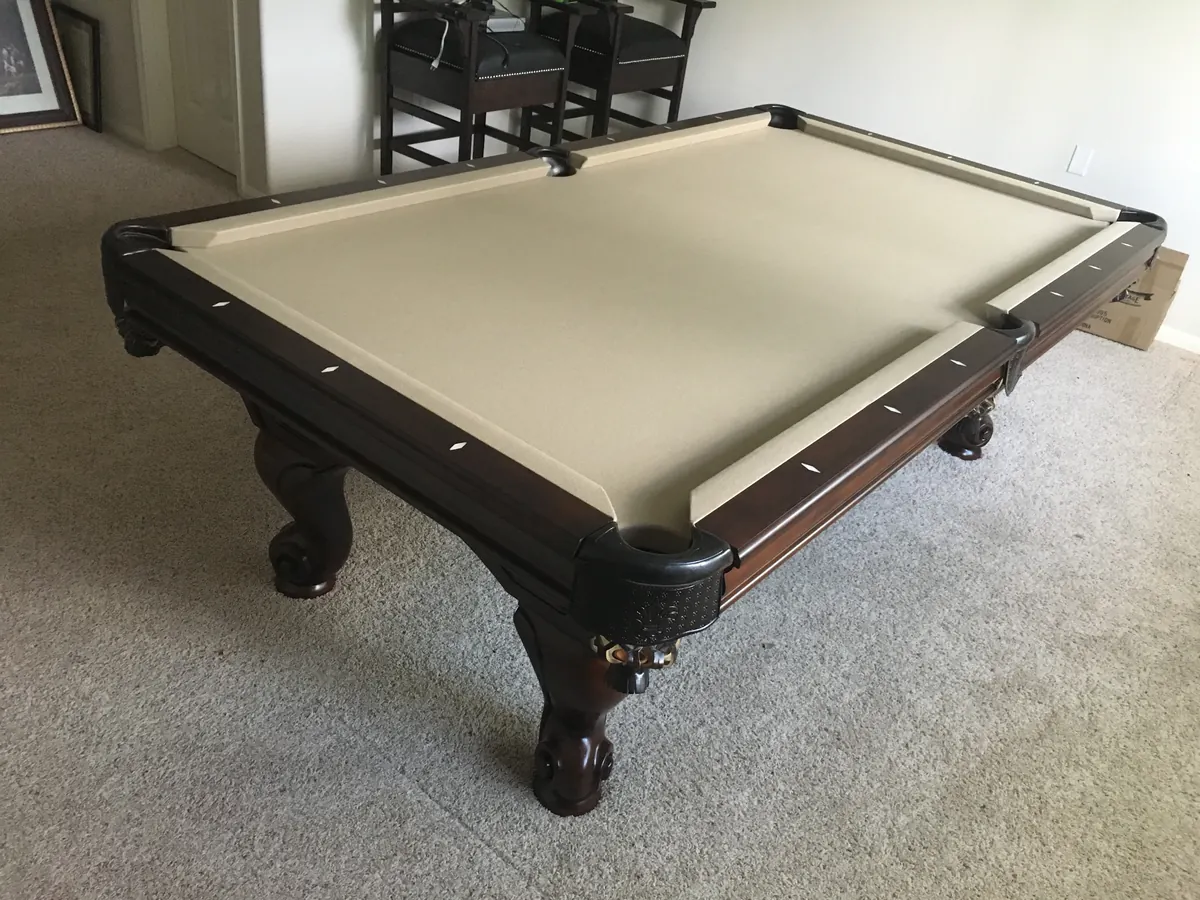
In my photo, you can see the cream cloth across the bed and on the cushions. Clear the balls and cues before taking your own photo so the fitter can see the whole surface.
A raised nap can tell you something about the surface. Color, pale ball marks or a fuzzy underside are too little evidence to identify a model. If you still cannot tell which cloth is on the table, ask the maker or fitter what care is safe before trying a new method.
How do you compare fitted cloth quotes?
Measure the playing area between the cushion noses. The nose is the cloth-covered edge the ball rebounds from. Measure length and width across from one nose to its opposite, away from the pocket openings. An 8-foot standard playing area can measure 44 × 88 inches. An oversize 8-foot table can measure 46 × 92 inches. Give the fitter both numbers and the table model. The pool table size guide explains how the cabinet and playing measurements differ.
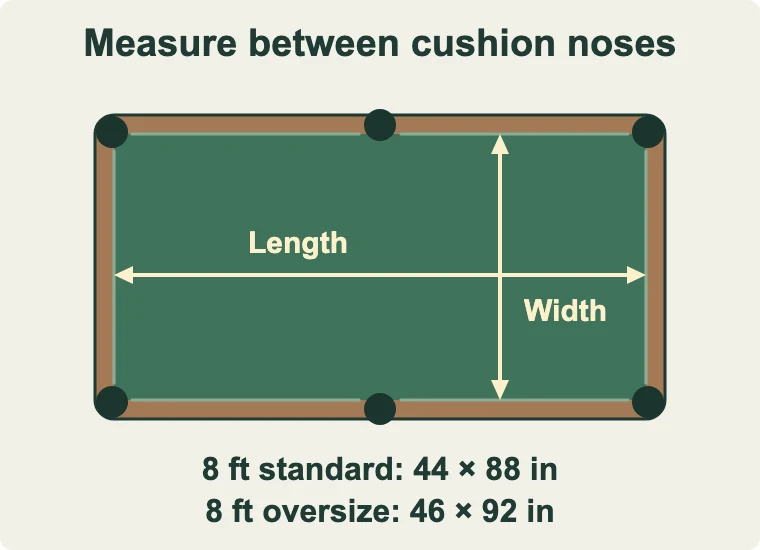
Simonis’ cut chart lists standard and oversize 8-foot sets separately. Ask the seller to confirm the cut and extra cloth needed for the pocket and rail fittings. A bed piece, a bed-and-rail set and yardage off a roll can each have different prices. Check what arrives before you compare the totals. Some brands sell only precut sets. Predator’s sizing notes recommend its 9-foot set for an oversize 8-foot table. Confirm this with your fitter before ordering. If your table uses cloth with a bonded layer on the underside, confirm the spec for the bed and rails separately. The Valley-Dynamo cloth guide gives an example with a backed bed and unbacked rail cloth. A wooden slate liner is a separate part under the stone.
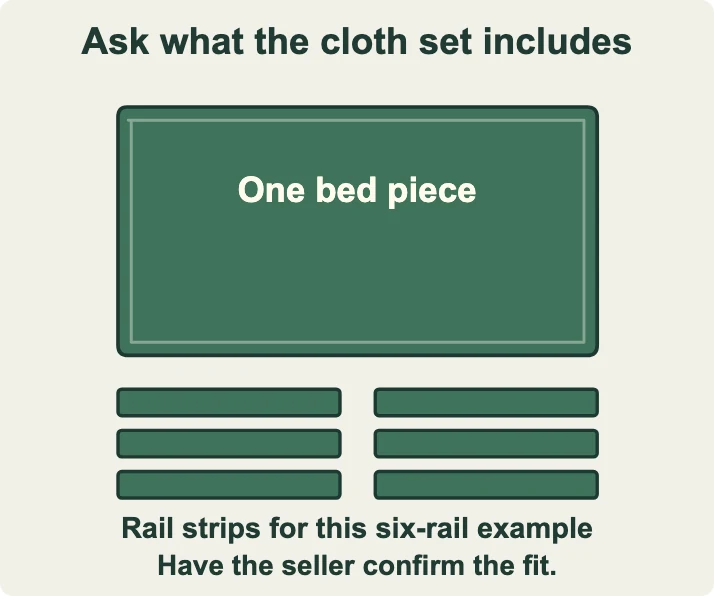
- Cloth and delivery. Record the exact line and color. Confirm the bed piece, all required rail pieces, delivery and tax.
- Fitting and final checks. Ask who removes the old cloth, fits the new bed and rails, finishes the pockets and checks how the table plays after reassembly. Confirm when you can play.
- Other work and follow-up. Ask what extra leveling, cushion rubber or bed repairs would cost if needed. Find out who handles a fitting fault and what the cloth warranty covers.
Here’s what the cloth choice can do to the total. One Southern California fitter’s rate sheet lists $375 for Championship Invitational and $615 for Simonis 760 or 860 for the same 7- or 8-foot job in Riverside County. Both include removing and replacing the bed and rail cloth. The difference is $240 for that local job. Nanco’s rate sheet lists $375 for 8-foot labor plus $450 for Simonis 760 or 860, or $825 before any other charges. Ask them to confirm the rail scope in writing. Use these US-dollar examples to compare the work included and expect your own quote to depend on your location and table.
Once you have a line in mind, use Felt Color Match to compare bed and rail colors alongside the wood, with both a top and an angled view. The cloth-only and installation allowance settings help you plan the budget before you get a written quote. Check a physical color sample before ordering. If you’re scheduling the work, the pool table refelting guide explains what to check before and after the fitting.
How should you care for the cloth?
Get care instructions for the cloth you’re buying. Hainsworth’s napped cloth guidance calls for brushing along the installed nap. For its smooth cloth, Simonis describes careful, low-suction vacuuming without a rotating brush. Its instructions allow wiping with a clean, barely damp towel after vacuuming. Wait for the cloth to dry completely before brushing it again or playing. Check your own cloth instructions and use the cloth-cleaning guide if you’re unsure which steps apply.
Check a mark in light from the side before buying a replacement. A pale ball mark can be flat. A tear has a break in the cloth. A loose ridge may move ahead of a rolling ball. Have the fitter check that area if a ball keeps hopping or changing direction there. A faulty slate joint or cushion may need work before the new cloth goes on.
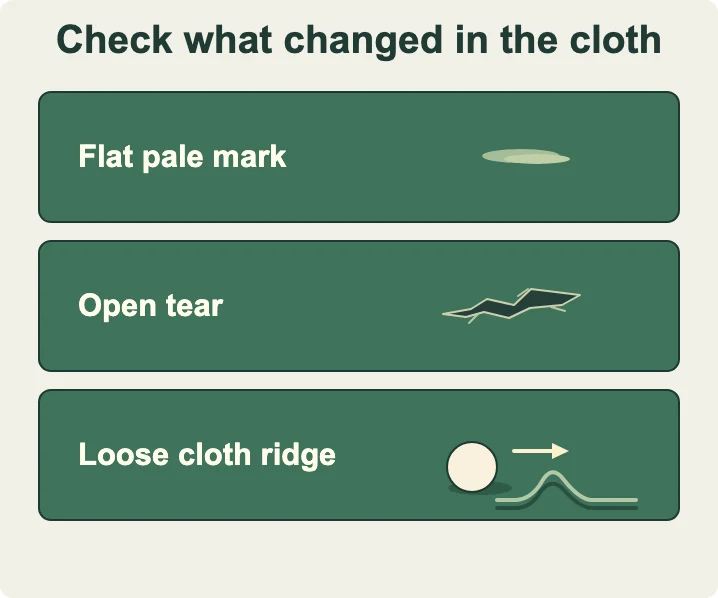
Before the fitter cuts anything, confirm the cloth name and color, the playing measurements and the work agreed in the quote. Keep the invoice and ask for a spare labeled piece. You’ll have the details next time you need care advice or have to match the cloth on a rail.