How do you win at 9-ball?
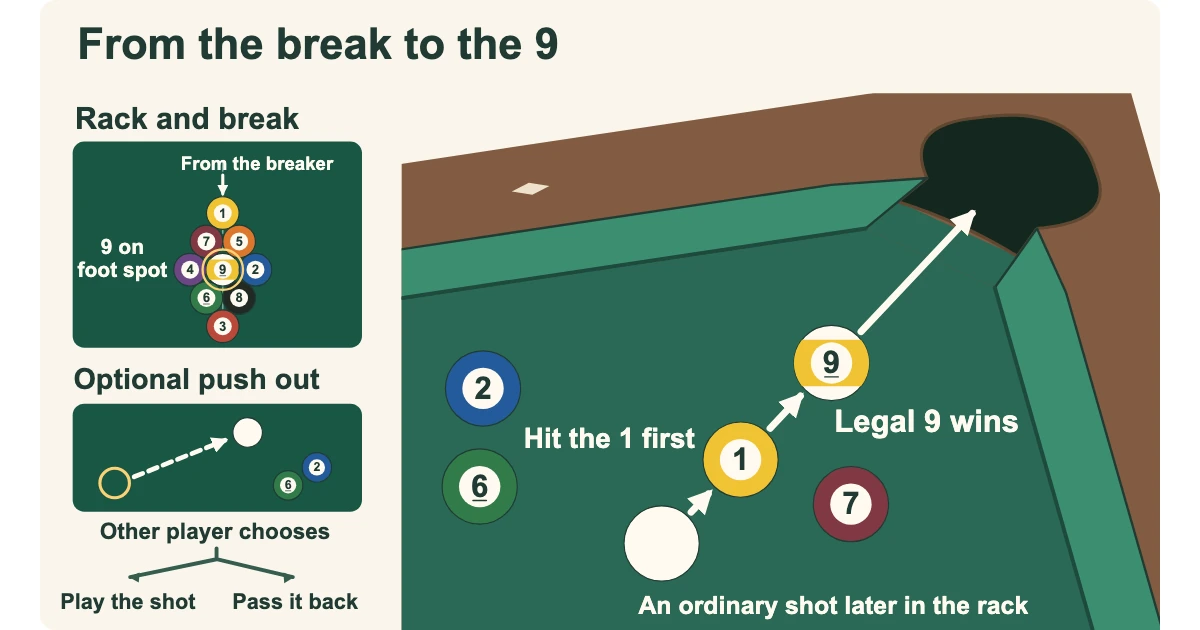
Pocket the 9 on a legal shot to win the rack. On ordinary shots, the cue ball has to hit the lowest number still on the table first. If the 1 is still up, you can hit it into the 9 and win without clearing the other balls. Hitting the 9 first while a lower number remains is a foul on an ordinary shot.
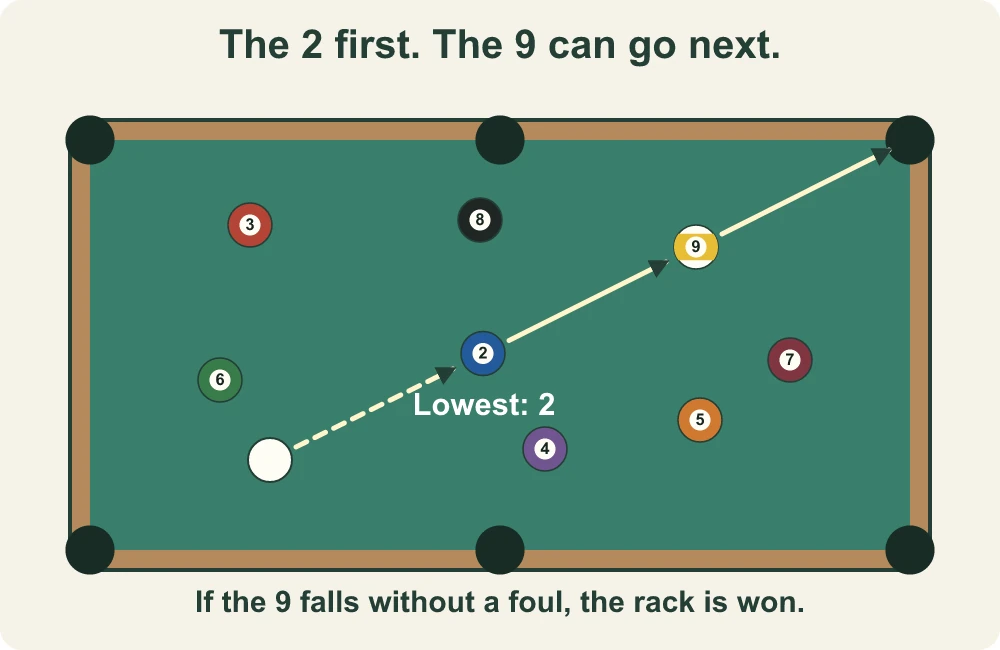
You can pocket a different ball from the one you hit first. Say the 2 is the lowest ball left. You hit it first and it knocks the 6 into a pocket without a foul. You keep shooting. Aim at the 2 again if it stayed on the table.
This guide uses the current WPA Rules of Play, effective October 21, 2026. The break section separately explains WPA Regulation 16, which is required at WPA ranking 9-ball events. I’ve included the APA and UPA differences at the end for players who use those league rules.
A rack is one game. For a race to five, record a point for each rack you win. The match ends when one player reaches five. Agree on your target before the first break.
Set up the table and equipment
Use the cue ball and balls 1 through 9 from a numbered pool ball set, a pool cue and a diamond rack. If you already play 8-ball, use the cue ball and the first nine numbers from that set.
Start at the head end, opposite the rack. The head string crosses the playing surface one quarter of the way from the head cushion. The foot spot is on the table’s lengthwise center line, one quarter of the way from the foot cushion. Measure from the cushion noses on the playing surface to locate those marks.
Give yourself room to pull the cue back at the end you’ll break from. For a home table, enter your room dimensions and cue length in the Pool Table Room Size Calculator to check cue clearance.
Lag to decide who breaks first. Each player starts a ball just behind the head string on their half of the table. Shoot at about the same time and send each ball down to the foot cushion and back. The player whose valid shot leaves their ball closer to the head cushion chooses the first breaker. After that, alternate breaks in a WPA race.
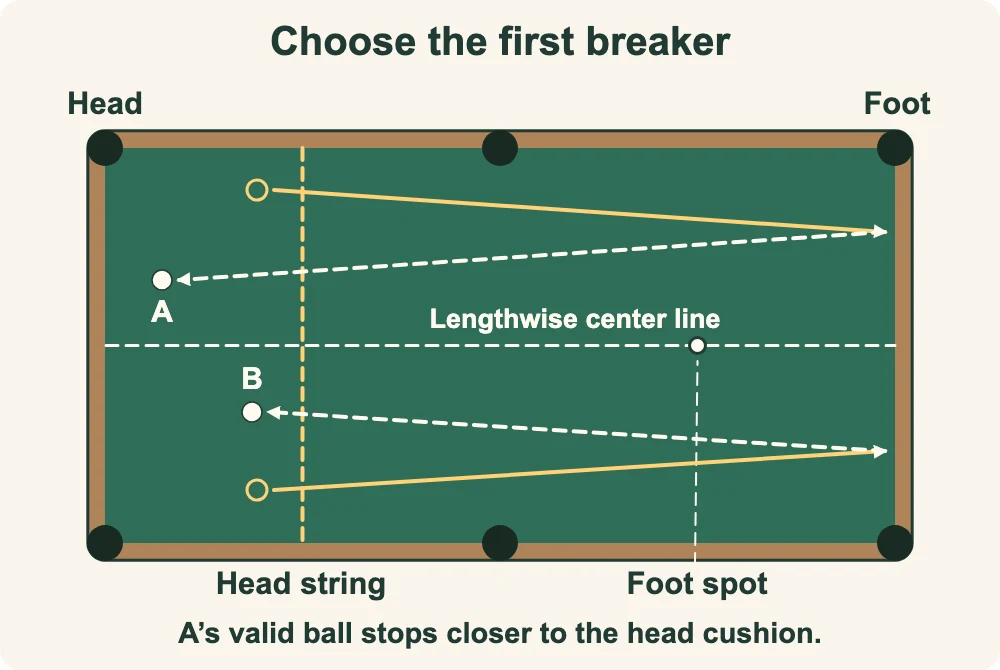
A lag is bad if the ball crosses the lengthwise center line, touches a side cushion, hits the foot cushion other than once, goes off the table or drops in a pocket. It is also bad if it stops in a corner pocket past the nose of the head cushion, or if the player commits a foul that doesn’t involve an object ball, except shooting while a ball is moving. Lag again if both shots are bad, the finish is too close to call, or one player shoots after the other’s ball has already touched the foot cushion.
How do you rack nine balls?
For the current WPA rack, put the 9 on the foot spot, in the middle of a tight diamond. Put the 1 at the front, pointing toward the head end. This differs from the 1-on-the-foot-spot setup still used by some leagues and older rule sheets. The diamond’s shape alone does not establish which setup you are playing.
- Use each number once. Arrange nine balls in rows of one, two, three, two and one, facing the breaker.
- Fix the 1 and 9. The 1 is the front ball. The 9 is the center ball in the three-ball row and its center sits on the foot spot.
- Leave the other positions random. WPA’s racking regulation does not permit deliberately patterning the remaining numbers.
- Keep adjacent balls touching. If you’re using a solid frame, lift it clear without moving the balls. If the rack separates, reset it before breaking rather than assuming it is still tight.
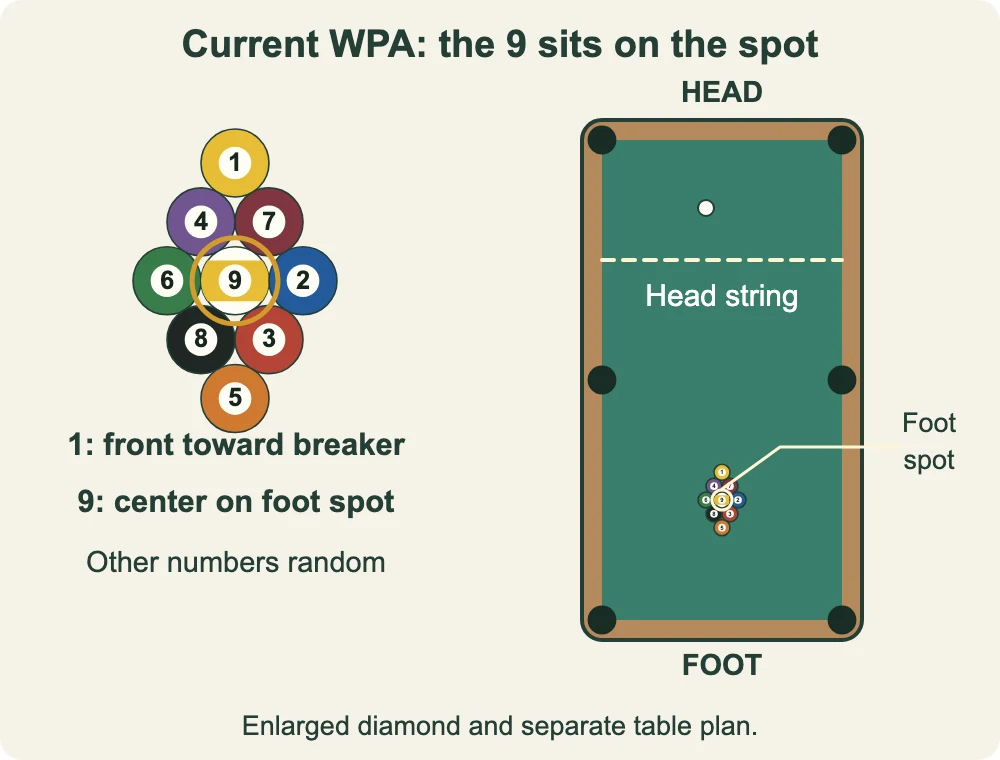
Do not choose a fixed position for the 2 because you saw it in a different league’s diagram. UPA specifies that rear position in its own rules. When you rack for WPA play, fix the 1 and 9 and vary the rest. The illustration shows one possible rack.
If you have no referee, agree whether to rack your own or rack for each other. Under the WPA regulations, rack for each other if you can’t agree.
Break fouls and the three-point rule
Check for a break foul first. Place the center of the cue ball in the kitchen, the area between the head cushion and the head string. Keep its center off the line. Hit the 1 first. If no numbered ball drops, at least four different numbered balls must reach a rail. A ball that hits two rails counts once. Falling short of four on a dry break is a foul. So is a scratch, which means pocketing the cue ball. On a standard break foul, the opponent puts the cue ball anywhere on the playing surface for the next shot.
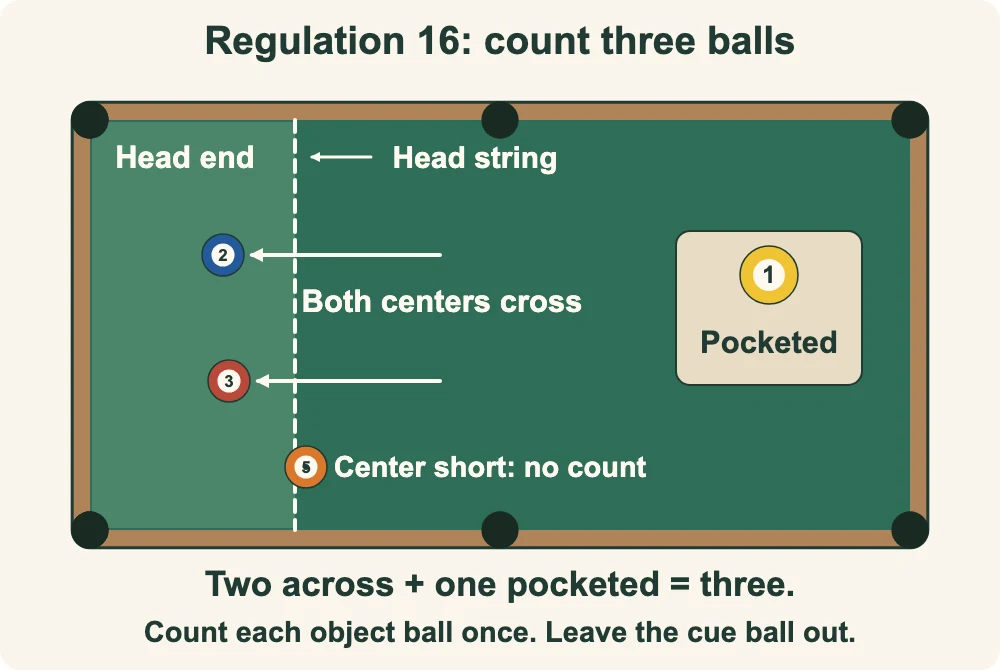
Then check the three-ball count. Rule 5.3(c) says that three balls must cross the head string on a dry break and refers to WPA Regulation 16. The regulation counts each numbered ball that drops or whose center crosses the line. Count each ball once and leave the cue ball out. One ball in a pocket and two other balls with their centers past the head string make three.
| Break result | Who shoots next? | Cue-ball position / push out |
|---|---|---|
| A ball drops, the three-ball count is met, and there is no foul | Breaker, unless the 9 wins the rack | Play the cue ball where it stops. The breaker can declare a push out if the rack is still going. |
| No ball drops, at least four object balls reach rails, at least three cross the line, and there is no foul | Opponent | Play the cue ball where it stops. The opponent may declare a push out. |
| No foul, and the break misses only the three-ball count | Opponent can shoot or give the shot back to the breaker | Spot the 9 if it dropped. Only the breaker can push out, and only if given the shot back. |
| Break foul, such as a scratch, wrong first ball, a ball driven off the table, or too few object balls to rails on a dry break | Opponent | Cue ball in hand anywhere on the bed. Spot the 9 if it dropped or went off the table. No push out. |
Say no ball drops, four numbered balls reach rails, and only two cross the head string. If nothing else went wrong, the opponent can play the position or give the shot back to the breaker. If only three balls reached rails on that dry break, the opponent would take ball in hand for the foul.
Use both checks when playing under full WPA conditions. At WPA ranking 9-ball events, Regulation 16 also requires a racking template or tapped ball positions that hold the shape of the rack. If you’re playing a house game, agree on any different break conditions before the match. In the WPA game here, a 9 on the break wins only after the break checks pass without a foul.
When can you play a push out?
A push out is an option on the first shot after the break. On a legal break that meets both checks, the player due to shoot can push out. That’s the breaker if a ball drops and the rack continues, or the opponent if nothing drops. When the break misses only the three-ball count, the opponent can give the shot back to the breaker, who may then push out. If the opponent accepts the position, they have to play a normal shot.
Before shooting, clearly declare “push out” to the referee, or to the opponent in an agreed unrefereed game. For that shot, the lowest-ball-first and rail-after-contact requirements are suspended. You can move the cue ball without contacting an object ball or a rail. Other foul rules still apply. A scratch, double hit or push shot is still a foul.
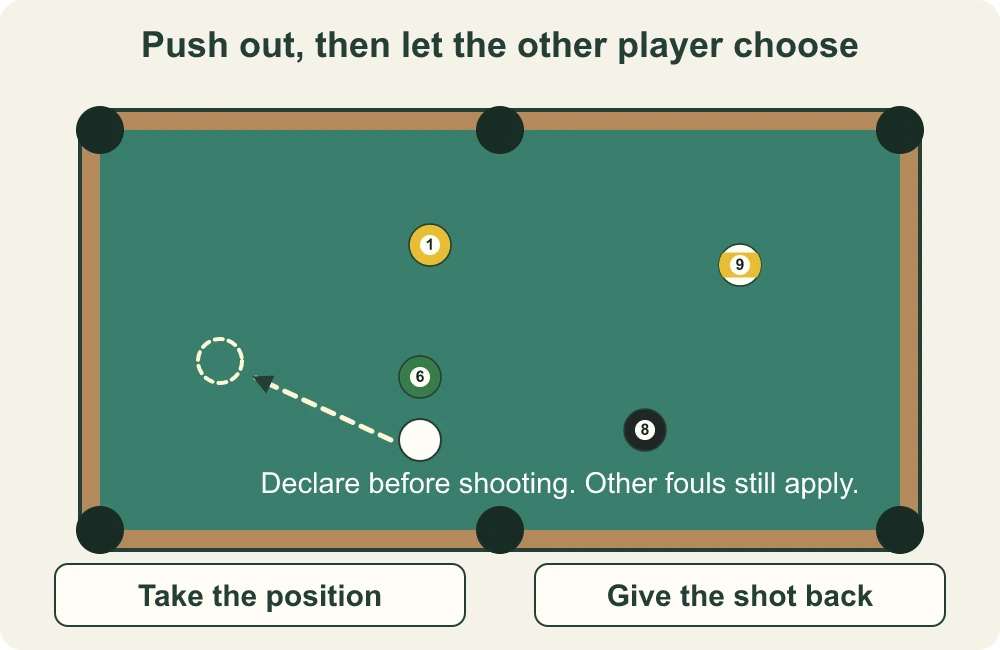
After a legal push out, the other player either shoots from the resulting position or returns the shot to the player who pushed. There is no ball in hand just because a push out was played. Normal contact and rail rules resume on the following shot, whoever takes it.
Leave any pocketed balls numbered 1 through 8 down after a legal push out. Spot the 9 if it drops. The opponent still chooses who shoots from that position. If the push out itself was a standard foul, the opponent gets ball in hand.
Check the shot you might get back. Before pushing out, look at the new position and picture yourself playing from it. Your opponent can pass it back to you. Use a normal stroke. Keeping the cue tip on the cue ball beyond a normal stroke is a push shot and a foul.
Play the lowest ball first
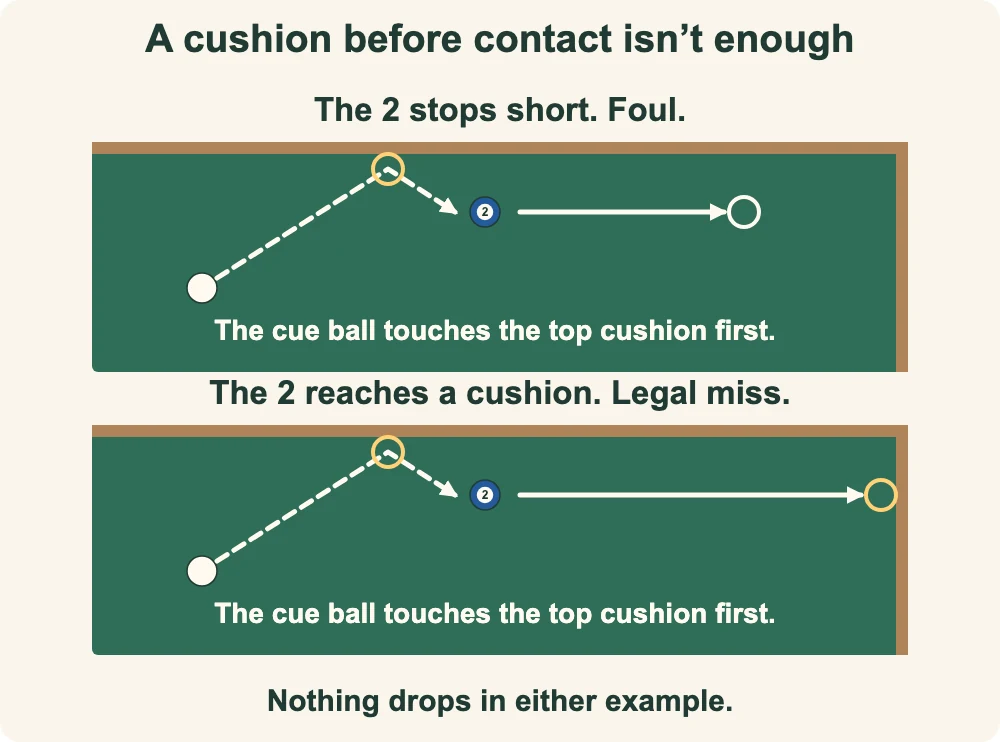
On an ordinary shot, find the lowest number still on the table, make that your first object-ball contact and complete the shot without a foul. You can reach it directly or by sending the cue ball off a cushion first. If no ball drops, the cue ball or an object ball must reach a rail after the legal contact. If the cue ball hits the legal object ball and a cushion so close together that you can’t tell which came first, WPA counts the ball first.
You do not call a ball or pocket in WPA 9-ball. If a ball you didn’t aim at drops on a legal shot, it counts. On a combination, the first object ball hits another ball. On a carom, the cue ball can go on to hit a second ball after its first contact. Both can send the 9 into a pocket for the win after you hit the lowest number first.
| What happened? | Result |
|---|---|
| Lowest ball contacted first, object ball pocketed, no foul | Keep shooting, unless the 9 wins the rack. |
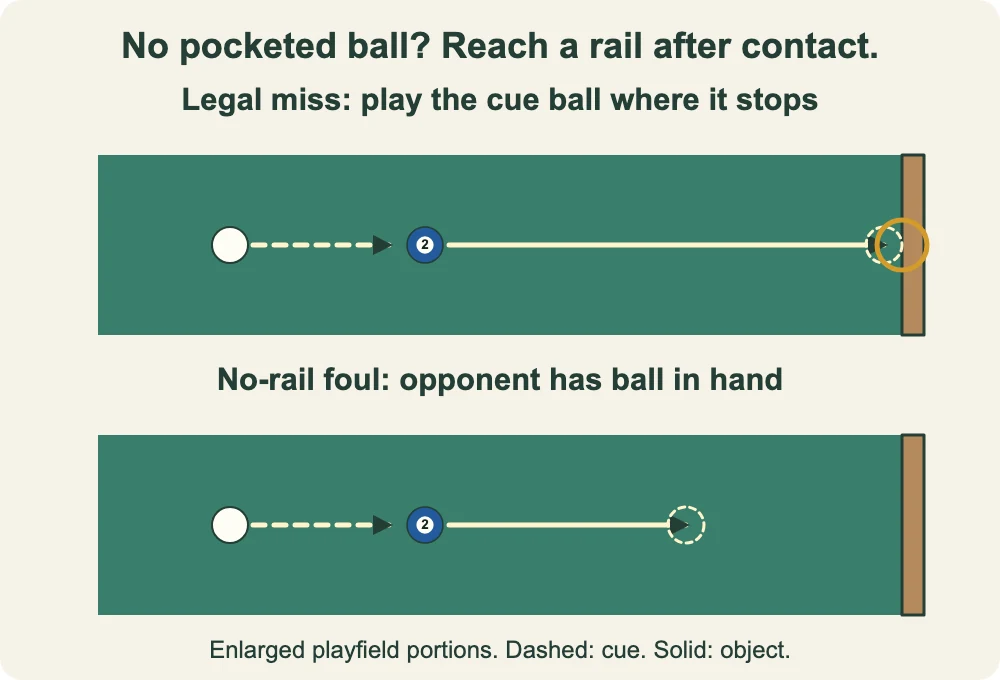
| Lowest ball contacted first, nothing pocketed, a ball reaches a rail afterward | Legal miss. Opponent plays the cue ball where it lies. |
| Lowest ball contacted first, nothing pocketed, no later rail contact | Standard foul. Opponent receives ball in hand. |
| Higher number contacted first, even if the 9 falls | Foul. Spot the 9 if it dropped. Opponent receives ball in hand for a standard foul. |
There is no solids-or-stripes assignment. Both players use the same remaining numbers, and the black 8 is an ordinary rotation ball here. If the 6 is lowest, hit the 6 before the 8 or 9. Once the 8 is legally pocketed and the 9 is the only object ball left, the 9 becomes the first target.
A safety is a defensive choice, not permission to ignore the contact rules. With no ball pocketed, make legal first contact and send some ball to a rail afterward. Calling “safety” in 9-ball does not let you pass after legally pocketing an object ball. You continue shooting unless a push out or another specific rule applies.
Which shots give away ball in hand?
A standard WPA 9-ball foul ends your turn and gives the opponent cue ball in hand anywhere on the playing surface. That applies to a scratch on the break as well as an ordinary scratch. Do not restrict the incoming player to the kitchen because you remember that rule from another game.
- Wrong first contact or no contact. On normal shots, reach the lowest remaining number first. If the cue ball hits that ball and a higher one so close together that you can’t tell which was first, WPA rules it legal first contact.
- No required later rail. If nothing is pocketed, a ball must reach a rail after object-ball contact. A ball declared frozen to a cushion must leave it and come back to count as reaching that same cushion. It can also reach a different cushion.
- A ball leaves the table. Driving the cue ball or any numbered ball off is a foul. A ball can touch the top of a rail and still return to the bed or drop in a pocket. A ball that would leave the table but bounces back off a light, person or other outside object counts as off. Leave balls 1 through 8 that went off out of play. Spot the 9 if it went off.
- Unpermitted contact. Do not touch an object ball with your hand, clothing or equipment. Placing the cue ball must not disturb another ball. WPA uses all-ball fouls, unlike some casual cue-ball-only arrangements.
- Stroke or timing fouls. A double tip contact, prolonged push shot, or shooting while a ball is still moving or spinning is a foul. At least one foot must touch the floor at cue-tip contact in ordinary standing play. WPA’s parasport provisions separately govern eligible adapted competition.
- Other standard fouls. Bad cue-ball placement, playing out of turn and slow play can bring fouls. Take a removed rack template off the table. If a ball strikes it while it is on a rail, WPA calls a foul.
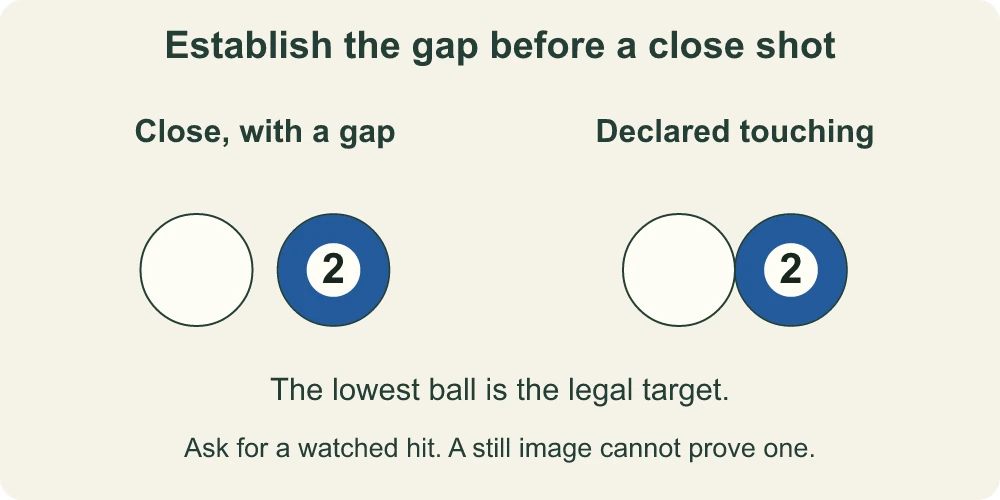
Check whether the balls touch before the shot. If there’s a gap and the cue tip is still on the cue ball when it reaches the object ball, that is normally a foul. WPA allows for a barely grazing hit on a very close ball. If the referee or opponent declares the cue ball touching the legal target, you can shoot toward that ball with a normal stroke. The shot counts as contact if it moves that ball. Shooting away from it alone doesn’t count. Ask someone to watch a disputed close shot.
Do not deliberately scoop under the cue ball to make it jump. Intentional miscues can be penalized as unsportsmanlike conduct under WPA rules. If the technique is unfamiliar, choose a different legal route or ask an instructor to demonstrate a legal jump before trying one.
Several violations on one shot do not become several separate standard fouls for the three-foul count. The general rule enforces the most serious foul. Intentional interference or other unsportsmanlike conduct can carry a referee-selected penalty beyond ordinary ball in hand.
Place the cue ball and spot the 9
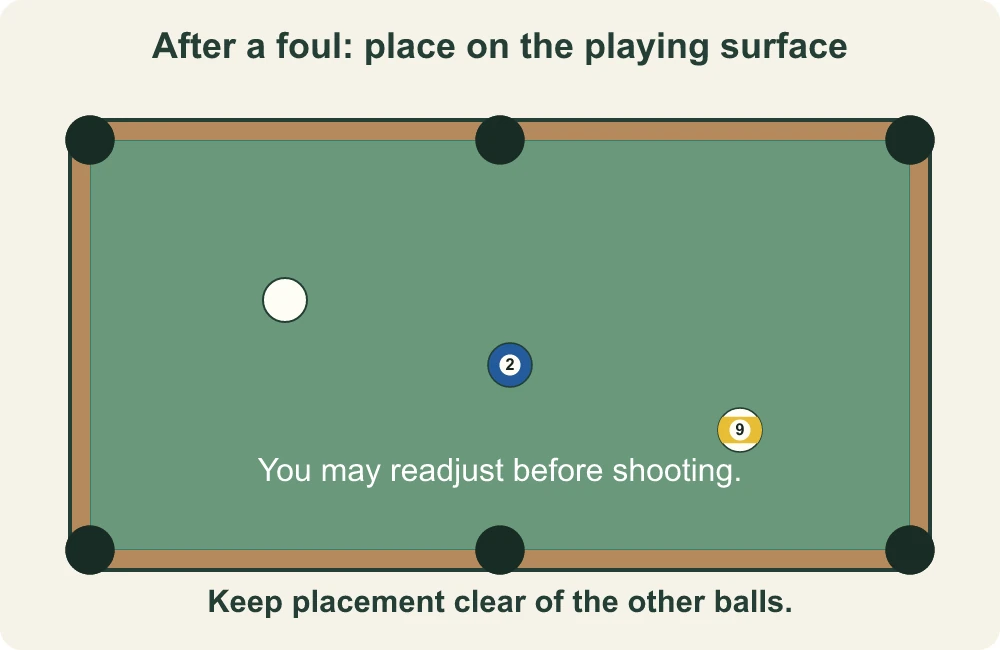
Ball in hand is placement, not an extra shot. Confirm the foul, put the cue ball on the playing surface and choose a position from which you can reach the lowest ball legally. You may readjust it before shooting. You can adjust the cue ball with your hand or the cue, including its tip, without using a forward stroke. Leave the other balls in place.
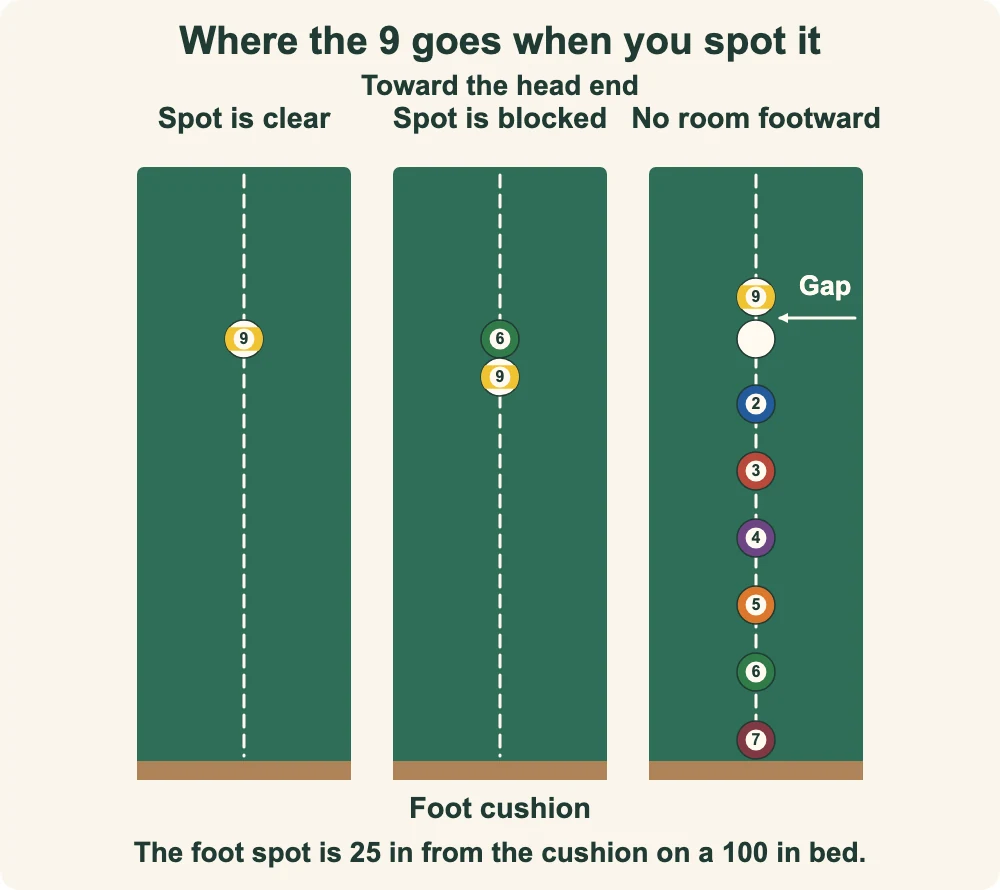
Spotting restores an object ball. If the 9 is pocketed during a foul or push out, or driven off the table, return it near the foot spot under the general spotting rule. If the spot is clear, the 9 goes there. If blocked, place it as close as possible on the table’s center line toward the foot cushion without shifting the obstructing balls.
If there’s no room anywhere between the foot spot and the foot cushion, move toward the head end along the same center line. Put the 9 as close to the spot as you can on that side. If an object ball blocks it, set the 9 touching that ball where possible. Leave a small gap next to the cue ball. Keep the balls already on the table where they are.
Under ordinary 9-ball spotting rules, pocketed or off-table balls 1-8 are not returned just because the shot was a foul. That does not override separate general rules for restoring a position after outside interference or a settling ball. Ask the referee to restore such a position instead of collecting arbitrary balls from the pockets yourself.
How does the three-foul rule work?
Three consecutive fouls by the same player, without an intervening legal shot, lose the rack under WPA 9-ball. All three must occur in one rack. Your opponent’s intervening turn does not reset your count. Your own legal shot resets your count, even if you miss the pot. A break foul counts toward your streak. A break that only misses the three-ball count doesn’t add a foul.
The referee must warn a player on two fouls when that player returns to the table. If that warning is not given, a possible third foul is counted only as the second, rather than automatically losing the rack. In an unrefereed game, agree how warnings will be announced and acknowledged before the match. Do not wait until after the shot to invent a warning.
| Your sequence in one rack | Result |
|---|---|
| Foul → opponent plays → foul → warning → foul | Three consecutive fouls. Rack lost. |
| Foul → legal miss with required rail → foul | Count restarts. You are now on one foul. |
| Two fouls → no required warning → another foul | Possible third is treated only as second. No automatic rack loss. |
| Two fouls in one rack → new rack begins | The previous rack’s consecutive-foul count does not carry over. |
On two fouls, examine legal contact before chasing the 9. A legal defensive shot resets your count even if you don’t pocket a ball. An intentional standard foul can still be the third counted foul, so deliberately handing over ball in hand is not a way around the warning. No strategy can guarantee a foul-free escape from every position.
For a stalled rack, WPA’s general stalemate procedure lets the referee announce three more turns each before declaring a stalemate, unless both players agree to accept it sooner. In 9-ball the original breaker then breaks again. A stalemate is separate from a player losing on three consecutive fouls.
Which 9-ball shots win the rack?
A legal 9 can win on the break or on a later shot, including a combination or carom. You need not nominate a pocket. Wait for every ball to stop moving or spinning before you count the win. If the cue ball drops too, it’s a scratch. Call any foul before the next stroke. A third consecutive foul after the required warning ends the rack instead of giving the opponent another shot.
| 9-ball outcome | What happens? |
|---|---|
| 9 pocketed on an ordinary legal shot | Shooter wins the rack, whether other numbers remain or not. |
| 9 pocketed on a fully qualifying break without a foul | Breaker wins, unless announced event conditions specify otherwise. |
| 9 pocketed with a scratch or wrong first contact | No win. Spot the 9. The opponent gets ball in hand for a standard foul. |
| 9 pocketed during a legal push out | No win. Spot it. The other player chooses who shoots. |
| 9 pocketed on an otherwise foul-free break failing Regulation 16 | Spot it. Opponent accepts the position or hands it back. |
| 9 driven off the table | Foul, not automatic rack loss. Spot the 9. The opponent gets ball in hand for a standard foul. |
If the 9 bounces back onto the bed, keep playing. It can count if it hangs inside the pocket on top of other pocketed balls and would drop without them. A ball that stays at the lip for five seconds after the shot ends is still in play. If it drops on its own later, the referee restores it. Watch the cue ball too. If it hits a ball already in the pocket, WPA treats it as a scratch even if it bounces back.
After the rack ends, record the score and follow the agreed break order. A rack win is not necessarily a match win. In this WPA race format you count racks, while APA handicapped 9-ball uses the point targets described below.
Make your first practice sessions useful
Start by practicing the rules you can observe. With a partner, call out the lowest ball before each shot, say whether a miss was legal and identify who shoots next. You are learning to distinguish an unsuccessful pot from a foul, not just counting how many balls fall.
- Read the next two targets. Before pocketing the current lowest ball, locate the next lowest one and decide from which side you would like to approach it. Reassess after the actual shot rather than following a plan that no longer fits.
- Choose a realistic objective. A pot, a legal safety and an early-9 attempt have different consequences. If you consider a combination, check the first contact and what you may leave if the 9 stays up.
- Practice with fewer balls. Place three object balls away from cushions and attempt them in increasing order. Start with ball in hand, then play from each actual cue-ball position. Reset after a miss or foul to compare attempts.
- Keep a simple record. Note wrong first contact, no-rail fouls, scratches and loss of position separately. A completed three-ball practice run is not a match rating or proof you can run a full rack.
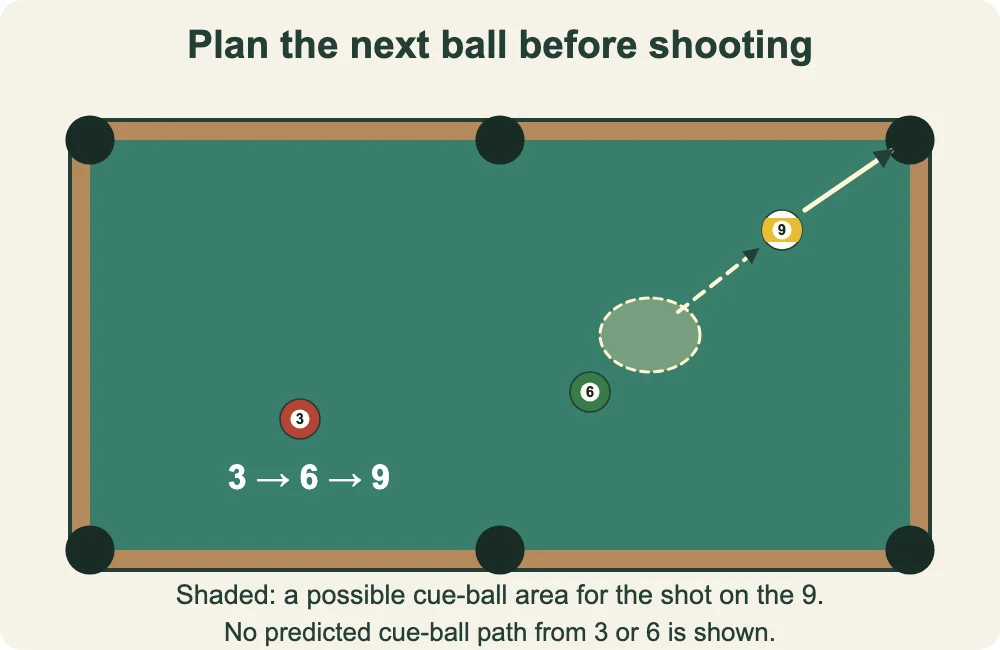
For more practice, Dr. Dave’s 9-ball strategy resources cover planning an attack, playing safe and changing your plan when the cue ball stops somewhere unexpected.
When you can play that three-ball exercise, add more balls. Practice the break on its own. Use a stroke you can control, let the balls stop, then count which numbered balls reached rails, crossed the head string or dropped. Use the actual results to decide how you’ll play the next shot.
Check league differences before you play
The same nine balls do not imply the same rack, break or scoring rules. The UPA’s own 9-ball rules put the 1 on the foot spot and fix the 2 at the rear. They also specify three object balls reaching rails on a dry break, rather than WPA’s four. Those are named UPA conditions, not corrections to apply midway through a WPA rack.
APA’s current game-rule booklet and its after-break rules describe another important difference. Handicapped APA 9-ball counts balls 1-8 as one point each and the 9 as two. Pocketing the 9 ends that rack but does not necessarily complete the player’s match-point target. Masters uses rack wins instead.
APA racks the 1 on the foot spot. In its handicapped divisions there’s no push out. In APA Masters, the player due to shoot may push out after the break. Any balls pocketed on that push out are spotted. In WPA 9-ball, only the 9 comes back after a push out.
For players coming from 8-ball’s groups and called finish, keep these changes in mind:
- Contact target: the lowest remaining number, not any member of your group.
- Winning ball: a legal 9 may win before the others are cleared, unlike the normal separate final 8-ball shot.
- Pocket calls: WPA 9-ball is not call-shot. WPA 8-ball requires intended non-obvious balls and pockets to be indicated.
- Foul tracking: WPA 9-ball includes three consecutive fouls as a rack loss. WPA 8-ball does not use that rule.
Before a league or tournament, confirm the governing edition, rack spot, break restrictions, push out, foul-warning procedure, scoring and who breaks next. Coaching, shot clocks and dispute procedures belong to that event’s conditions. If players disagree at the table, pause before the next shot and consult the governing rule or official. Do not resolve the disagreement by combining whichever rules each player remembers.