How Points Decide a Frame
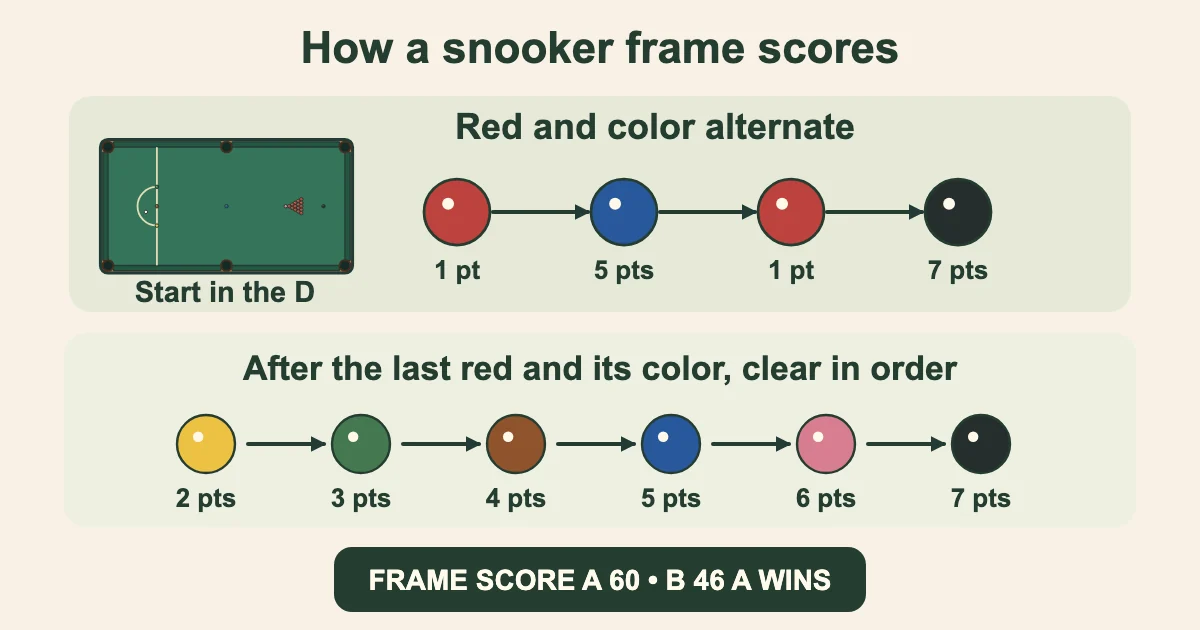
Win a snooker frame by scoring more points than your opponent when the frame ends. Five reds alone are five points. One red and a black are eight. Each red is worth one point and can earn you a shot at a color worth two to seven points. You also gain points when your opponent fouls.
A frame is one game from the opening shot to its result. A break is the points one player scores at the table in a single turn. Winning a match depends on the agreed format, often a race to a set number of frames. The points that win one frame don’t carry into the next in an ordinary frame-count match.
These steps follow the current World Professional Billiards and Snooker Association rules for standard 15-red snooker. A smaller table, fewer reds or a local US ruleset may change the setup or rulings. Ask which version you’re playing before you count the first score.
| Ball | Points | When it comes back |
|---|---|---|
| Red | 1 | A red legally potted normally stays down. |
| Yellow | 2 | Colors return during the red-color phase, including the color played after the last red. During the final clearance, a legally potted color stays down. |
| Green | 3 | |
| Brown | 4 | |
| Blue | 5 | |
| Pink | 6 | |
| Black | 7 |
Set Up the Reds and Colors
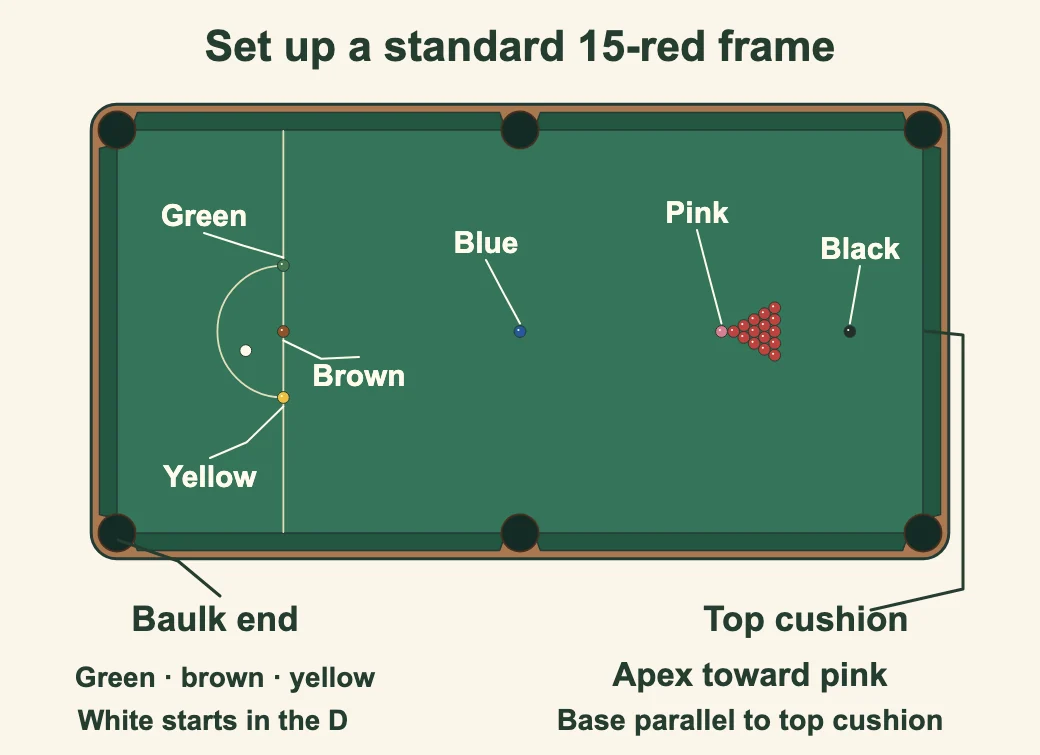
Put each color on its own marked spot and rack the 15 reds with the front ball just beyond the pink. A full-size snooker table is often called a 12-foot table. The WPBSA playing area measured between cushion faces is 11 ft 8½ in by 5 ft 10 in, within its stated tolerances. Standard colors are solid and unnumbered. The official diameter is nominally 52.5 mm. The standard snooker ball set has 15 reds, six colors and a white cue ball. Use a snooker cue and a 15-ball snooker triangle that matches the size of the balls.
- Recognize the baulk end. The baulk line is the transverse line near the starting end. The D curves from that line toward the nearby cushion. Stand there and look along the table. Green is on the left intersection of line and D, brown is at the midpoint, and yellow is on the right intersection.
- Place the other colors. Blue goes at center. Pink goes in the middle between the blue spot and the far short cushion. Black goes on the marked centerline spot near that far cushion.
- Keep the triangle clear of pink. Point the apex toward the pink and baulk end, with its base parallel to the far cushion. Set the foremost red on the centerline just beyond the pink, as close as possible without touching it. Fit the pack tightly and lift the triangle away.
Use the room’s marked spots where available. For a home setup, choose Snooker in the Game Room Layout Planner to plan where the table and surrounding furniture go. Check the actual table’s dimensions and swing a cue around the intended position before committing to a room layout.
Start From the D
For the opening shot, put the cue ball on or inside the D and hit a red first. Play from on or inside the D in any direction. In a friendly game, agree who starts or draw lots. Alternate the opening stroke after that. The opening does not require scattering a set number of balls. A thin contact on a red at the outside of the pack can bring the cue ball back toward baulk and leave a harder shot.
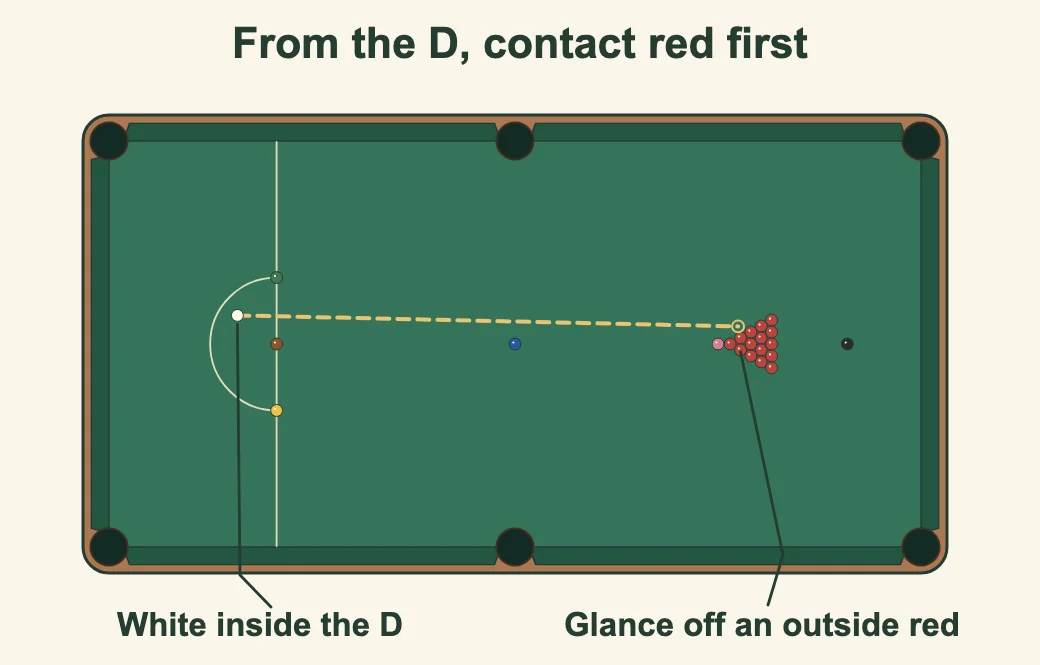
The baulk line helps mark the D. It is not a barrier the cue ball must cross before touching a target. After a normal legal miss, you leave the other player facing the position you created. Opening the pack too much can leave an inviting first pot. Without changing where the balls start, try the thin break-off gently and watch which red ends up furthest from the pack. On the next attempt, judge both the final cue-ball position and whether that loose red goes into a pocket from there.
What Do You Pot Next?
On the first shot of a turn with reds still on the table, play a red. The legal target is called the ball on. On a normal shot, the white must hit a ball on first. You don’t have to pot a ball or reach a cushion after a legal first hit. A legal safety can end your turn without adding points for either player.
- Pot a red. Add one point for each red you legally pot on the same stroke. They stay down. You get one next shot at a color even if two reds dropped together.
- Choose one color. Make your choice clear. Name the color if there’s any doubt about what you’re playing. If you pot it legally, score its value and put it back on the correct spot before the next stroke.
- Go back to red. Each clean scoring stroke lets you stay at the table. On a legal miss, your turn ends and the incoming player starts on red as long as reds remain. On a foul, settle the penalty and next position first.
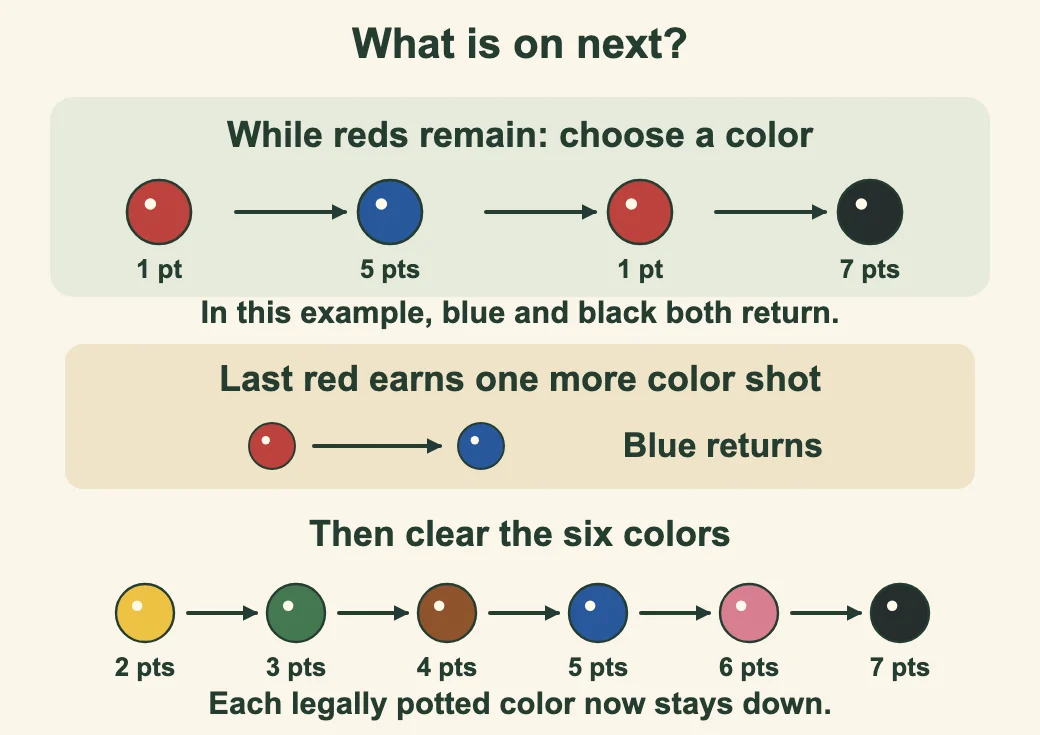
Suppose you make a red, blue, another red and black. It’s a 14-point break, from 1 + 5 + 1 + 7. Blue and black go back onto the table after their shots. Which color you choose depends on your route to the next red and how much risk you want to take. Even a legal shot that hits the right color can leave a pot for your opponent if you miss.
The last red earns a color shot. If you take the last red cleanly, play the color you choose next and re-spot it if you make it. That color can be yellow. You would then play yellow again to begin the final ordered clearance. If you miss the color legally, yellow is on for the other player. If the last red goes off on a foul, it does not earn you a color shot.
Clear in value order. Once the color shot earned by the last red is complete, work through yellow, green, brown, blue, pink and black. At this stage each legally potted color remains down. If you miss without fouling, your opponent takes over at the same color. There are 27 points in the six colors, so count from the next color on through black before doing the math.
Where to Re-spot a Color
Return a color to its own spot when the rules call for it and there’s room. A spot is occupied if the color can’t sit there without touching another ball. Don’t nudge the ball that was already there.
- Use the highest vacant spot. If the color’s own spot is occupied, use the highest-value available spot of any color. It can be worth less than the ball being returned. If two colors needing alternative spots come back at once, the higher-value ball takes priority.
- Use the space toward the top cushion when all spots are occupied. Place the ball as close to its own spot as possible between that spot and the nearest part of the top cushion. It must stay clear of any nearby ball.
- For pink or black, go the other way if necessary. If pink or black has to return, all spots are occupied and there’s no room toward the top cushion, place that ball as close to its spot as possible on the long centerline toward baulk.
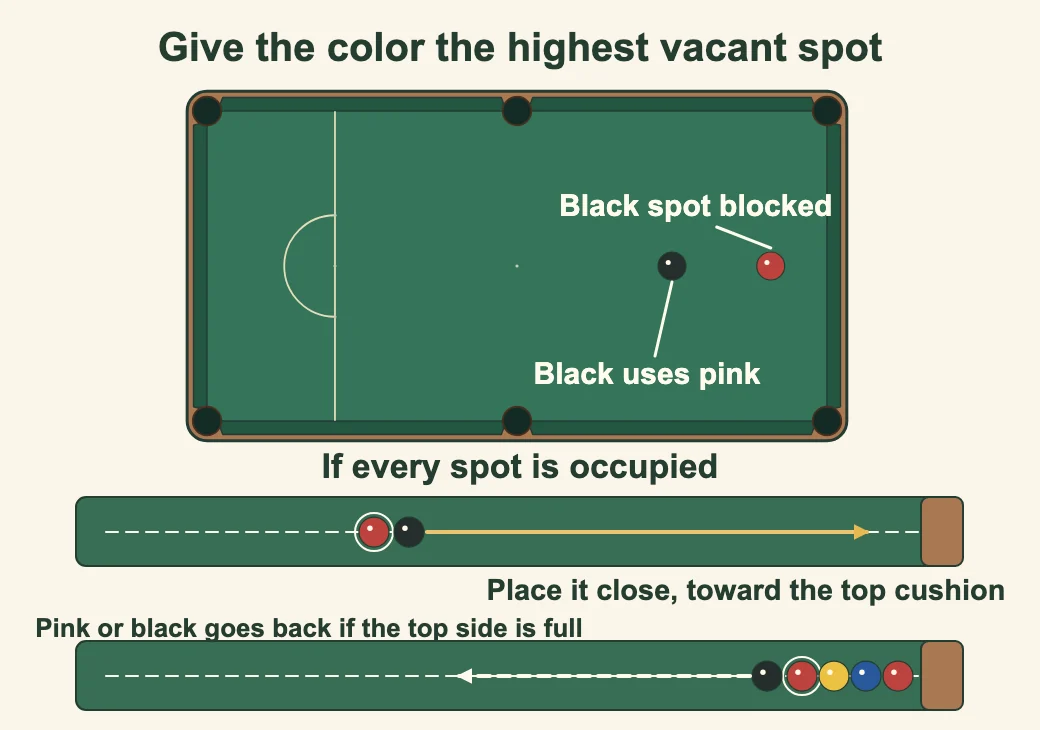
Wait for the color to be placed before taking the next stroke. After a legal color in the alternating phase, look for the next red. During the clearance a color brought back because of a foul remains on if it was the one you were due to play.
Play Away From a Touching Ball
When the white is already touching a ball, don’t try to push through it. Have the referee or both players look at the contact before the shot. Under the WPBSA touching-ball rule, the referee declares when the white is touching a ball on, or one that could be on. Play away from the touching object ball without moving it.
If the touching ball is on, playing away without moving it satisfies the contact requirement. When the next ball is a color of your choice and you nominate the touching color, you can play away under the same rule. Choosing another color instead means you still have to hit that chosen color first. It’s the nomination that settles the next target, even when the cue ball touches a different color.
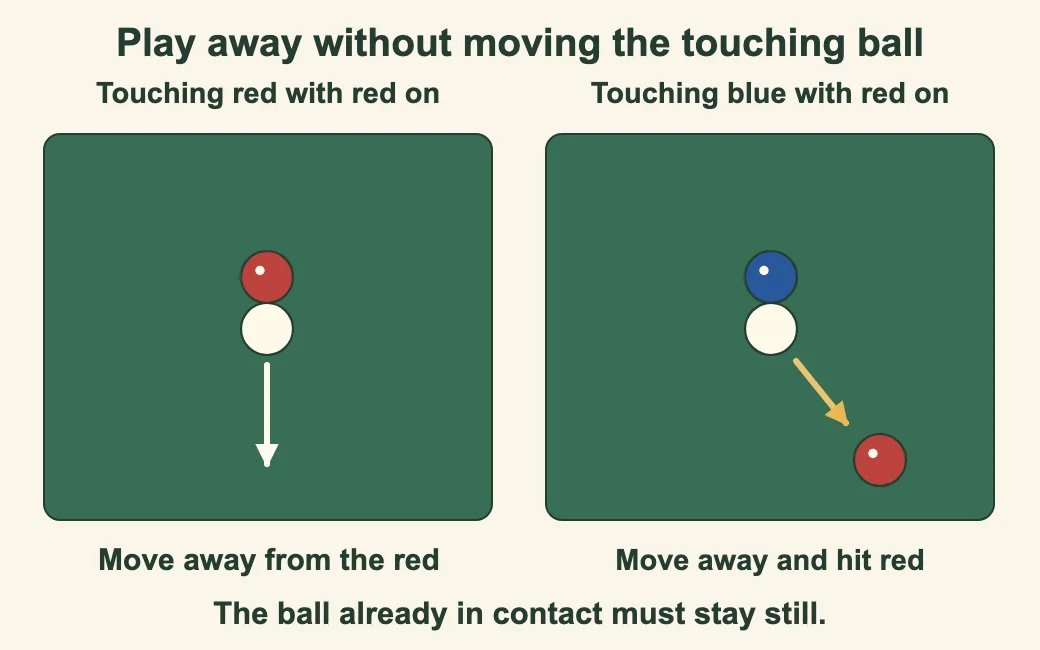
If the ball touching the white is not on, it doesn’t supply the required first contact. Keep it still while playing away, then hit a ball on. If there’s a gap, the usual first-contact rule still applies. Don’t push through the nearby ball or hit the cue ball twice. Let the referee look at close contacts at cloth level before you lean in.
How Foul Points Are Awarded
After a foul, award the points to the other player and end the offender’s turn. The usual penalty has a four-point minimum, with higher values depending on the ball on, the ball involved and the kind of infringement. For instance, hitting black first when red is on costs seven. A simple in-off while playing red costs four. Some offenses in the official rules carry seven regardless of the ball on.
| Example | Penalty | Cue ball for the next stroke |
|---|---|---|
| Red is on and the white misses all balls. | 4 points to the opponent. | Play from where it stopped unless an applicable miss ruling restores the earlier position. |
| Red is on and the white first hits black. | 7 points to the opponent. | Where it stopped unless the relevant restoration rule applies. |
| Pink is on and the white is pocketed. | 6 points to the opponent. | In hand on or inside the D. |
| The ball on is blue and a red drops as well as blue. | 5 points to the opponent. The blue is spotted and the red normally stays down. | Where it stopped if there is no other placement issue. |
You might also foul by disturbing a ball, striking while balls are moving, making a push shot, playing a jump shot or sending a ball off the table. If more than one foul occurs on the same stroke, apply the highest applicable penalty. A pot during that foul adds no points to your own break. Normally, colors potted or forced off during the foul are spotted and reds remain off, subject to a specific restoration rule.
The next player has a choice. After a foul that hasn’t ended the frame, the non-offender can usually take the available position or ask the offender to play again from it. If the white went in-off or off the table, the next striker plays it from the D. A referee can restore a ball moved before the stroke. A foul-and-a-miss decision can also add the option of restoring the previous position. Any free-ball option is cancelled when the offender is asked to play again.
What Is Foul and a Miss?
A referee can call foul and a miss when the striker fails to hit a ball on first and the referee judges the attempt fell short of their best effort. When any part of a ball on is open in a straight line and they fail to hit it first, the referee normally calls a miss as well as the foul. After the call, the non-offender can play the available position, ask the offender to play again from it or ask for the previous position to be restored for the offender to play from there. The original type of target still applies after restoration. Where a color of the striker’s choice was on, they get that choice again.
There are exceptions when a player already needs or comes to need penalty points and the miss was unintentional. There is also special handling when the ball on is impossible to hit and a genuine attempt is made with enough pace to reach it except for the obstruction. A referee makes those decisions. There is a separate warning sequence after a first miss where the cue ball could hit a ball on full in a straight line, or was touching a ball that could be on. If the same position is restored and the striker fails again, the referee warns them before another replay. A further failure after that warning awards the frame to the other player. Playing from a different position ends that sequence.
When a Ball Drops Off a Pocket Edge
Wait to see whether a ball dropping near a pocket is part of the stroke. A ball that briefly balances at the lip and drops as part of the shot counts as pocketed. The normal scoring and foul rules still apply. That’s different from a ball that sat there and then fell by itself without any stroke affecting it.
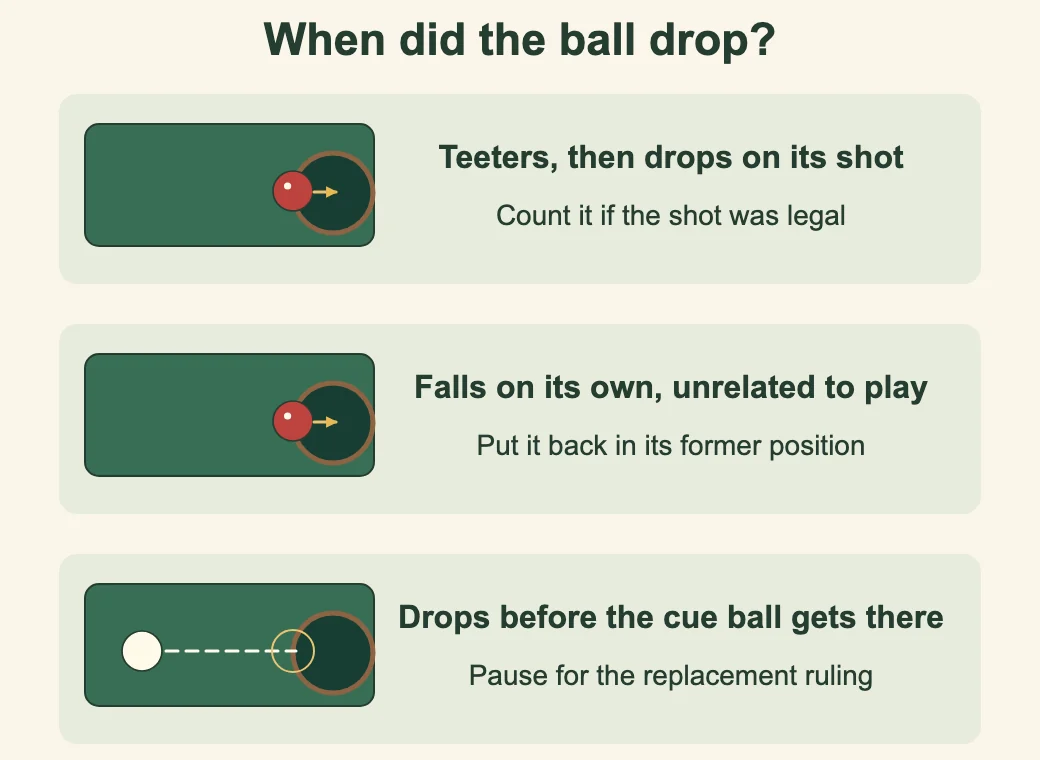
If a ball falls on its own and has no part in a stroke, return it to its previous place. Keep any points from a separate valid pot. If a ball that would have been contacted drops before another ball reaches it, pause before either player takes the next shot. That can change which balls need replacing.
When the dropped ball would have been hit with no other foul on the stroke, the referee replaces all the balls and the same striker can play again. The striker may choose a different stroke. If the stroke involved a foul that still counts, apply the penalty, replace the balls and give the next player the usual after-foul choices. Let someone who saw the stroke settle the sequence before anything is moved.
The WPBSA pocket-edge ruling treats the timing and contact separately. The practical question is whether the ball was already out of the way before anything could touch it. Even the right score can look wrong if you return a ball that fell during the scoring stroke.
When Are You Snookered?
You’re snookered when balls that are not on block a straight route to at least one extreme edge of every ball on. It can be possible to hit part of a red directly and still be snookered. If you can hit both extreme edges of even one ball on directly, you aren’t snookered. A cushion does not count as an obstructing ball for this rule.
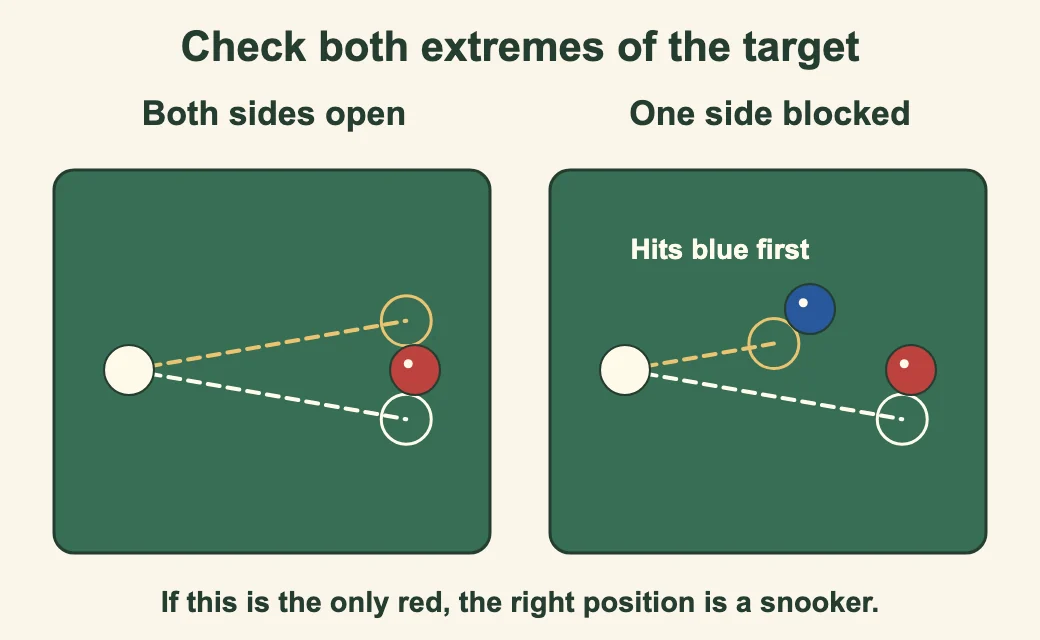
Remember the practical difference between a snooker and any hard shot. A red far away with both sides open may be tough to pot, yet the shot is open. A red near the cue ball with a color covering one side can be a genuine snooker. Look for a cushion route that reaches the right ball first if the straight route you need is closed. A legal escape still ends your visit if nothing goes in.
How a Free Ball Works
If a foul leaves the incoming player snookered, the referee calls a free ball. With the cue ball in hand, test the possibilities on or inside the D first. If there’s a starting point with both edges of a ball on available, the cue ball isn’t snookered under this definition.
After choosing to play, you can nominate a ball that isn’t on to stand in for the ball on. Hit that nominated ball first or simultaneously with a ball on. It takes the value of the ball on for the stroke and is spotted if you pot it.
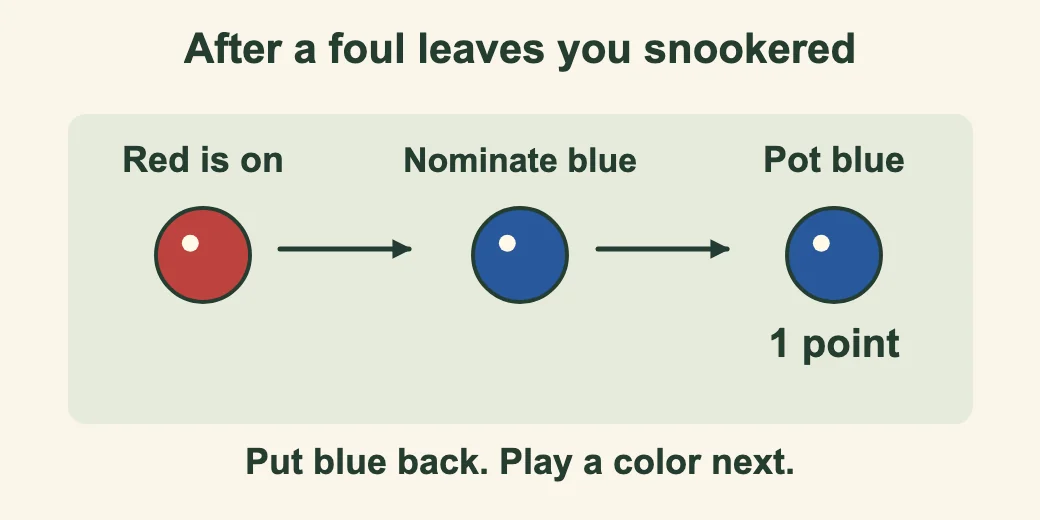
If red is on and a free ball and a real red both drop legally, score a point for each. The nominated substitute goes back and the red stays down. If an ordinary color is on and it goes in together with the nominated free ball, only the value of the color on is scored. The color on stays down and the nominated ball goes back. If the stroke scores nothing, you generally can’t leave the opponent snookered behind the ball you nominated. That applies to all reds if red is on, or the current color if the clearance has started. The exception is when only two object balls remain: pink and black, or black and one other color in the last-two-color case covered by the spotting rule.
The Final Black and a Tie
When black is the only object ball left in a normal frame, the first pot or foul settles the frame unless it leaves the scores level. In an ordinary frame-count match with only black left, the striker can claim the frame if ahead by more than seven. When the non-striker is already ahead by more than seven, the rules award them the frame. If any player needs penalty points, a player may offer to concede. The concession ends the frame when the opponent accepts. Don’t treat the moment a player needs penalties as a mandatory concession.
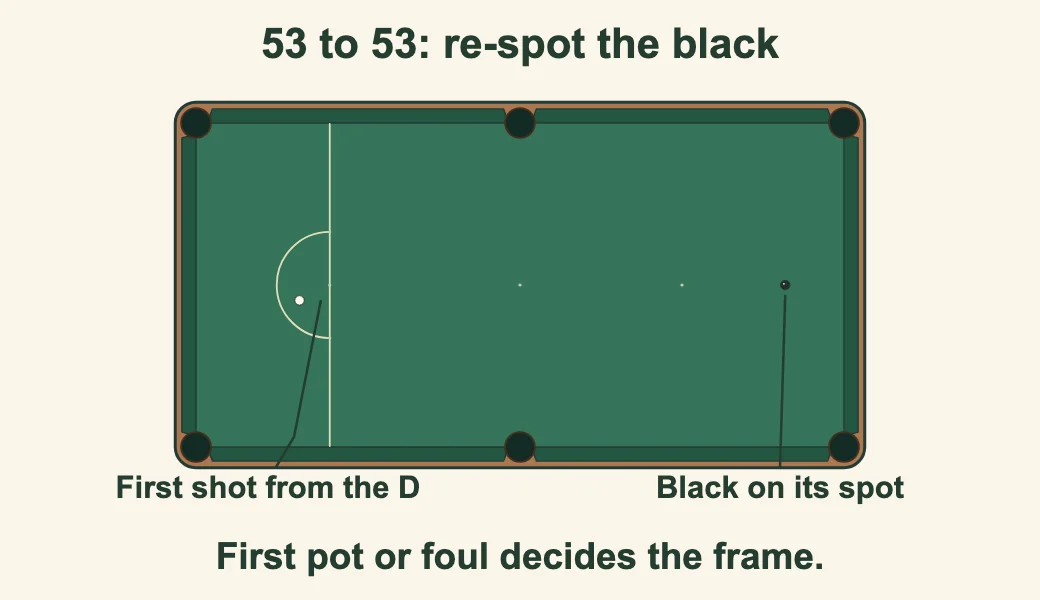
For example, 53 to 46 with just black left is a seven-point difference. If the trailing player pots black, the score is 53 to 53 and you deal with a re-spotted black. A foul can also create a tie. If the leading player instead pots it, the frame ends 60 to 46.
- Put black back on its spot. In ordinary play where aggregate scores don’t decide the match, a tie after the final black is settled with a re-spotted black.
- Draw lots. The winner chooses who plays first. The first striker plays from in hand in the D. After a legal miss, the second player takes the cue ball where it stopped. The D is used for the first re-spotted-black stroke.
- Settle it on the next score or foul. A legal pot wins the frame. A foul gives the other player the points and ends it. A quiet safety by itself doesn’t settle the tie.
In a match decided on aggregate scores rather than frame count, the official rules handle a tie in the aggregate separately. Agree how many frames will decide an ordinary friendly match and keep the tally of frames separate from the points inside each one.
Make the Next Shot Easier
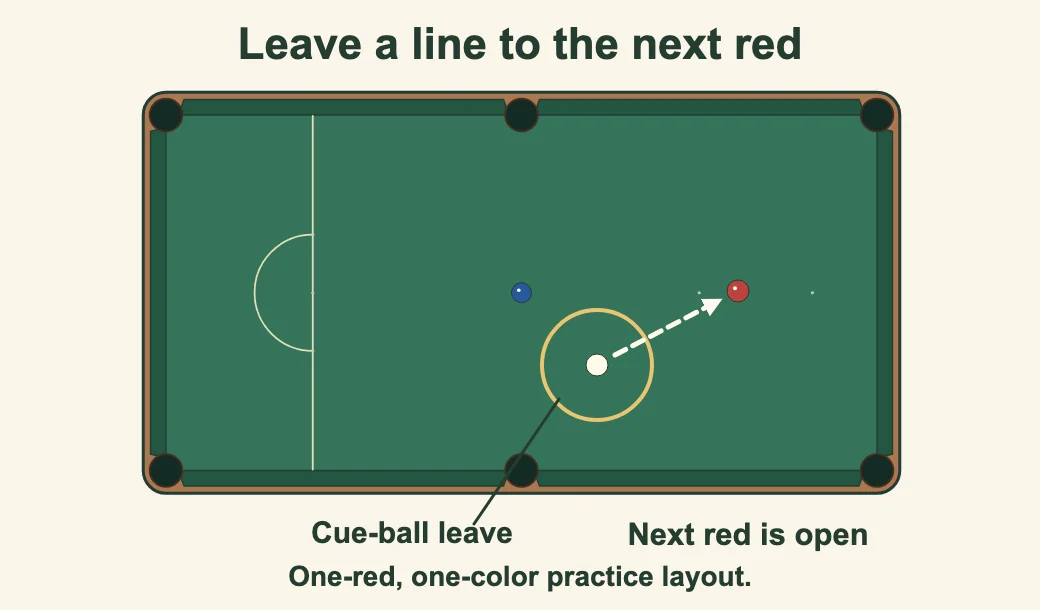
Choose a color you can make while keeping a usable route to the next red. The black’s seven is attractive, especially after a red near the pack. A blue from a straightforward angle can be worth more to the break than a forced black followed by a long, low-percentage red. Look at the cue ball’s possible finishing area before choosing which color to play.
- Start with two pots. Place one red and one color on the table. Pot the red and see whether the cue ball lands where you can reach the color. Change the red’s position and try again. The point is seeing how the next shot changes with a slightly different line.
- Choose a safety when the pot is difficult. Before you play, check what red the other person could see from where the white is likely to finish. A white that finishes near baulk can leave a longer red. Use a color as a blocker only when you can hit the legal target first and the stroke otherwise meets the rules.
- Count what is left. If only pink and black remain, 13 ordinary pot points are available. If you’re 18 behind, even making both colors would be five points short of a tie. If you plan to win by clearing pink and black, earn at least six penalty points first. That changes the value of leaving a difficult escape for your opponent.
Count the Points Still Available
With red on, start by counting each remaining red as a potential eight points. That allows one for the red and seven for its following black. Then add the value of the colors that will be cleared in order. It’s an upper limit for ordinary pots. You may have to play a lower-value color to keep your turn going, which brings the actual total down.
With two reds remaining and a red on, the maximum for ordinary pots is 43: two red-and-black pairs for 16, plus 27 for the final six colors. If you’ve just potted a red and are still due the color shot, include that choice separately. On the next turn, the same two reds would still offer 43 if their layout remains unchanged.
Once the clearance starts, count from the current color to black. If brown is on, brown through black is 4 + 5 + 6 + 7, or 22 points. At 22 behind, making every color with no more penalties would tie the frame. At 23 behind, potting brown, blue and pink leaves you eight behind with only black left. That ends the frame in your opponent’s favor, so you need penalty points before the black. Before deciding on a safety, check whether you need a foul, a tie on the black, or simply a reliable route to the next pot.
When all 15 reds are paired with blacks in one visit, they score 120 points. Add the six colors in order for 27, totaling 147. It’s the normal maximum break. With a free ball as an extra red before any actual red is potted, an extra red-and-black pair makes 155 possible. The World Snooker Tour’s maximum-break explanation distinguishes those two situations.
Follow the Score Through One Finish
Watch how the next legal ball changes as a close frame moves from one red to the final black. In this example, A leads 51 to 48, B is at the table, and one red and all six colors remain. Neither player needs a foul to catch up. Keep a mark beside the next legal ball when the turn changes.
| What happens | Score A to B | Next action |
|---|---|---|
| B makes the last red, then blue. | 51 to 54 | Blue goes back. B starts the clearance on yellow. |
| B makes yellow and green, then misses brown. | 51 to 59 | Yellow and green stay down. A takes the table on brown. |
| A pots brown, blue and pink. | 66 to 59 | A has black on and can win with the pot. B could still tie. |
| A misses black legally. B pots it. | 66 to 66 | Set up the re-spotted black and draw lots for choice of striker. |
B earned one for the last red and five for blue immediately afterward. Counting blue as removed then would have taken five points away from A’s later clearance and changed the result. After a legal miss during the clearance, the same color stays on for the other player. Call out the running score when the turn ends.
Use the same scoring habit around a foul. Record the penalty for the other player before looking at who is next and where they play from. Penalty points affect the frame total and the points left to catch up. They don’t become part of the player’s break. A written tally makes those two numbers easy to check after a long safety exchange.
What Feels Different From Pool?
Snooker shares the idea of hitting a legal ball first, but what makes it legal changes during the frame. On a normal 9-ball stroke the lowest numbered ball is first contact and the 9 can finish the rack. Under 8-ball rules, each side eventually plays its own group and calls the pocket for the finish on the 8. In snooker any red may be on, the color after a red is a choice, and the last colors follow value order.
One-Pocket also asks players to keep a running score and think carefully about the leave. In One-Pocket each player scores in their own corner. Both corners are at the same short cushion. Snooker points come from the ball you legally pot and its value. An unintended pot of a ball on can still score if the stroke meets the rules. Sinking a ball that isn’t on is generally a foul. WPBSA rules require hitting the ball on first. There’s no need to call a pocket.
If your pool hall offers American snooker, check its posted rules. For example, the American snooker rules published by Billy Aardd’s Club put the apex red on the foot spot and pink ahead of the pack. A sanctioned event in the Americas can still use WPBSA rules. Check the local or event rules to see which layout applies. The rack, foul and end-of-frame choices above are the WPBSA ones. That agreement matters more than the name on the table.