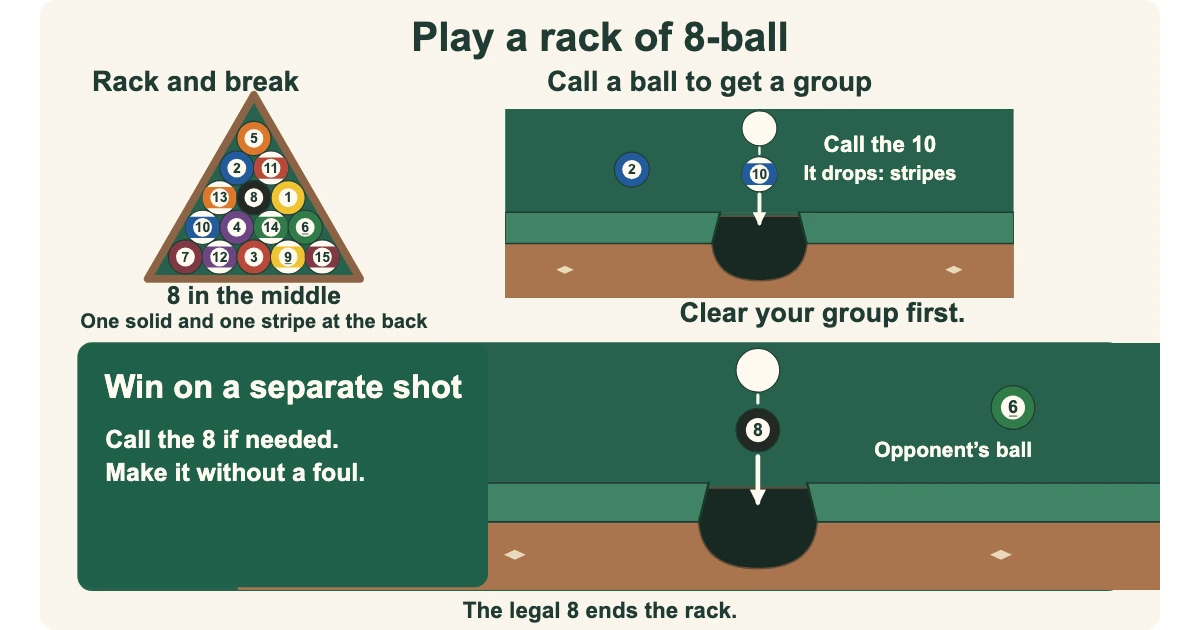
Clear your group, then pocket the 8
To play 8-ball pool, start by choosing a ruleset with your opponent. Use the rules already posted by the venue or league if they apply. For a home game, you can both use the World Pool-Billiards Association (WPA) rules described below. Strike the white cue ball with your cue and send it into a numbered ball.
This guide explains American-style 8-ball under the WPA Rules of Play effective October 21, 2026, principally section 4 and its general rules. Solids are numbered 1 through 7 and stripes 9 through 15. Once the groups are set, each player plays their own group in any order. To win, clear your group and then pocket the black 8 legally in its intended pocket. The APA comparison below explains differences for league players. English blackball and phone games use their own rules.
A rack is one game, from the break to the finish. Your turn can last more than one shot while you pocket the required balls legally. A miss, a foul or a called safety gives your opponent the next turn. Before you start a match, decide how many racks you need to win it.
Rack the 8 in the third-row center
You need a six-pocket table, a numbered pool ball set with fifteen object balls and one cue ball, a pool cue, and a triangle rack that fits the balls. Read the numbers if your set uses different colors. You’ll need all seven balls from each group plus the 8. An event may use a thin ball rack template. The steps below use a triangle.
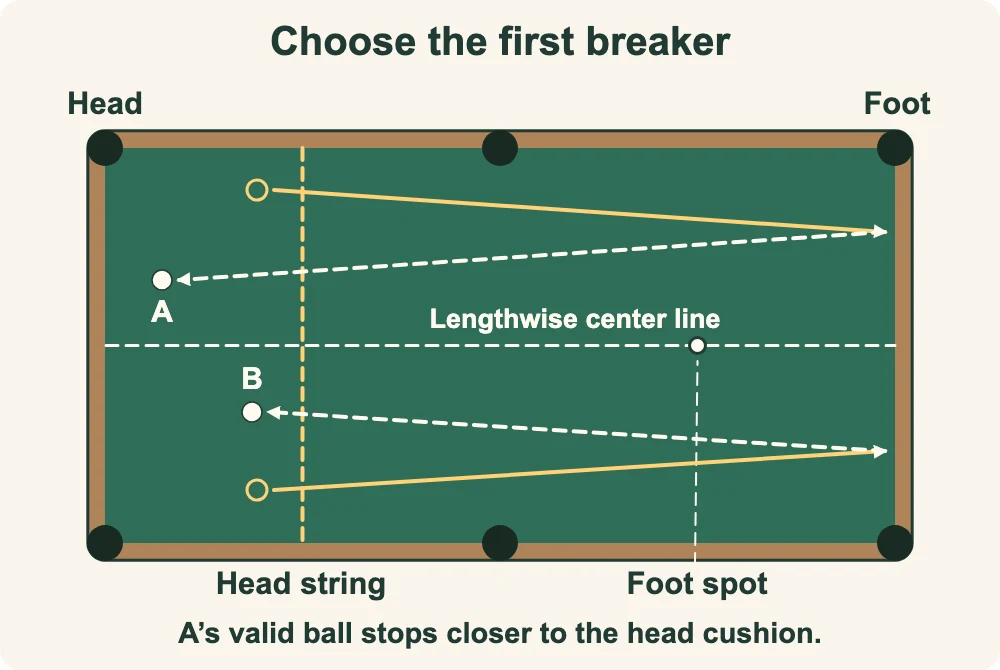
Lag to decide who breaks first. Do this before you rack. Each player starts a ball just behind the head string on their own half of the table. Shoot at about the same time. Each ball should hit the foot cushion once and roll back on its own side. The player whose valid ball stops closest to the head cushion chooses the first breaker. WPA alternates the break after that unless the event specifies another format.
A lag is bad if it hits a side cushion, crosses the lengthwise center line, misses or hits the foot cushion more than once, goes off the table, or drops in a pocket. A ball that stops past the cushion nose inside a head corner also loses the lag. Repeat if both shots are bad, the finish is too close to call, or one player starts after the other ball has reached the foot cushion.
- Place the front ball on the foot spot. The foot spot is centered across the table, one quarter of the playing length from the foot cushion. It is the center of the ball, not the triangle's outer tip, that belongs over the spot.
- Put the 8 in the middle of row three. The rows contain one, two, three, four and five balls.
- Use different groups at the rear corners. Put a solid at one rear corner and a stripe at the other. Either side is allowed. Arrange the other balls without a deliberate pattern. WPA does not require the 1-ball at the front or alternating stripes and solids.
- Bring the balls together. Make the rack as tight as possible, then lift a solid triangle clear without disturbing the balls. Recheck the apex over the spot and visible gaps before the break.
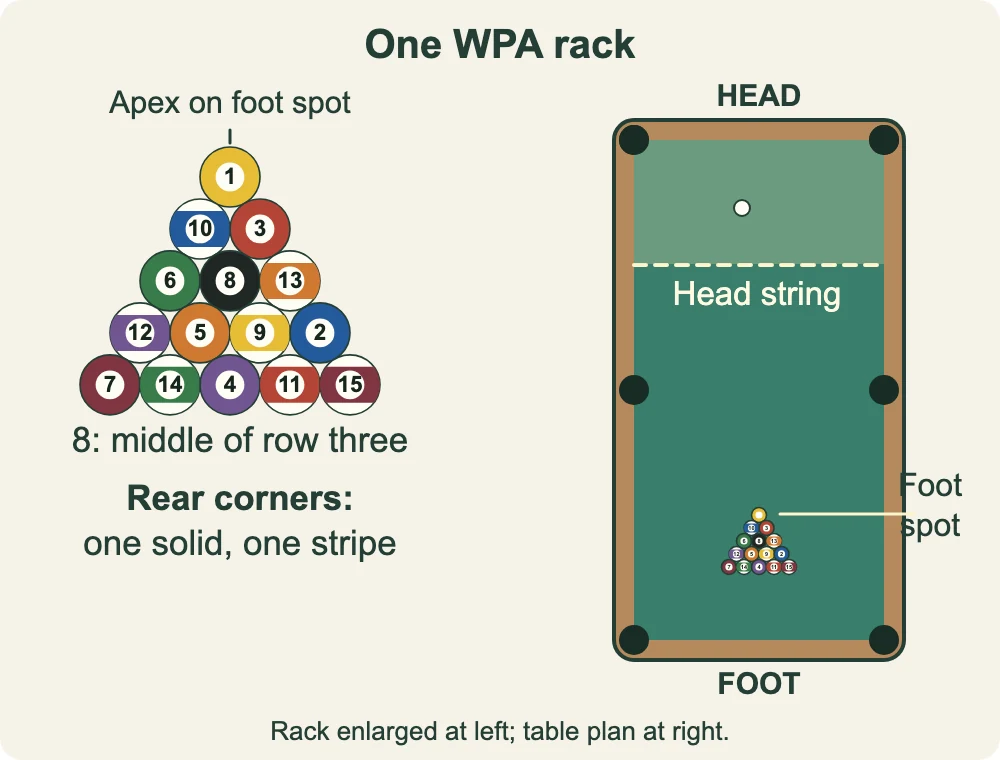
The head string runs across the bed one quarter of its playing length from the head cushion, at the end opposite the rack. Put the center of the cue ball between the head cushion and the line for the break. Keep its center clear of the line itself. This area is called the kitchen. If you’re choosing where to play at home, use the Pool Table Room Size Calculator to check cue clearance.
Break legally, then check what happened
Start with the cue ball behind the head string. You can hit any racked ball first on a WPA break. You don’t call a pocket. If nothing drops, at least four different numbered balls must reach one or more rails. Count each ball once even if it reaches several rails.
If a numbered ball drops on a legal break, you normally keep shooting. Check the special choice below if it was the 8. If the break was legal and nothing dropped, your opponent shoots. Both players still have a chance to get either group. The break doesn’t give anyone solids or stripes in WPA.
| Break result | What happens next under WPA |
|---|---|
| Nothing pocketed, fewer than four object balls reach rails | On a short break with no separate foul, the incoming player can shoot from where the balls stopped, rerack and break, or rerack and let the same player break again. |
| 8 pocketed on a legal break | The breaker either spots the 8 and shoots from the position left, or reracks and breaks again. |
| 8 pocketed with a foul | The opponent chooses to spot the 8 and shoot with cue ball in hand behind the head string, or rerack and break. |
| Object ball driven off the table | It is a foul. The incoming player can accept the position or take cue ball in hand behind the head string. The 8 is spotted if driven off. Other object balls stay out of play. |
| Other break foul, including a scratch without the 8 dropping | The incoming player can play the cue ball where it stopped if it is still on the bed, or take ball in hand behind the head string. After a scratch, use the behind-the-line option because the cue ball is in the pocket. |
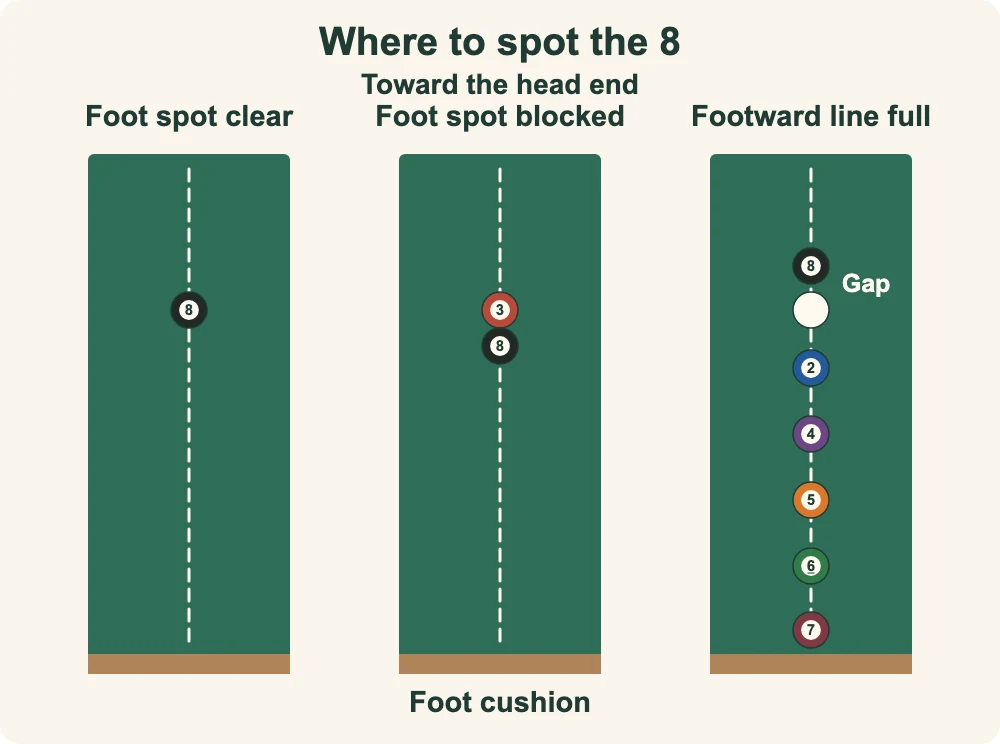
Spot the 8 when the break rule calls for it. Put it on the foot spot if the spot is clear. If it’s occupied, put the 8 on the lengthwise center line nearest the spot toward the foot cushion. Touch the blocking object ball if you can. Leave a small gap next to the cue ball. If the entire footward line is blocked, use the nearest position toward the head end along the same line. Leave the other balls in place.
Pause if several things went wrong on the break. Check whether the 8 went in or off the table and whether the cue ball is still on the bed. Get a ruling under the agreed break rules before either player moves a ball or starts the next shot.
Choose solids or stripes after the break
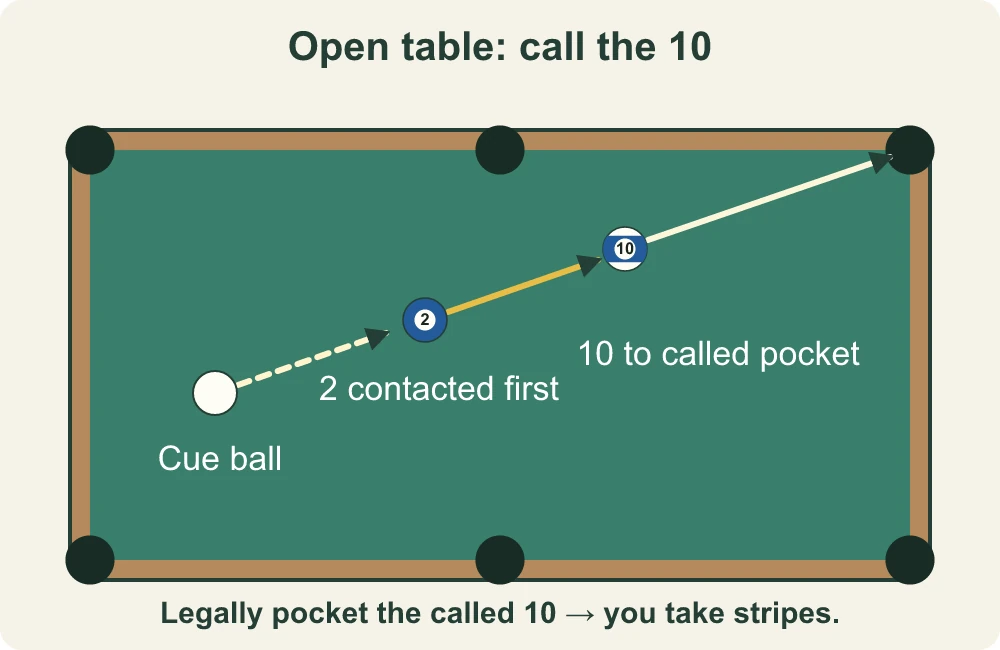
An open table is one where neither player has a group yet. Say you call the 10 in a corner pocket and make it there without a foul. You get stripes and your opponent plays solids. If a solid also goes in, you still get stripes because the 10 was the ball you called.
On an open table, you may contact a solid first to pocket a called stripe, or contact a stripe first to pocket a called solid. Once groups are assigned, your cue ball must contact one of your own group first. Later contacts with other balls do not automatically make the shot a foul.
Leave the 8 alone as the first ball on an open table while both groups still have balls up. If all seven balls from one group have already gone in, WPA lets the shooter claim that cleared group for a shot at the 8. You can win with that legal shot. If you miss without fouling, your opponent gets the position and the table is still open.
An ordinary miss, foul or called safety also leaves the table open before groups are decided. If you hit the 8 first too early and it stays on the table, you’ve fouled. If the 8 also drops early outside the break, you lose the rack.
Contact your ball, then pocket or rail
Once groups are set, a legal ordinary shot must contact one of your group first. When your group is cleared, the 8 becomes your legal first-contact ball. If no ball is pocketed, a ball must be driven to a rail after object-ball contact. That can be the cue ball, your object ball or another object ball.
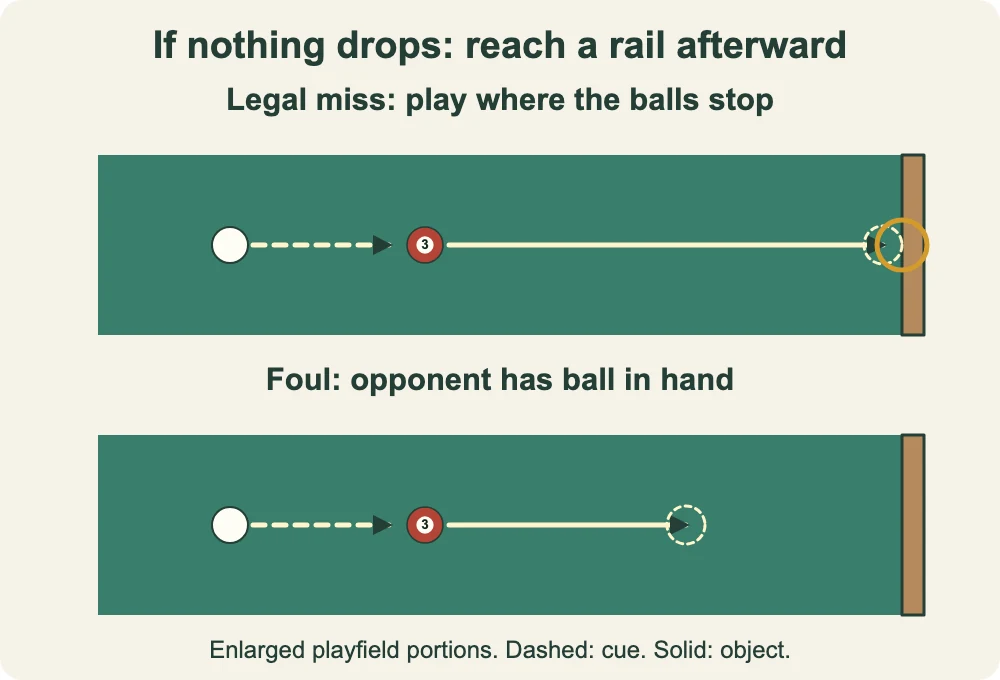
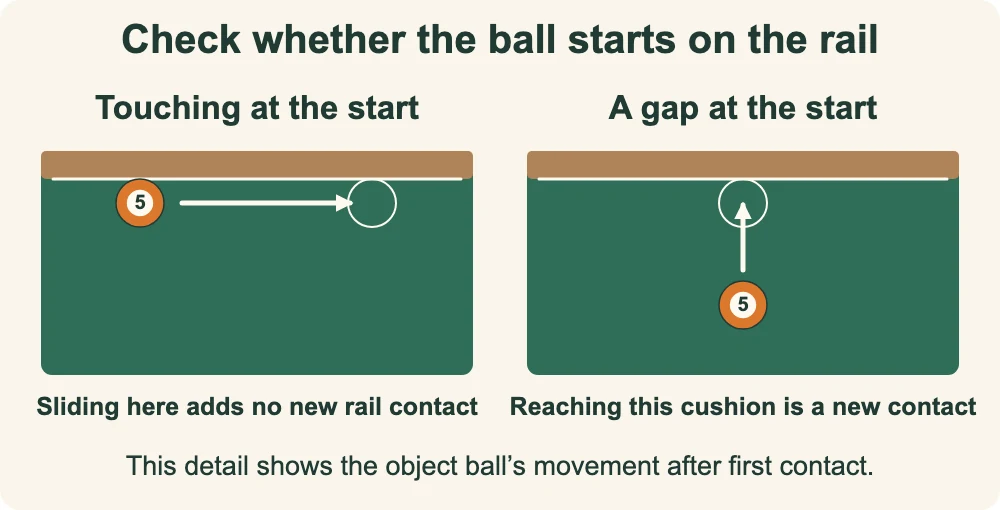
You can kick the cue ball off a cushion before it hits your ball. If nothing drops, a ball still has to reach a rail after that first object-ball contact. If a ball was declared frozen to a cushion, it has to leave that cushion and return to count on that same rail. It can qualify by reaching a different rail instead. Ask for a ruling before shooting if the contact order is too close to see.
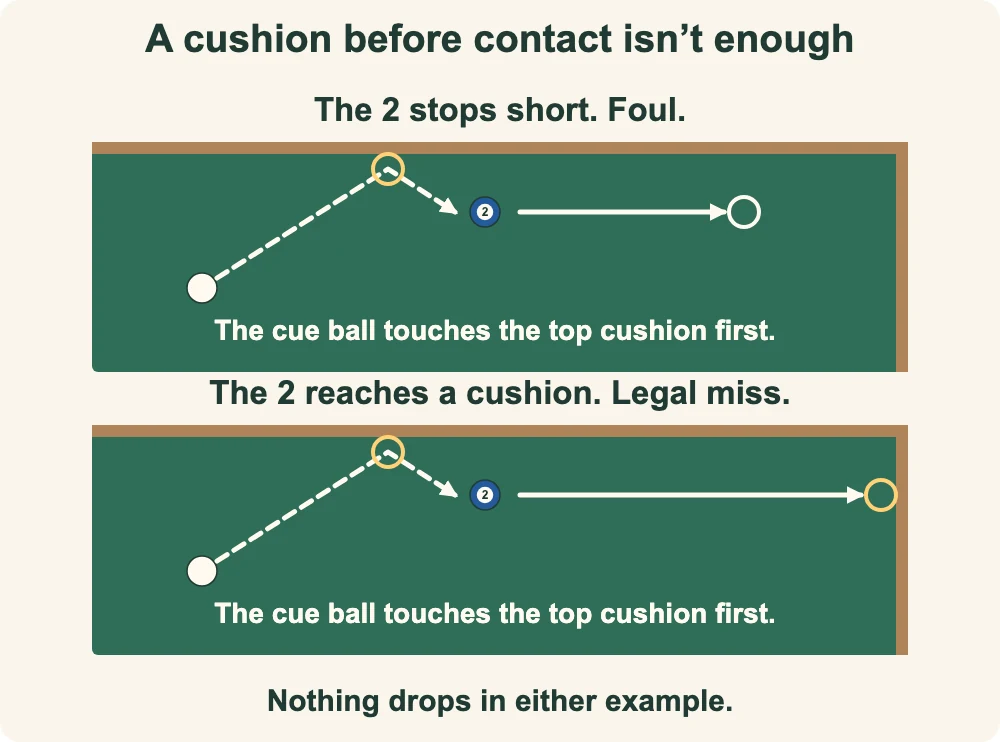
Say the cue ball hits your 3 first and the 3 reaches a rail. Nothing drops and you haven’t fouled, so the other player shoots from where the balls stop. If no ball reaches a rail after contact and nothing drops, your opponent gets ball in hand for the foul.
Call the intended ball and pocket clearly
When your shot could be unclear, say which ball you’re trying to make and where it should go. For example, say “12 in the left corner.” Under WPA an obvious ball and pocket do not need an announcement. If the object ball comes off a cushion before going in, that’s a bank. If you use one numbered ball to send another in, that’s a combination. Indicate the intended ball and pocket for both.
If a called group ball drops in a different pocket without another foul, it stays down and your turn ends. An accidentally pocketed opponent ball also stays down. If you legally pocket your called ball as well, that extra ball does not by itself end your turn. Pocketing a different ball alone does not let you continue.
You may instead call safety before an ordinary shot. Your turn ends after the shot even if one of your balls drops. It stays down and your opponent shoots from where the balls stopped if your shot was legal. Follow the same first-contact and rail rules on a safety.
| Ordinary shot result | Next turn |
|---|---|
| Group ball made legally in its intended pocket | You continue. |
| Legal miss or legal safety | Opponent plays the position left. |
| Ordinary non-break foul | Opponent has cue ball in hand anywhere. |
| A rack-loss condition on the 8 | Rack is over. |
Separate ordinary fouls from losing the rack
After an ordinary foul, your opponent can place the cue ball anywhere on the playing surface. That’s ball in hand. Call the foul before the next shot. Move the cue ball with your hand or any part of your cue, including the tip, and leave the other balls alone. You can adjust it until you shoot. A forward stroke with the tip starts a shot.
- Scratch or cue ball off the table. A scratch means you pocketed the cue ball. Driving it off the table is also a foul.
- Wrong first contact or no contact. First hit one of your group, or the 8 after you clear that group. Missing all numbered balls also fouls. When the cue ball hits a legal and an illegal target so close together that you can’t tell the order, WPA counts the legal one first.
- No pocket or rail afterward. After legal first contact, pocket a ball or send a ball to a rail. This also applies when you call safety.
- Improper contact. Striking the cue ball twice or keeping the tip on it past normal stroke contact fouls. Keep your clothing, hand and equipment clear of the numbered balls, even when placing the cue ball.
- Other fouls. Wait for all balls to stop moving or spinning, and shoot when it’s your turn. In ordinary standing play, keep a foot on the floor when the tip strikes the cue ball. Slow-play and rack-template fouls also apply under the rules.
Look for a gap when the cue ball is close to a numbered ball. If the tip is still on the cue ball when it reaches the object ball across that gap, that’s usually a foul. If the referee or your opponent confirms the cue ball is touching a legal target, a normal stroke toward that target can be legal. Moving it counts as contact. Shooting away alone doesn’t count. Agree who will watch a close hit before you shoot.
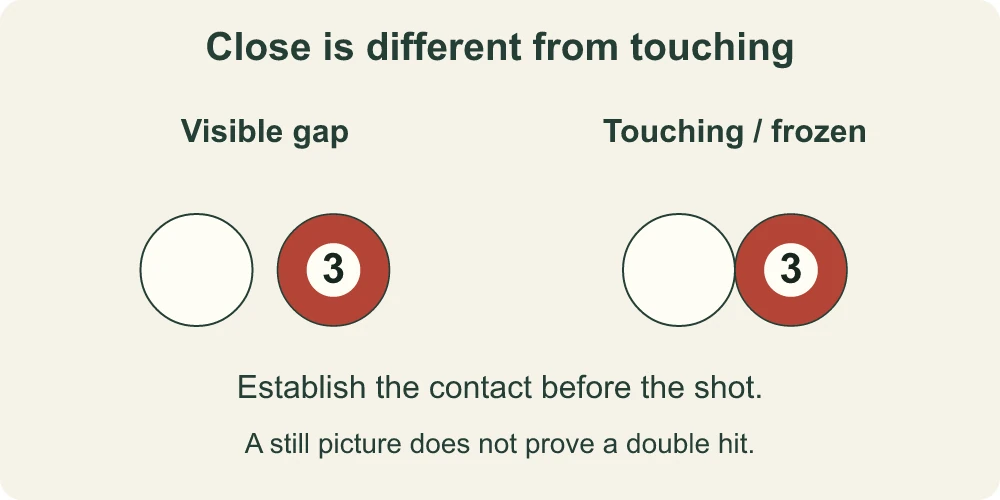
Driving a ball off the table is a foul. Leave numbered balls that go off out of play, except for the 8. If the 8 goes off on the break, spot it as the break table explains. If you drive it off on a later shot, you lose the rack. WPA 8-ball has no automatic loss for three ordinary fouls. A referee can apply a different penalty for unsportsmanlike conduct.
Use the kitchen only when it applies
When a break ruling gives you ball in hand behind the head string, put the cue ball anywhere between that line and the head cushion. Its center has to stay on the head-cushion side of the line.
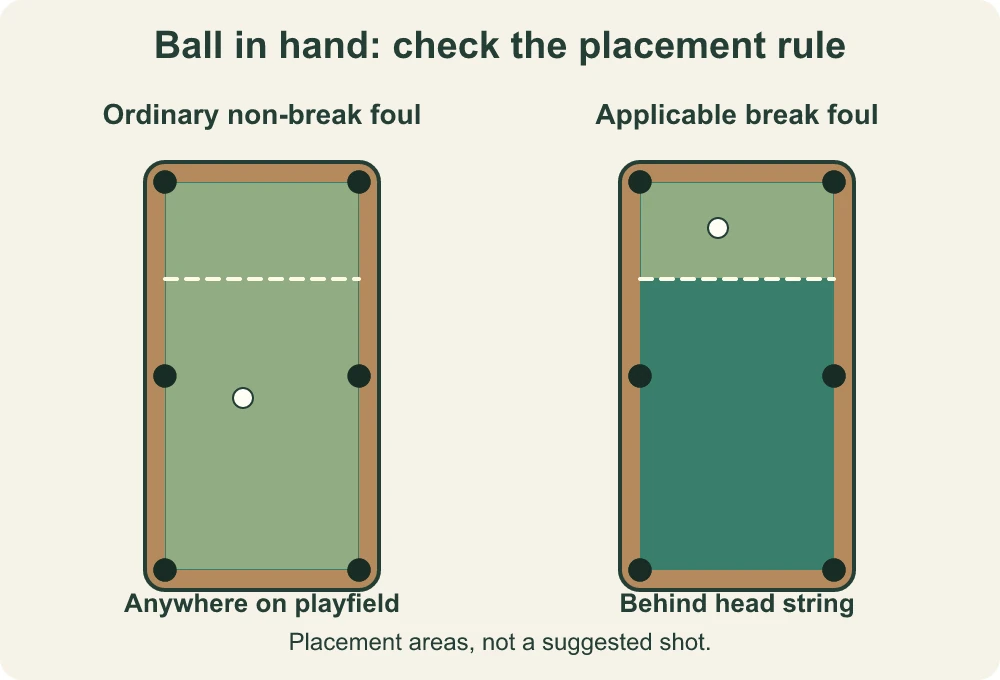
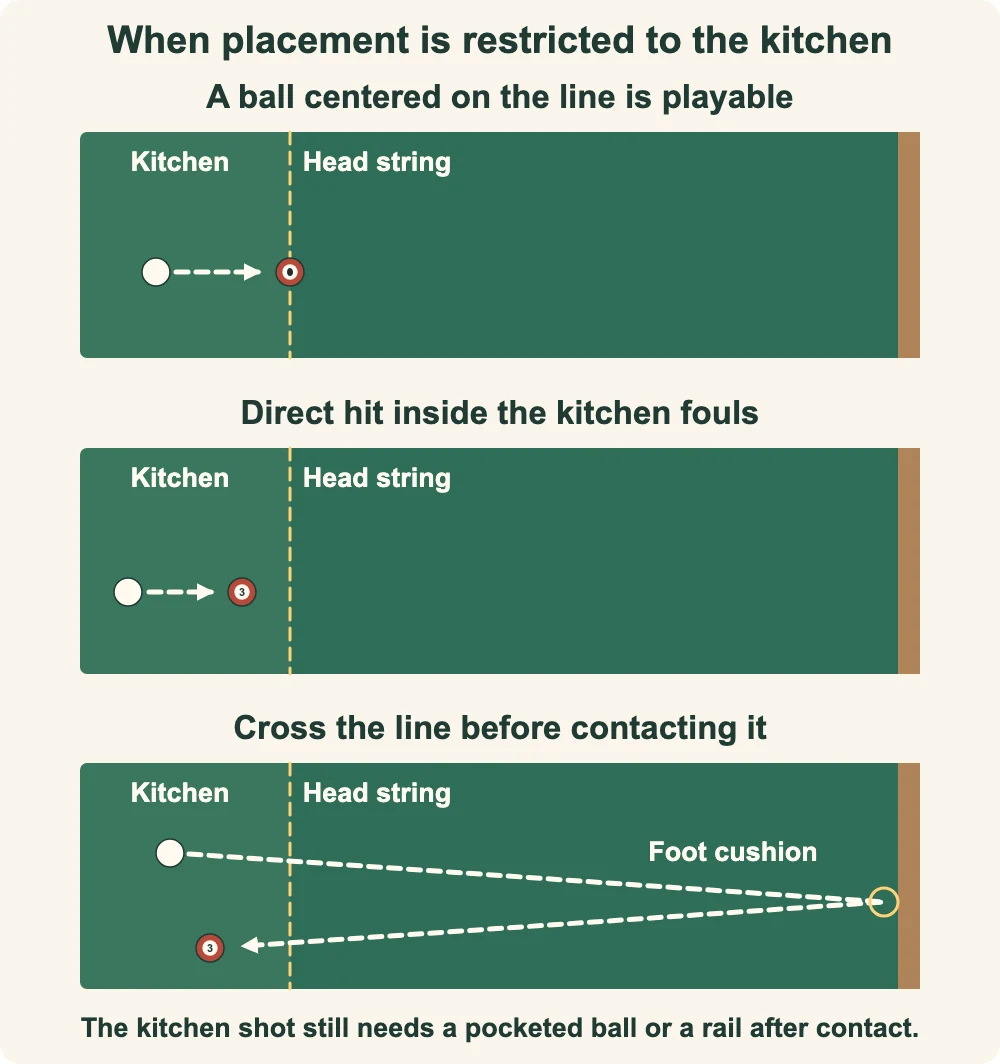
Look at the center of the ball you want to hit. A legal target centered on or beyond the head string is available directly. If the target’s center is in the kitchen, send the cue ball across the head string before it comes back to hit that ball first. A direct hit on a ball in the kitchen fouls when ball in hand is restricted to that area. Rule 1.6 discusses asking to spot a legal ball when they are all in the kitchen. The 8-ball spotting rule is narrower, so ask for a ruling and leave the object balls where they are.
Finish on a separate, legal 8-ball shot
Once every ball in your assigned group is off the table, take a separate shot at the 8. Indicate the intended pocket if it’s unclear. Hit the 8 first and make it there without a foul. If you get another attempt, you can choose a different pocket. You don’t need a bank or the same pocket that took your last ball.
| Outside the break | Result |
|---|---|
| Group cleared, 8 pocketed in its intended pocket without a foul | Win the rack. |
| 8 pocketed before your group is cleared, including on the shot that pockets your last group ball | Lose the rack. Clear the group before the 8-ball shot. |
| 8 pocketed in an uncalled pocket, or pocketed while fouling | Lose the rack. |
| 8 driven off the table | Lose the rack. |
| Scratch while shooting at the 8, but the 8 stays on the table | Ordinary foul under WPA: opponent has ball in hand. APA differs. |
| Hit the 8 first too early, but it stays on the table | Wrong-first-contact foul, rather than automatic rack loss. |
Wait until the balls stop before you count the win. After a legal miss on the 8, your opponent shoots from where the balls stopped. Apply the special break choices if the 8 fell on the break.
Myth: A scratch while shooting the 8 always loses the rack.
Under WPA: If the cue ball drops but the 8 stays on the table, your opponent takes ball in hand. APA league rules award the rack to your opponent in that situation.
Plan the finish before clearing easy balls
Look for a last group ball that can leave you a clear shot on the 8. That’s your key ball. Dr. Dave’s 8-ball strategy guide walks through choosing a group, finding problem balls and planning back from the 8.
- Choose the group you can clear. Look for balls crowded together and balls with no clear route to a pocket. Check both groups before committing to an easy opening shot.
- Plan backward from the 8. Pick the pocket for the 8 and the area where you want the cue ball. Save the group ball that gives you the best route into that area.
- Keep options while solving problems. Address a trapped ball while other available shots remain. Avoid moving already useful balls unnecessarily. Reassess after the layout changes.
- Choose defense deliberately. When you cannot see a workable finish, consider a legal safety rather than clearing easy balls and leaving only your hardest one.
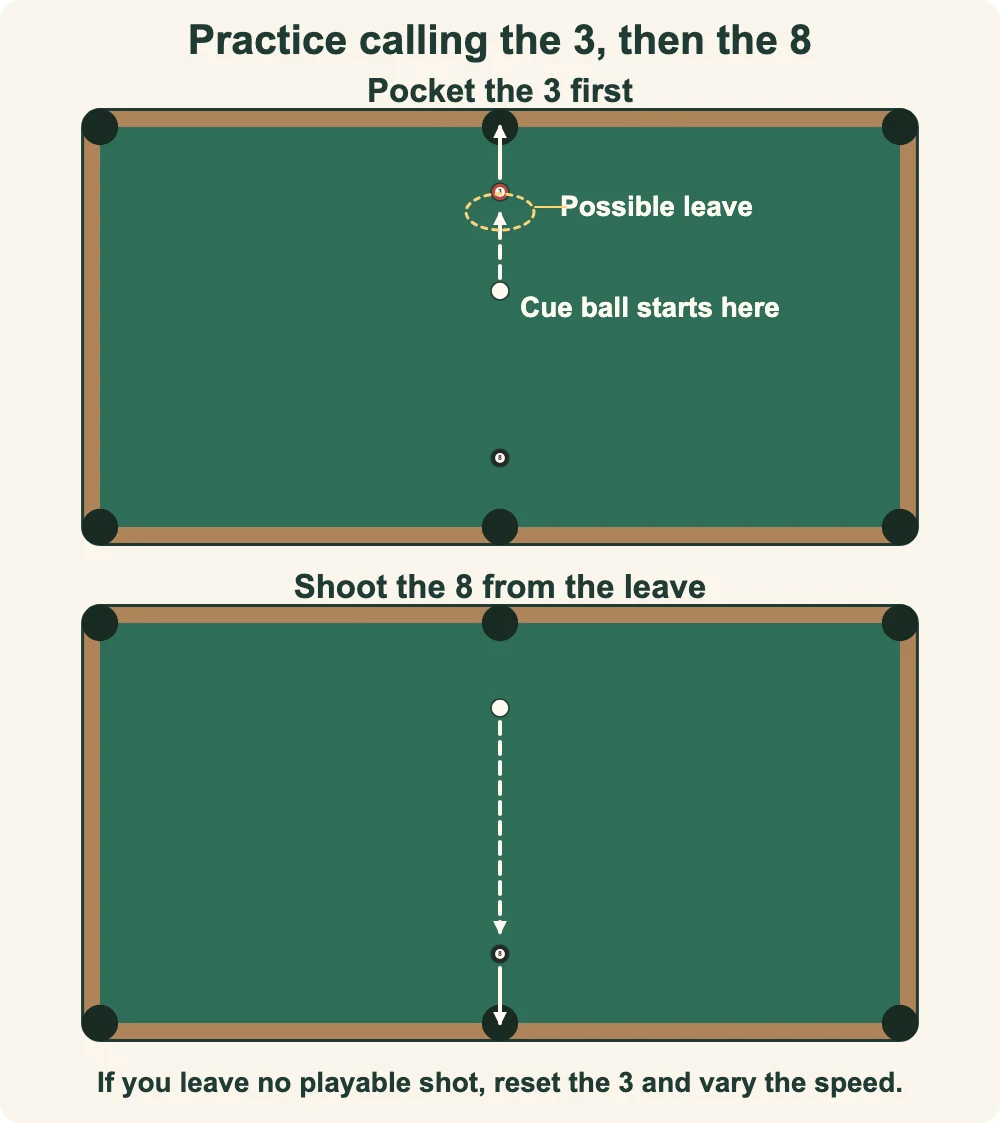
Try a two-shot drill. Set the 3 near one side pocket and the 8 near the opposite side pocket as shown. Line up the cue ball behind the 3 and pocket it first. Try to stop the cue ball where you can see the 8 and its pocket. Shoot the 8 separately from where the cue ball stopped. If you have no shot, set up the 3 again and try a different speed.
Check WPA, APA and house rules separately
Ask which rules the room uses before you start. The American Poolplayers Association (APA) runs its own league rules. The Billiard Congress of America publishes world-standardized rules, while the BCA Pool League uses CSI rules. If someone says “BCA rules,” check which one they mean. A house may also post its own rules.
| Decision | WPA described here | APA ordinary 8-ball league rules |
|---|---|---|
| First ball hit on the break | You can hit any racked ball first. | Hit the front ball or one of the two balls directly behind it. Don’t send the cue ball to a cushion first. |
| Scratch on an otherwise legal break, 8 still up | Opponent has ball in hand behind the head string. To hit a ball in the kitchen first, the cue ball has to cross the line and return. | Opponent has ball in hand behind the head string. First hit a ball centered on or beyond that line. |
| 8 and cue ball pocketed on an otherwise legal break | Opponent spots the 8 and plays from behind the head string, or reracks and breaks. | The breaker loses. |
| 8 pocketed on a legal break | Spot and continue, or rerack and break. | Win. |
| Groups after the break | Open until a called group ball is legally pocketed afterward. | Making balls of only one category on a legal break establishes that category. If both categories fall, the table is open. |
| Calls | Intended ball and pocket, with obvious shots excepted from announcement. | Ordinary object-ball shots aren’t called. Before shooting the 8, put a coaster or other allowed marker beside the intended pocket. A marker already beside the correct pocket can stay. |
| Cue ball pocketed or driven off on a shot at the 8, with the 8 still up | Ordinary foul with ball in hand. | Rack loss. Missing contact with the 8 while the cue ball stays on the table is a foul. |
The APA sources for these distinctions are Breaking, After the Break and How to Win a Game. For an event, follow its current rulebook and published conditions. Before casual play, agree on group selection, called shots, ball-in-hand placement, break outcomes, what loses on the 8 and who breaks next.
If the referee sees no progress, each player gets three more turns unless both accept the stalemate sooner. If the referee declares a stalemate, rerack and give the original breaker another break. In a home game, both players can agree to restart a stalled rack the same way. When there’s a winner, mark the rack for that player and follow the break order you agreed on.