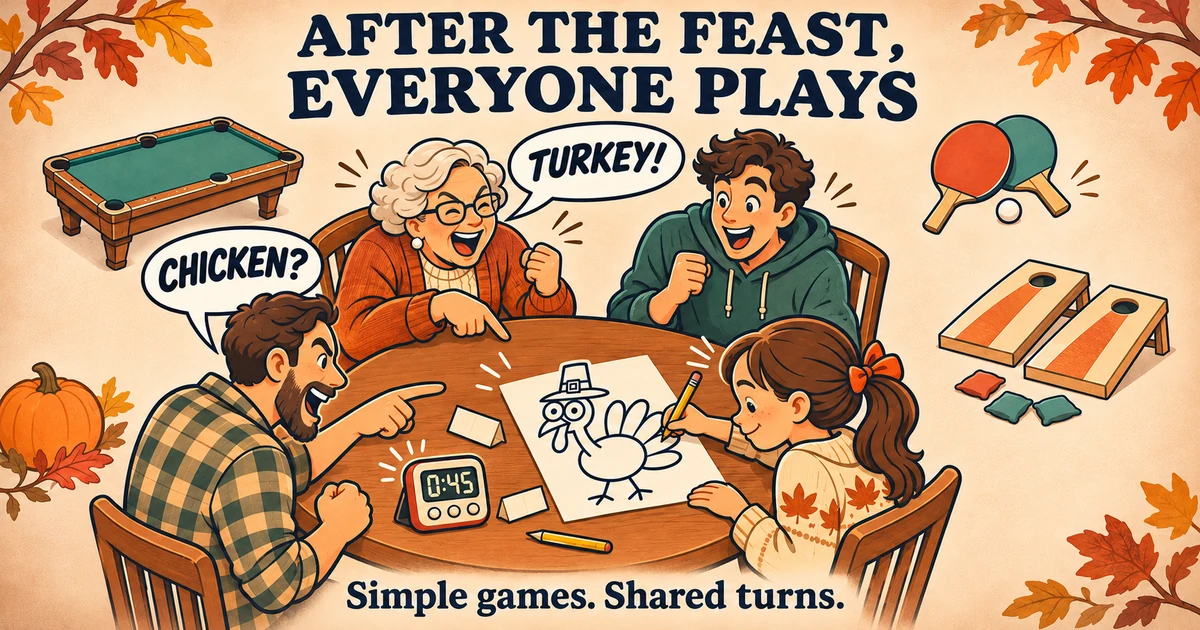
Choose a game for the people who are there
Start with a game that everyone who wants to join can take part in, then offer a separate activity for guests who want more competition. Ask whether people would rather talk, draw, act or play a table game. Someone can enjoy keeping score or guessing without wanting a turn with a cue. Make watching and passing on a question equally welcome.
The suggestions below are ways to organize your gathering, not manufacturer age ratings or promises about how long a game takes. The entries identify house formats and the regular sports rules they borrow, so agree on your version before you play. Choose one, explain its stopping point and play a practice turn before keeping score. You do not need to run the whole list.
| What your group wants | Start here | What you need | When to stop |
|---|---|---|---|
| Everyone can stay seated | Would You Rather or the story chain | No special equipment | One turn around the group |
| A little acting or guessing | Thanksgiving charades | A person to give prompts quietly | Equal turns for both teams |
| A quieter shared activity | Drawing and guessing or thankful notes | Paper and something to write with | One turn per willing player |
| Beginners at a cue table | Six-ball team pool or the snooker challenge | The appropriate table, balls and cues | Three visits per player |
| Four people playing together | Table-tennis or foosball doubles | A suitable table and its equipment | One game, then new pairs |
| A turn-based contest | Darts or table shuffleboard | An established playing area | Five darts turns or four shuffleboard ends |
| A quick head-to-head game | Air hockey | A working table, puck and two mallets | First to seven, then rotate |
| A backyard activity | Cornhole | Boards, bags and a clear, suitable lane | First to at least 21 after a full frame |
Keep the route between the kitchen, dining area and seats outside the playing area. If you are arranging several games, the game room layout planner lets you position equipment and look at the surrounding space before you start moving furniture. Check that space in the actual room too, with everyone seated and doors open.
Thanksgiving games without special equipment
Choose a spoken game when guests have just sat down, food is still being served or nobody wants to prepare supplies. These three house formats can start with people in their existing seats. Keep the prompts about ordinary preferences and imaginary situations so nobody has to share something personal.
1. Thanksgiving Would You Rather
Choose this for: a conversation game in which there is no wrong answer. A host reads two possibilities, and each person chooses one. There is no elimination or winning score.
- Ask one of the questions below and give everyone a moment to think.
- Go around the group. Each person can answer, explain their choice or pass.
- Let the next person choose the next question. Finish after everyone who wants to has asked one.
Try these original prompts: Would you rather make dessert or choose the music? Have a tiny parade in your living room or a giant picnic in your backyard? Eat the same favorite side dish all weekend or try a new one at every meal? Play one long game or several short games? Be the family’s official taste tester or its game-night referee?
For a child who does not want to speak in front of the group, let them show one finger for the first option or two for the second, whisper to a partner or simply listen. Avoid turning people’s answers into a vote on who gave the best one. The choices are enough to get a conversation going.
2. The missing-dessert story chain
Choose this for: a group that would enjoy making up a story together. Each person adds one sentence. It works as a cooperative activity, with no scoring and no need to remember the story word for word.
- Start with: “Just as we were ready for dessert, the pie disappeared.”
- The next person adds one sentence explaining what happens next. Continue in a fixed order so people know when their turn is coming.
- After one trip around the group, ask the next willing player to give the story an ending. If everyone wants another round, start a new story rather than making the first one endless.
A younger player can add a single word, make a sound or ask a partner to say their sentence. If someone gets stuck, offer a choice: “Did the dog find the pie, or did it go on a bus?” Keep that help optional so it does not become one person telling the entire story.
For another start, try: “Our Thanksgiving table had one unexpected guest: a very polite penguin.” You are inventing a shared story, so an impossible turn is fine. Agree to leave real guests out of jokes that could embarrass them.
3. Thanksgiving charades
Choose this for: people who would rather act and guess than answer questions. In this house version, teams alternate one-minute turns and receive one point for each correctly guessed prompt. Use a timer if you can, or agree on the untimed version below.
- Split willing players into two teams. Choose a reader who can quietly give the actor a prompt, then change readers when that person wants to play.
- The actor uses gestures without speaking, spelling letters in the air or pointing at the answer in the room. Their own team guesses.
- A correct answer earns one point. In the timed version, the reader gives another prompt after each correct guess, and the actor may pass while the clock keeps running. In the untimed version, use one prompt per turn. At the end of that turn, the other team plays.
- Finish when every willing actor has had one turn. Give both teams the same number of turns, using extra volunteers if needed. A tied score stays a tie.
Original prompts to start with: carrying an enormous pie, a turkey learning to dance, washing a mountain of dishes, looking for a missing chair, a balloon escaping from a parade, and trying to stay awake after dinner. Let players act while seated, use a partner or choose a different prompt before their turn starts. Clear enough space for gestures without entering someone else’s path or knocking into a chair.
Games with paper and pencils
Use paper games when people want something to do with their hands while staying together at the table. Clear the food and drinks from the playing surface first. Ordinary paper and pencils are enough, and the prompts below can be read straight from this page.
4. Draw the Thanksgiving scene
Choose this for: teams that enjoy guessing from a picture, including people who do not want to perform. This is a homemade drawing game, with its own rules rather than a purchased game’s instructions.
- Make two teams. A player from the other team gives the drawer a secret prompt.
- Allow one minute to draw and guess. Use pictures rather than written words, numbers or spoken clues.
- A correct guess gives the drawing team one point. Swap teams and use a new prompt.
- After each willing drawer has played, finish with equal turns for the teams. Keep a tie or play one extra turn each.
Draw a squirrel carrying a pie, a table with one chair missing, a turkey watching football, a mountain of mashed potatoes, or a parade balloon caught in a tree. The drawing does not need to look realistic. Before starting, agree that an answer with the same meaning counts, such as “the turkey is watching a game” for the football prompt.
Use large paper or have the drawer hold it up so everyone can see. A player can dictate a scene to a drawing partner if they prefer. If the one-minute limit makes the game frustrating, remove it for both teams and play one picture per turn.
5. Guess the thankful note
Choose this for: a gentle guessing game that leaves personal sharing optional. Ask people to name a small, everyday thing they appreciate, such as warm socks, a library book or a good sandwich. They can use an imaginary answer or pass.
- Each willing player writes one note without a name and folds it. A helper can write for someone who asks.
- Mix the notes in a bowl. The host reads one, and each player gets one guess at who wrote it.
- Ask the author whether they want to reveal themselves. If they do not, put the note aside without pressing for an answer.
- Continue until the notes are finished. Do not keep a score or declare the most meaningful answer.
Make it a silly version by asking what an imaginary turkey would be thankful for. That removes the need to identify real experiences and gives children a clear subject. Use a bowl from the kitchen, or pass the folded notes to the host instead. No printable or signup is needed.
Games using the equipment you already have
Use the game room for guests who want a more active contest, with a clear turn order so beginners get to play. These are separate activities, not equipment you need to buy for Thanksgiving. Use the table’s proper balls, pucks or bags, and follow its maker’s instructions for operation and supervision.
6. Six-ball team pool
Choose this for: mixed-experience guests at a pool table. This house potting challenge gives every player the same number of visits. It is not eight-ball, and the ball numbers do not control shot order.
- Make two teams with the same number of players. Use a cue, the white cue ball and six object balls from a pool ball set. Set the six balls in the open positions shown below, without touching a cushion.
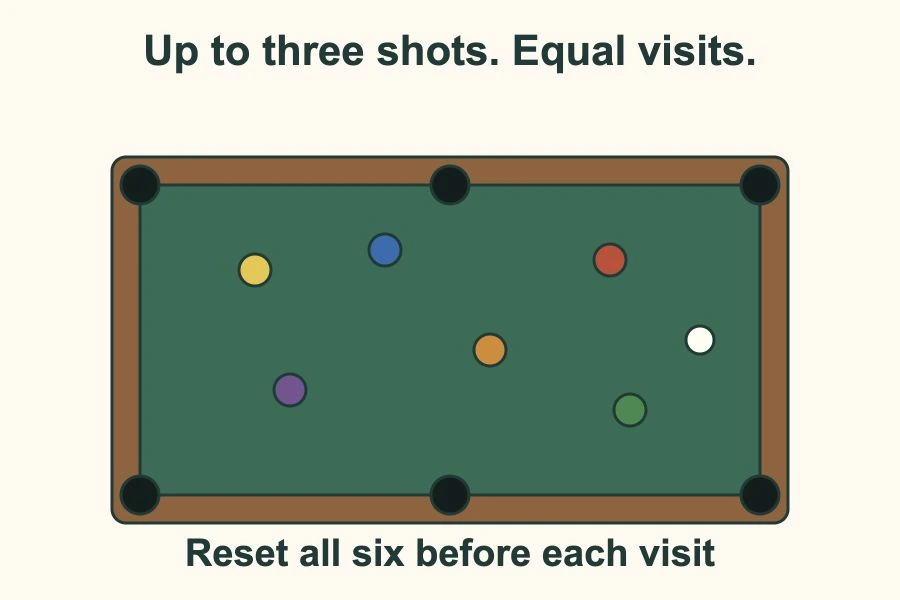
- Choose a shooting order that alternates teams. Before each visit, restore the same six-ball layout and let the shooter place the cue ball in open space, clear of the object balls.
- Give the shooter up to three shots. They strike the cue ball with the cue tip and may aim at any object ball. Each object ball legally pocketed earns one point. A shot earns no points if the cue ball is pocketed or leaves the table, an object ball is touched by hand or cue, or an object ball leaves the table. A foul ends the visit, with no points for that shot. Keep points already earned on earlier shots. An ordinary miss uses a shot but does not end the visit. Restore the whole layout for the next player.
- Wait for the balls to stop before the next shot or reset. Finish after three visits per player, add the team totals and allow a tie.
Spread teams by experience rather than putting all the regular players together. Give everyone a practice visit, with help available to learn the bridge and stroke. Keep the scoring visits consistent once the contest starts. For guests who prefer a full game, our eight-ball rules guide explains groups, fouls and the legal finish instead.
Before a crowded gathering, check the tightest shot using the pool table room size calculator, then try the cue in the actual furnished room. A cue-length fit by itself does not provide extra room for a backswing. Keep plates and glasses off the cloth and rails.
7. A red-and-yellow snooker challenge
Choose this for: guests who already have access to a snooker table and want a brief introduction to potting. This house drill uses a red worth one point and a yellow worth two, following those balls’ values in the WPBSA rules. It does not use a full snooker frame’s foul penalties or colour sequence.
- Use the table’s matching snooker balls and cues. Put one red, the yellow and the white in the open starting positions shown below. Leave the other balls off the table.
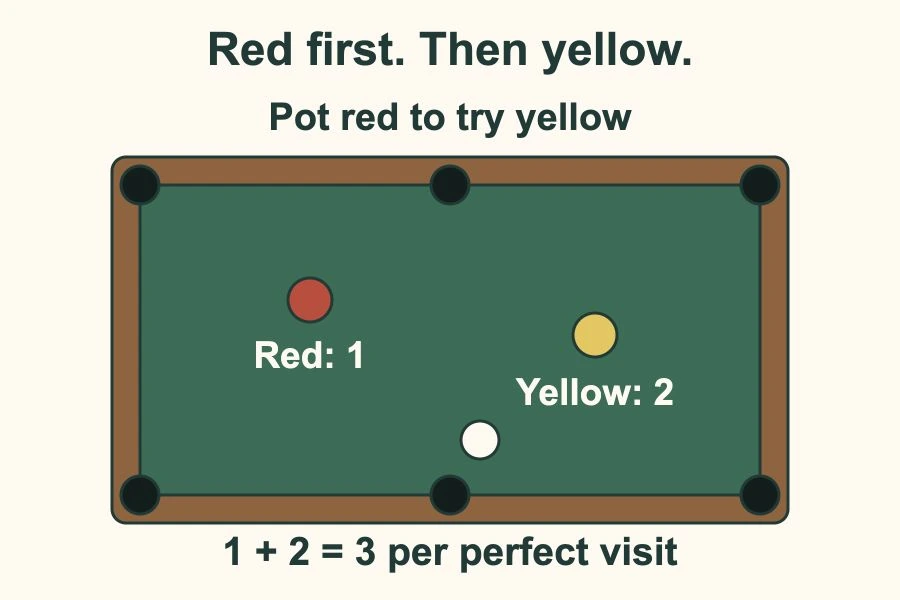
- Each visit starts with a shot at the red. Pot it without a foul to earn one point and one shot at the yellow. A legal yellow pot adds two points. The visit ends after that yellow attempt, or as soon as the red attempt fails.
- In this drill, a foul means the white fails to hit the intended ball first, the white is pocketed or leaves the table, an object ball leaves the table, the wrong object ball is pocketed (including the yellow during the red attempt), or a hand or cue touches an object ball. Touching the white other than with the cue tip during the stroke is also a foul. A foul scores zero for that shot and ends the visit. Keep points from an earlier legal shot.
- Reset all three balls for the next player. After three visits each, the highest total wins, with a tie allowed. Three perfect visits score nine points.
Give a new player a comfortable shot rather than starting with a long, difficult pot. Use a cue rest when needed instead of asking someone to stretch across the table. If the group wants the full game, the snooker rules guide covers the complete setup and scoring sequence. A full frame is a different commitment from this short challenge.
8. Table-tennis doubles
Choose this for: four guests who want to play at once at a table-tennis table. Use four paddles, a ball and the table’s net. Play one game to 11, winning by two points, rather than making guests wait through a long match.
- Make two pairs and choose the first server and receiver. Label the players A and B against C and D. Start with A serving to C.
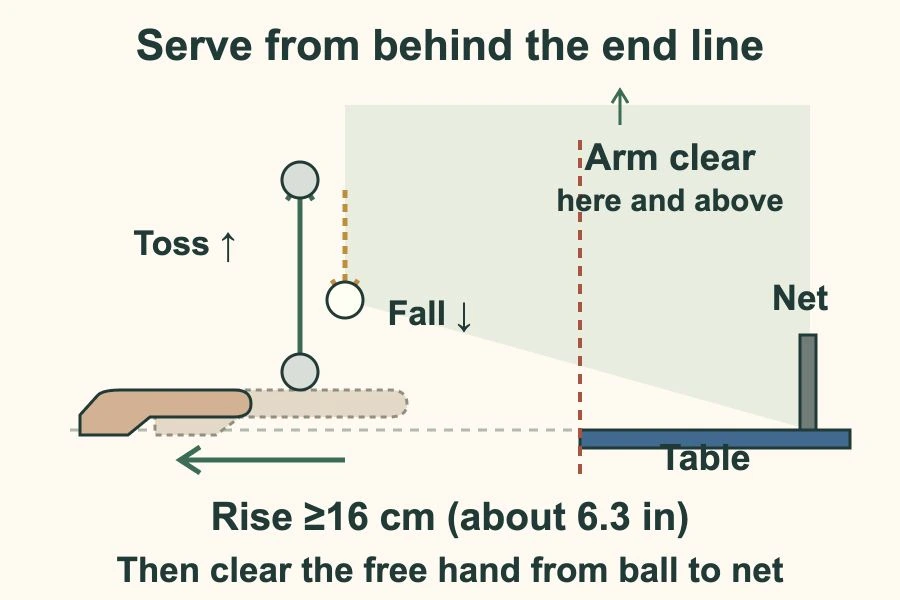
- Rest the ball on your stationary, open, flat free hand. Keep it above the playing surface and behind the end line from the start of the serve until you strike it. Toss it almost straight up at least 16 cm (about 6.3 inches), without adding spin, then strike it as it falls. As soon as you toss it, move your free arm and hand out of the space between the ball and the net. Keep the ball visible. In doubles, the serve bounces on the server’s right half, then the receiver’s right half. A net-touching serve that is otherwise correct is replayed.
- During the rally, hit after one bounce on your side. Partners alternate every stroke: A serves, C returns, B hits, D hits, then A again. A miss, double bounce or return that fails to land on the opponents’ side loses the point. The ball can land anywhere on their side after the serve.
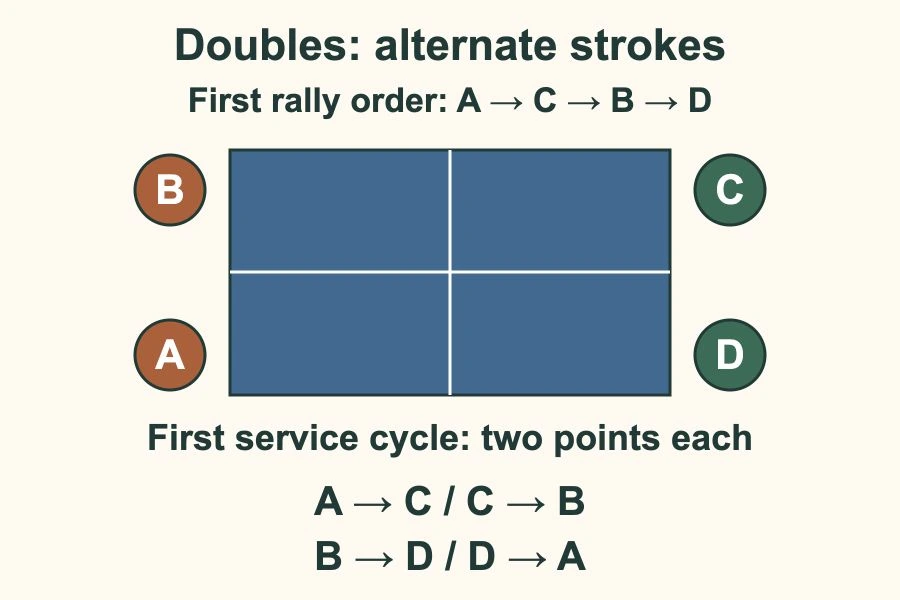
- Change server every two points: A serves to C, then C to B, B to D, and D to A. At 10-10, change after every point and continue until a pair leads by two. Swap ends when a pair reaches five in this single deciding game. At that change, the pair due to receive swaps its receiving order, and the service cycle adjusts accordingly.
For example, suppose A and B win the first five points. B has just served once to D. After the change of ends, C receives B’s remaining serve. C then serves to A for the next two points. Keep using the rule that the old receiver serves next and the old server’s partner receives.
The scoring and service basics follow USA Table Tennis and the ITTF laws. If beginners prefer just keeping the ball moving, skip the competitive game and count a cooperative rally instead. Clear movement space at both ends and beside the table. The table-tennis room calculator helps compare layouts, but cannot check whether an occupied chair is in a player’s path.
9. A short around-the-clock darts game
Choose this for: guests who can safely use the installed dartboard and its appropriate darts. This house version shortens the usual 1-20 sequence to targets 1-10, with five turns each. Follow the equipment maker’s age and supervision guidance. For younger children, choose a suitable non-sharp game or one of the seated activities.
- Write each player’s name and a starting target of 1. Use the board’s proper throwing line. Keep everyone else behind the thrower and out of the lane.
- Each turn has up to three darts. Hit any part of the current numbered segment to move to the next number. A double or triple advances one target, not two or three. A miss leaves the target unchanged.
- Once a player completes 10, their score is ten targets. Any players who have taken fewer turns get their next turn so everyone has had the same number. If no one completes 10, play five turns each. Compare completed targets after everyone’s final turn.
- A dart that bounces out does not complete a target. Wait until the thrower has finished before retrieving darts. Share a tie rather than adding an unplanned sudden-death round.
For example, a player aiming at 3 who hits 3, misses 4 and then hits 4 has completed four targets and starts the next visit at 5. The Autodarts explanation of around the clock describes the longer sequence if your group wants to continue. Do not move the throwing line for one player during a scored round without agreeing to a different house contest.
10. Four ends of table shuffleboard
Choose this for: a turn-based game where guests can watch the result of each shot. At a table shuffleboard, use two colours of weights, also called pucks, with four per side. This house match ends after four complete ends rather than at the usual target score.
- Play one against one, or pairs with one partner from each team at each end. Choose the first shooter. Opponents at the same end alternate all eight weights toward the far scoring end.
- Remove a weight that does not clear the short foul line. Weights that leave the playing board do not score. Knocking an opponent’s weight off the board is part of the game, but hitting or moving the table is not.
- After eight shots, the side with the weight farthest down the board can score. Add its weights that are farther down than the opponent’s best remaining weight. The other side scores zero. Use the table’s zones, counting a weight on a dividing line in the lower-value zone. An end hanger is a weight that projects over the far end while part of it still rests on the board. It counts four on the common 1-2-3 layout. Overhanging a long side alone does not earn four. If the leading opposing weights are tied, neither side scores.
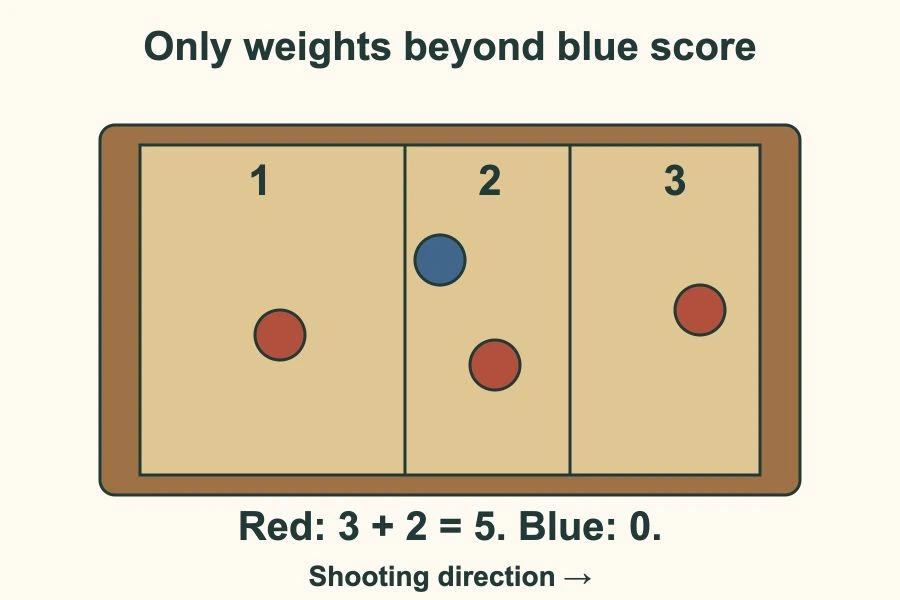
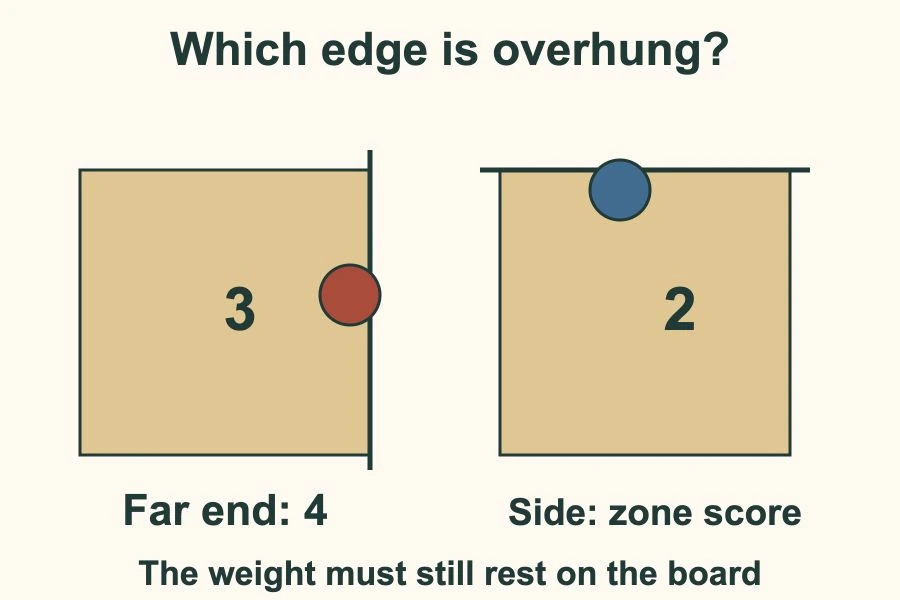
- Agree on the score before moving weights. Play back from the other end, with the side that scored shooting first. If neither scored, reverse the previous first-shooter order. After four ends, the higher total wins. Allow a tie.
The scoring follows the McClure Tables explanation and the Shuffleboard Federation rules. Ask the owner about the table’s markings before starting. Keep hands out of the receiving end while someone shoots. Give guests a practice weight so they can feel the speed before the scored ends.
11. Foosball pairs
Choose this for: four guests who want a team game without taking turns alone. Each pair shares one side of a foosball table. One player controls the goalkeeper and defence rods, while the partner controls midfield and attack. Use the table’s matching ball.
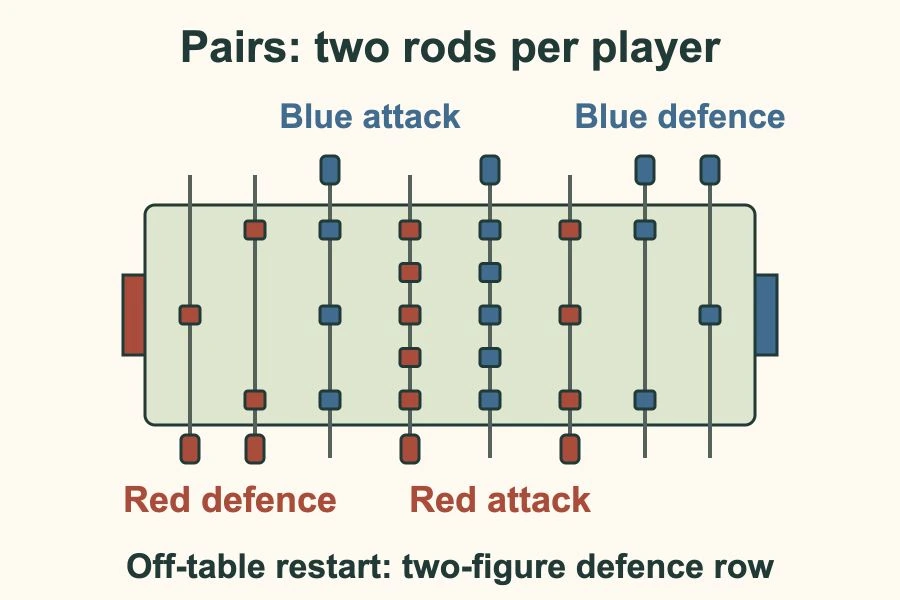
- Play this house match to five goals. Toss a coin for first possession. Set the ball stationary at that team’s midfield row, ask “Ready?” and wait for the other team’s answer.
- Move and turn your rods to pass and shoot. Do not spin a rod through more than a full rotation before or after contact, shake the table or reach into play. Each goal counts one, including a ball that enters the goal and rebounds out.
- After a goal, the team that conceded restarts at midfield once everyone is ready. If a team hits the ball off the table, its opponents restart at their two-player defence row. Place the ball under a figure with play stopped, ask “Ready?” and wait for the answer before moving it between the two figures and playing on. If it stops where no figure can reach it, pause and agree a midfield restart for the team that last conceded, or the initial receiving team before the first goal.
- For an illegal spin or table jolt, stop and give the other team a ready-checked midfield restart. This simple penalty and the five-goal match are house arrangements, not the complete tournament procedure. Change partners for the next game.
Keep people clear of projecting rod ends, including children walking past the table. The New Zealand Table Soccer Federation’s introduction explains the regular game, and the ITSF rulebook covers tournament decisions. Give a beginner a few passes before the match rather than expecting them to learn while a partner controls every shot.
12. Air-hockey games to seven
Choose this for: two players at a time, with the next pair ready to take over after one game. Use an air-hockey table with its correct puck and mallets. Keep the blower running as the maker directs.
- Use a house coin toss to choose first possession instead of a tournament face-off. Each player uses one mallet. Agree to play a game to seven points.
- Score one when the puck enters and drops into the opponent’s goal. The player who conceded gets the next serve. Keep the mallet from crossing completely over the centre line, and do not strike a puck entirely on the opponent’s half.
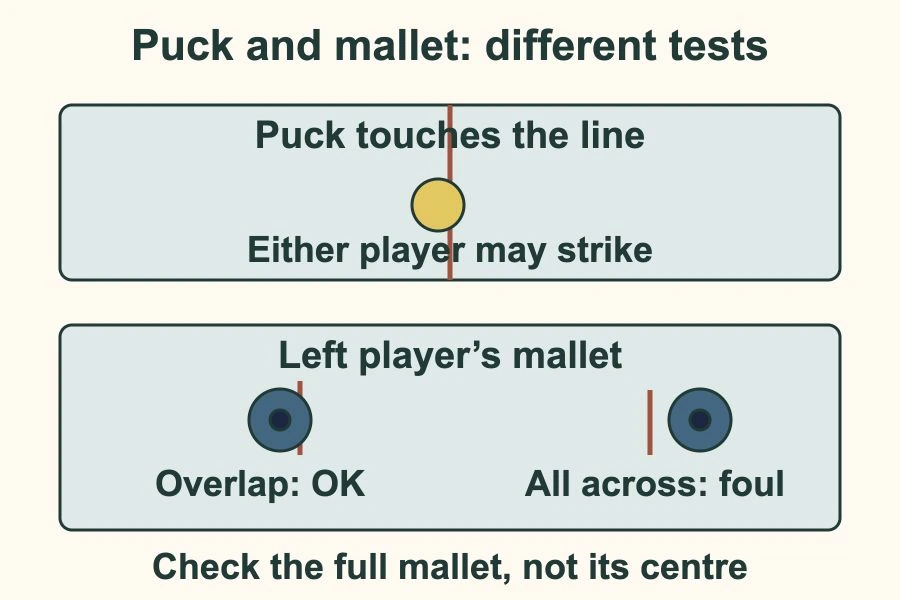
- Keep hands off the live puck and do not trap it by putting the mallet on top. Send a puck on your side back across within seven seconds. If a puck leaves the table, stop before retrieving it. An attacking strike that sends it off gives possession to the defender. If a defender moves the mallet forward, toward the opponent, into a shot and knocks it off, possession goes to the attacker; a sideways, backward or stationary block leaves the attacking player responsible instead. For this casual game, replace the puck flat on the awarded player’s half while play is paused, then restart when both players are ready. That restart is a house arrangement. In this family version, centre-line violations, hand contact with the live puck, topping it or taking more than seven seconds also give the opponent possession with the same paused restart. This simple possession penalty also replaces the full rules’ free shot for hand-blocking a goal. Do not count a goal by someone who fouled on that shot; if the other player scores despite the foul, count the goal.
- When one player reaches seven, both players leave and the next pair plays. If a table’s electronic scoring is set differently, keep the agreed seven-point total separately rather than changing the finish mid-game.
These basics come from Gold Standard’s basic air-hockey rules and its published USAA rules. Our air-hockey playing guide explains possession, fouls and out-of-play pucks in more detail. A winner-stays-on queue can leave beginners waiting, so give every pair one game before anybody returns.
An outdoor option: cornhole
Choose cornhole when you already have a suitable outdoor playing area and guests want to throw rather than sit at the table. Check the surface, weather and lighting before setting up. If the lane cannot stay clear of people, use an indoor activity instead.
13. Cornhole pairs
Choose this for: four players, two on each team, using cornhole boards and bags. Under ACO rules, boards are 27 feet apart from front edge to front edge. A shorter household layout is a house adaptation, so agree on it before keeping score.
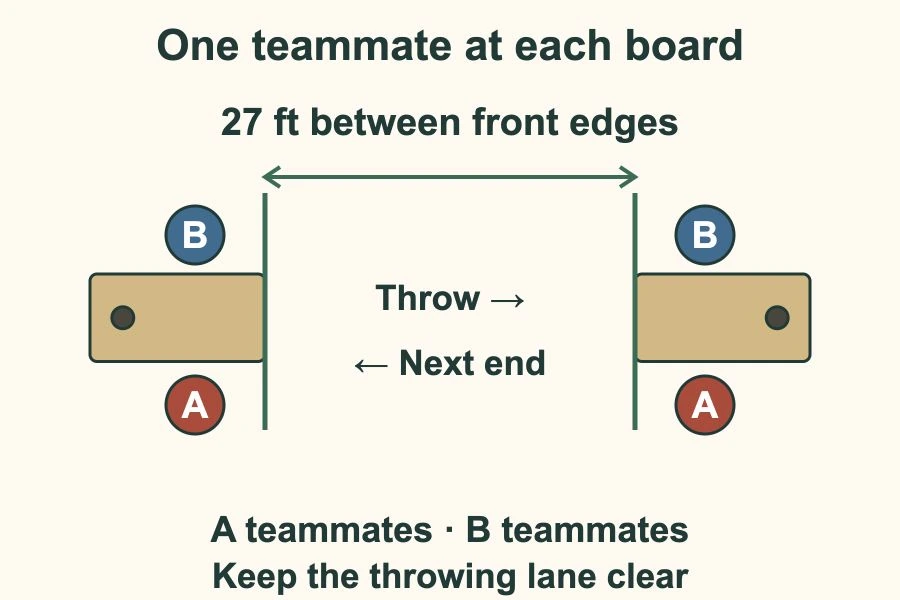
- Put one teammate at each board, with an opponent beside them. Each team has four matching bags. Toss a coin to choose who throws first.
- At one end, opponents alternate underhand throws toward the other board until all eight bags are thrown. Stay behind the front-edge foul line. Do not enter the lane to collect bags while the end is in progress.
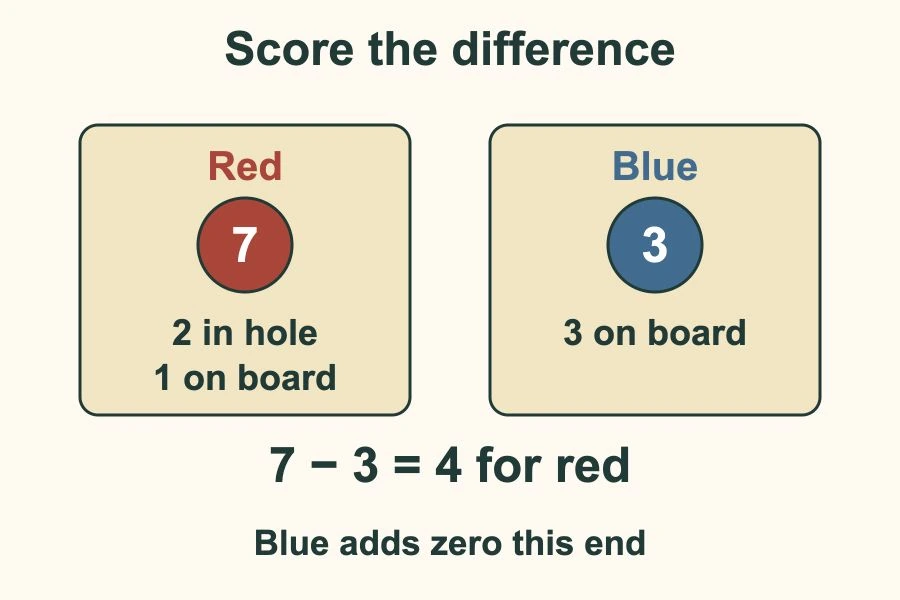
- After the bags stop, count three for each bag through the hole and one for each bag still on the board. A bag that hits the ground before reaching the board, or rests touching the ground, does not count. Subtract the lower total from the higher: 7 against 3 gives the leading team 4 points, not 7.
- The players at the other end throw back. The team that scored throws first; after a tied end, the previous first team keeps that privilege. Finish when a team has at least 21 after a complete end. You do not need exactly 21.
Let new players try a few throws before the game. For a more relaxed session, keep a cooperative total rather than comparing a child’s throws with an experienced player’s. Use the same agreed throwing positions throughout that session and keep spectators outside the lane.
Keep a larger group involved
Rotate whole pairs after a game so the same confident players do not occupy the equipment all afternoon. Write a visible order and keep a seated activity available for people who are waiting or would rather stay nearby. Nobody needs to play every game.
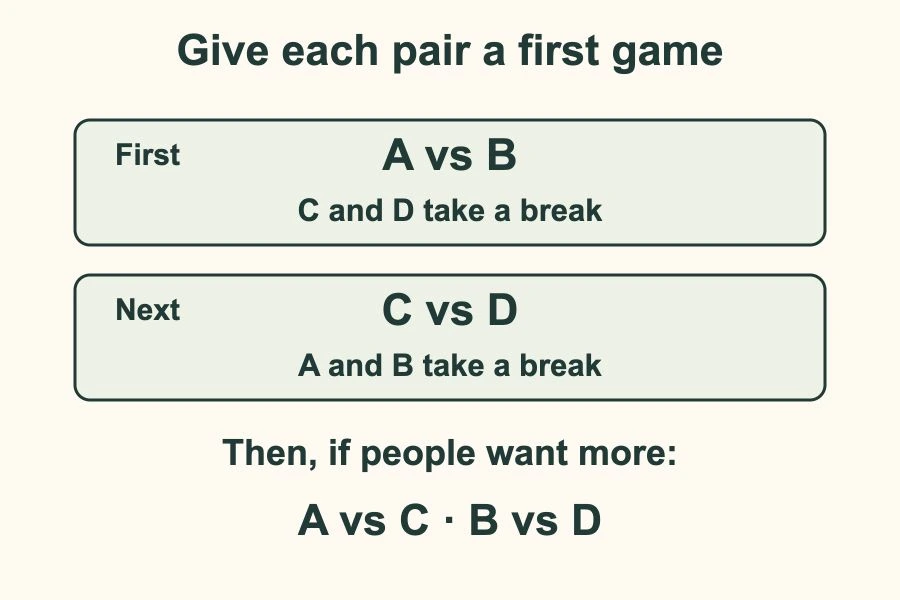
For eight willing players, label four pairs A, B, C and D. Let A play B while C and D choose a seated activity or watch. Next, C plays D while A and B take a break. Then offer A against C and B against D if people want to continue. These are suggested pairings, not a tournament with a promised finishing time.
With an odd number, add a willing scorekeeper for one game and give that person the next playing turn. In the pool or snooker challenges, equal visits matter more than team labels. Compare individual totals or form equal-sized teams, rather than adding an extra player’s points to one side.
Keep the rules you agreed on for the round. If the format is too difficult, finish that round or agree together to restart with a simpler version. Quietly changing a target score or giving extra attempts halfway through makes the result harder to understand.
A simple plan for today
Pick one seated game and one optional activity using equipment that is already ready to play. Would You Rather can start while people are together, then a drawing game or a table-game queue can continue after the dishes are cleared. Read only the chosen entry’s instructions to the group, give a practice turn and let people join without committing to the whole afternoon.
The point of choosing Thanksgiving games for families is to spend time together, so stop while people still want another round. A shared story with no winner can be as useful as a scored match. Leave the more involved games for the guests who want them.