Commercial Pool Tables for Bars: Buy or Use an Operator?
A pool table can give regulars a reason to come in or give guests something to do while they wait. Start by deciding how people will use it and where they can take a shot without blocking service. Then decide whether you want your staff to run it or a route operator to supply and maintain it. Those choices narrow which tables and payment setups are worth pricing.
By Tony P.||17 min readSpeedFree voices come from your browser or device. Choose one and preview the article.
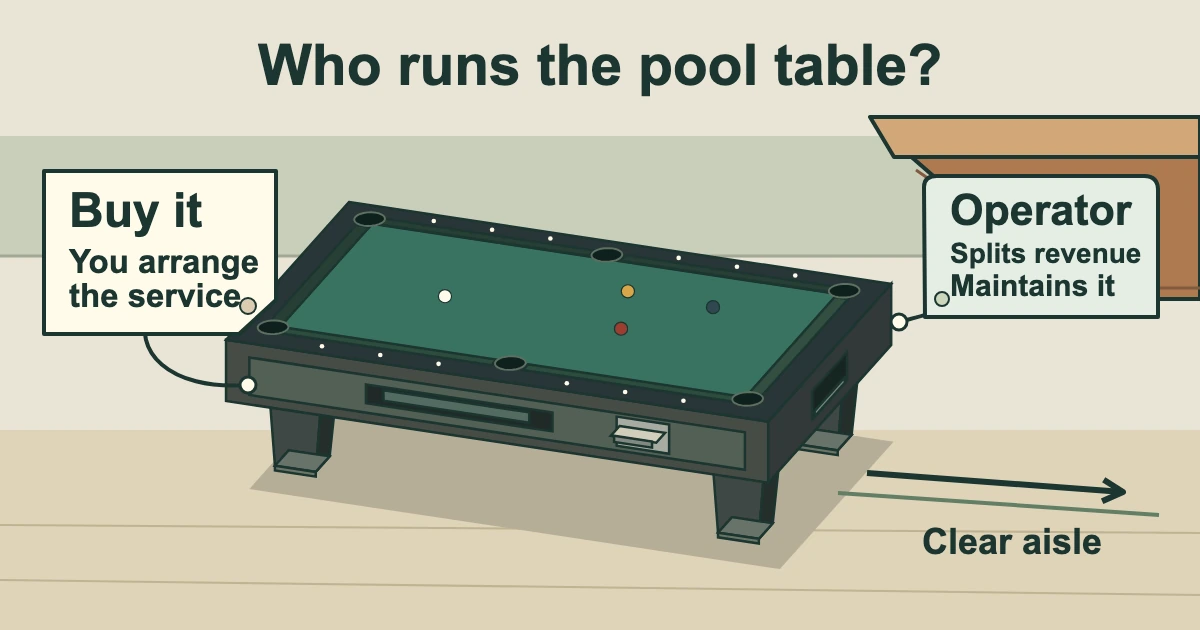
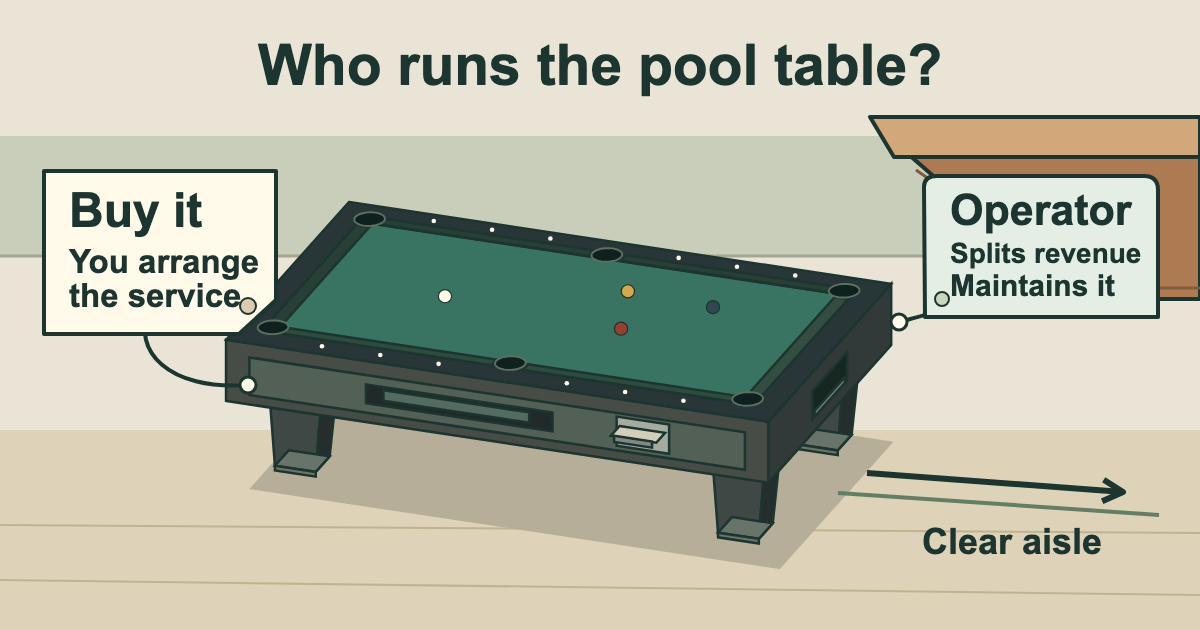
First check whether the table fits a working bar. Then compare who owns it, who gets paid and who puts it back in service. Original illustration.
Quick Summary
Leave room for play and service. Try a full stroke with seating in use, then walk past the table.
Pick how guests start. Confirm which payment or free-play mode works on the exact table.
Compare buying with placement. Ask what buying costs over time and what the bar keeps with an operator. Find out who pays for repairs.
Test a used table as a customer. Pay for a rack, check each pocket and see that the correct cue ball for that model returns.
Can the table fit a working bar?
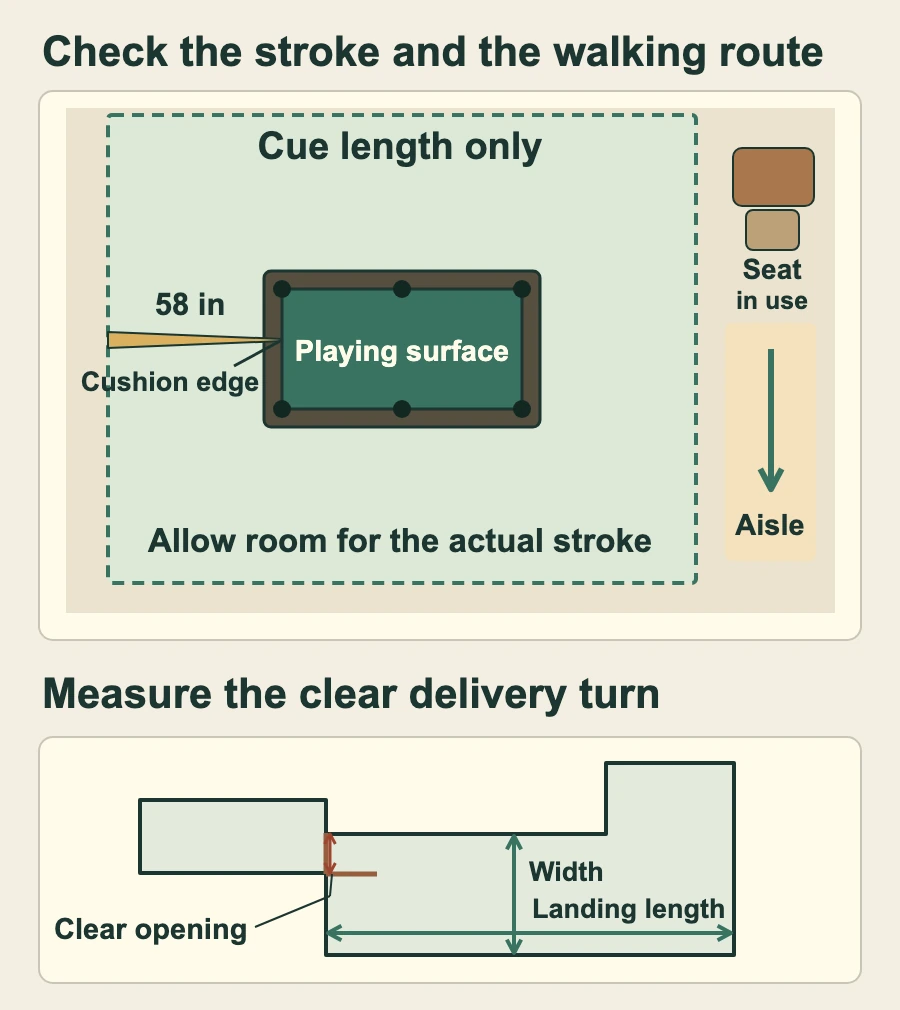
Mark the space for a shot and the space customers will walk through before you choose a commercial pool table. Put the stools and chairs where they sit during service, including the chairs that get pulled out. Tape the table cabinet on the floor, then mark the inside cushion edges. Carry a full-length house cue around the outline and try a normal stroke at the nearest wall, post and chair. Leave room for a player to get behind the cue and for someone else to pass. A clear path on opening day is of little use if a customer sitting at a high top blocks it every Friday.
Ask for the playing surface and the outside cabinet dimensions for the exact model. A Valley 93-inch cabinet example has a 40 × 80 in surface between cushion noses. Add twice the cue length to each playing dimension. With a 58-inch cue, the cue-only rectangle is 13 ft wide by 16 ft 4 in long. In a clear 14 × 18 ft room with this table centered, that leaves six extra inches at each long side and ten at each end. Try the stroke in the room to see whether that is enough. Allow enough room for the player’s stance and backswing before marking an aisle. For other common playing sizes and cue lengths, see the pool table room size chart. Recalculate with the actual dimensions if your model differs from the chart.
Measure the shot from the cushion edge and leave the walking route clear with chairs in use. For delivery, measure the opening past the door leaf and give the installer both dimensions inside the turn.
Use the Game Room Layout Planner to put the cabinet, a bar and the seating on the same floor plan. Mark the space for the open service doors at the table too. Check the actual walkways at the venue with the person responsible for the layout before you commit to the floor plan.
Walk the delivery route with the installer before you order. Ask for the dimensions of the largest piece in the position it will be carried, including its protection and handling equipment. Measure the clear doorway with the door open, the tightest turn and any landing or low obstruction. Get the table's weight and tell the installer where it will sit. If you are unsure what the floor can support, have the building owner or a qualified building professional check it before delivery. The pool table moving guide explains what to record for the crew.
How will guests pay and get the balls back?
Choose how guests will start a game and how staff will help if the table takes a payment without releasing the balls. For a bar charging by the rack, a mechanical push chute can keep coin operation simple. Electronic controls can suit a room that sells time, changes rates by session or uses a compatible cashless reader. Free play lets a lounge offer pool as an amenity without buying a payment system. Decide this before you buy. A coin table that a seller says is set to free play still needs to release the balls in the way your staff expect.
How you run play
What to confirm
Coin per rack
The chute takes the coins you plan to use. After payment, the full set comes out and the chute resets.
Bills, card or phone
Ask exactly which hardware is included, who activates it and how staff issue a refund. Compare the way each payment is recorded and any ongoing fees.
Timed sessions
Ask the dealer to start a timed session and show what happens to play and ball release when time runs out. Confirm who can change the setting.
Free play
Start a game and collect the balls again after a rack without paying. Confirm who can switch to free play if the venue uses both modes.
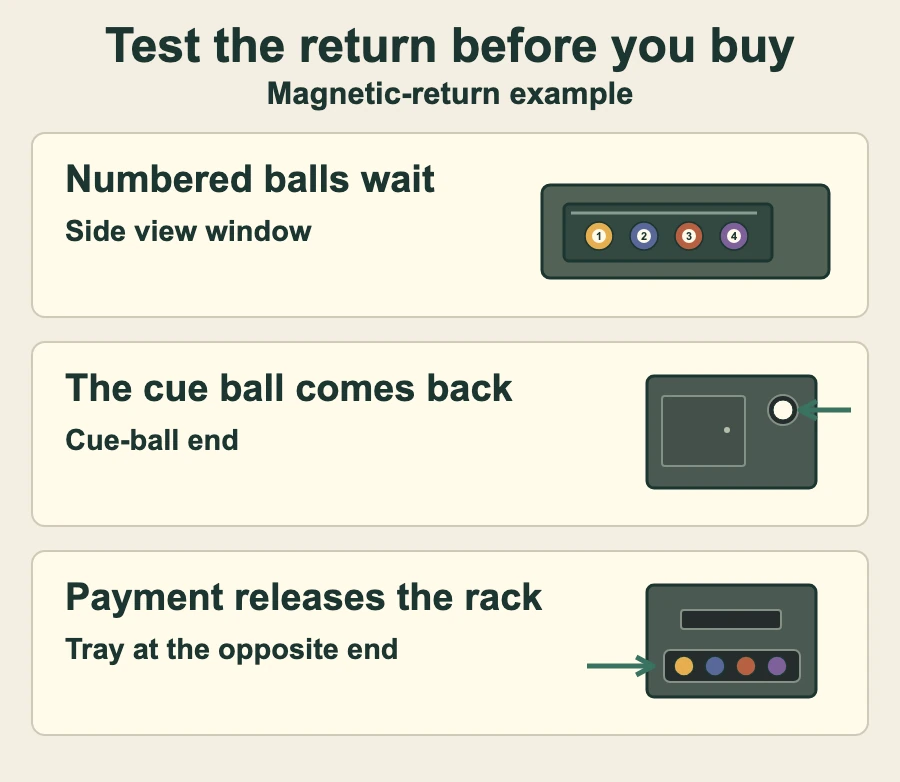
A paid-rack table can hold the numbered balls after they are pocketed and send a scratched cue ball to a separate opening so the current game can continue. In the magnetic example below, a matched cue ball takes a different path from the object balls. The customer can see the stored balls through the side window and pick them up at the collection tray after the next paid release. Confirm how your own table identifies the cue ball before buying replacements. Valley lists a ball set with a magnetic Panther cue ball. Check that your model uses it.
In this Valley example, the cue ball returns at one short end. At the other end, there’s a tray for the numbered balls. The side window shows balls still held inside.
Have the seller or installer run a complete paid-rack test in the mode guests will use. Pay to start, then pocket the numbered balls one at a time. Before you pocket the last numbered ball, scratch with the matching cue ball and check that it comes to its own opening. Make sure the numbered balls are held as designed. Pay again and count every numbered ball in the collection tray. On a magnetic Valley, have a fitter check the cue ball, magnet and holder, and the return rail before replacing parts. The Valley service bulletin shows those checks.
What makes a good bar table?
Look for a sound structure and a return you can service locally. Check how the legs fasten to the cabinet and how the cabinet carries the slate. If the seller can show the frame safely, look for cracked joints, loose fasteners and changes from the original supports. On a used table, ask the fitter to check any movement before judging whether a foot simply needs adjustment. You may be able to live with a scuffed finish. Ask for a separate repair quote if a joint is weak.
The Valley Panther ZD-12 is one mechanical example. It has a laminate exterior, a one-piece slate bed and a coin push chute. The Valley Panther ZD-12X has a bill acceptor and programmable options. Its ZD-X service manual identifies rack pricing, time play, scheduled prices and battery requirements. Ask the dealer to identify any extra reader or service you would need for the payment method you want.
The Great American Eagle coin-operated table is another mechanical example with a one-piece slate and a magnetic cue-ball return. Confirm the options you are ordering, because that model is also offered without coin operation. The Diamond Smart Table uses a different return. Its optical sensor identifies the cue ball and signals the separator. Ask the dealer which ball the model needs and who can service the sensor or payment hardware in your area.
Some commercial tables have a collection tray without a pay gate. A furniture-style home table may have drop pockets or a return. Check the actual parts and how you will use them.
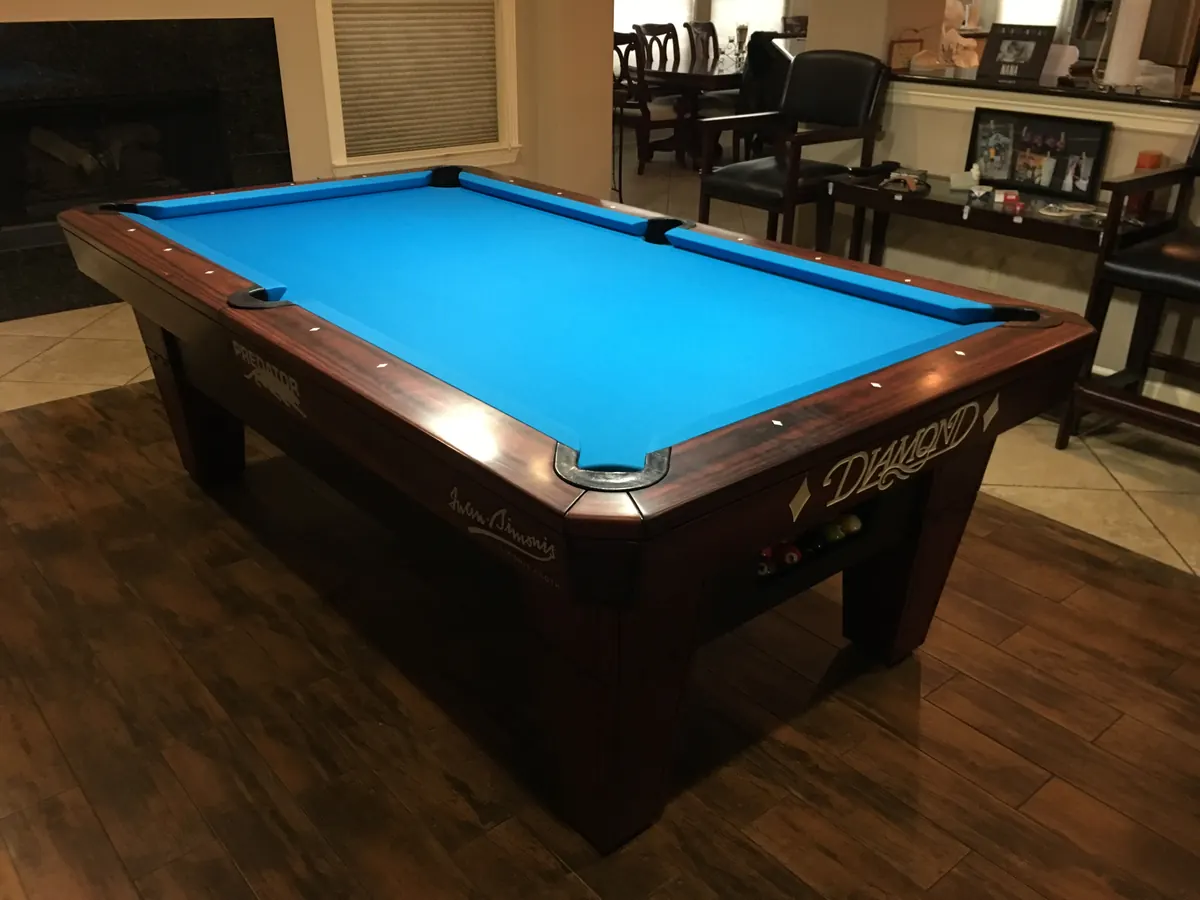
In this close-up from my photo, you can see the balls at the collection opening in the end of the cabinet. Check that guests can reach the tray at your venue. Ask the dealer to show how the return works on the exact table you might buy.
If you want to host an American Poolplayers Association (APA) or Valley National 8-Ball League Association (VNEA) league, ask the local organizer which table sizes, pockets and balls they use. Request a game on the proposed setup if possible. The play you want matters more than a blanket claim that all bar tables play slow or have wide pockets.
What will it cost to put the table into play?
Compare a written price for a playable table in the venue. Game Room Shop listed the following two 7 ft tables with Black Frost cabinets and green cloth on November 24, 2026. Both have a 93-inch cabinet length. The $800 difference compares those two selections at one dealer. It gives you a real starting point for deciding whether the electronic features earn their place.
Table
Listed table price
Main difference
Valley Panther ZD-12
$6,095
Mechanical coin push chute.
Valley Panther ZD-12X
$6,895
Bill acceptor and programmable play settings.
Give each seller your exact size, payment choice and address. Ask for the delivered and set-up total in writing. Have them list who brings the table into place, installs it, levels it and demonstrates the return. Check whether access, an optional reader or other equipment adds to the total. Ask who handles warranty service for a table used in your venue.
A commercial pool table can also carry service costs after opening. Price the consumables and parts separately and ask how long the installer takes to respond when the table is down. If you are comparing a used offer with a new table, include the carry, inspection and parts needed to get both to the same working condition. Our pool table cost guide shows how to build that total without counting a service twice.
Should you buy or use a route operator?
Buy if you want to set the terms and are prepared to arrange repairs, payment collection and replacement. Ask a route operator for a placement agreement if you want the operator to provide and service the table. A route operator supplies equipment to several venues and services it along an established route. Pay attention to what the venue keeps and what work it still has to do.
Meadowbrook Amusements describes a revenue share for qualified venues on Long Island. D&R Star describes providing and maintaining equipment and sharing revenue in its service area in southeastern Minnesota. Get the offer for your address. Compare the split after any deductions, report access, collection schedule, refelt responsibility, response time, notice to end the agreement and who removes the table if it stops working for the venue. Ask whether the operator can change the rate or move the table without your agreement.
Put ownership and placement on the same playing assumptions before comparing them. Suppose you charge $2 per rack and sell 150 racks in a month, or $300 before costs. In this example, an operator offers half of that amount to the venue and handles service. With ownership, you keep the $300 and set aside an assumed $60 for service. Both sides of the example assume the same traffic and no other deductions. The numbers below illustrate the comparison.
Monthly example
Operator placement
Buy the table
Gross play revenue
$300
$300
What the venue keeps after the stated split or service reserve
$150
$240
Extra monthly amount the venue retains by buying
Baseline
$90
If the hypothetical purchase put $6,000 more up front than placement, dividing by that $90 difference gives about 67 months to make up the purchase under the same conditions. Try your own figures for slower months, card fees and days out for repair. If owning leaves the venue with no more per month than placement, there is no payback in this comparison. For a free-play lounge, compare the cost of keeping a table available with what you want the amenity to do. Leave drink sales out of the projection unless you have your own records to support the estimate.
What should you test on a used bar table?
Visit while the commercial pool table is assembled and working if possible. Agree with the seller on a test that includes payment, a scratch and the next rack. Treat a table already taken apart as a different purchase. Get a parts inventory and agree who bears the cost of anything you cannot check until it is installed.
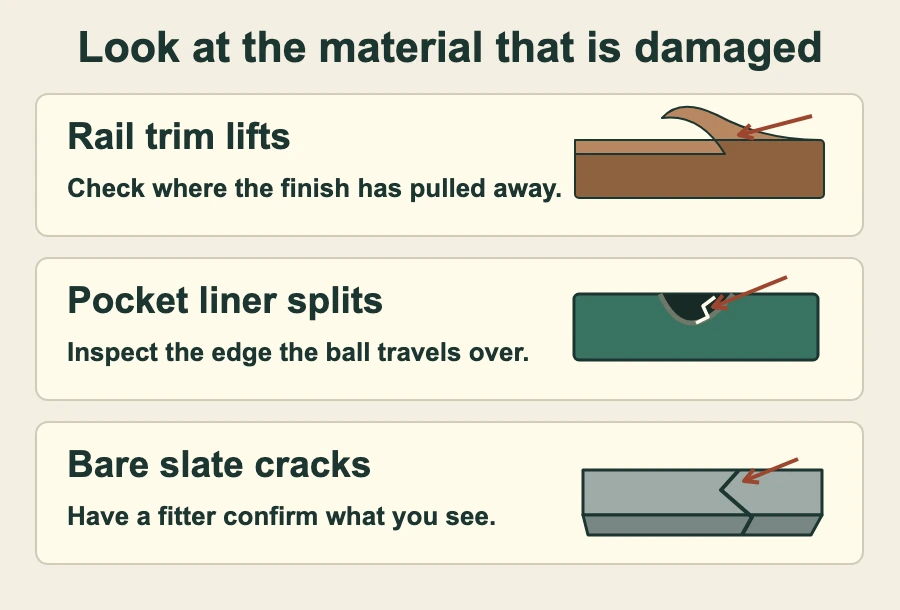
As you look around the cabinet, separate lifted trim and split liners from damage to structural parts. A problem at the slate or a leg joint needs its own inspection before you decide what the table is worth.
Loose trim and a split liner are visible repairs. Verify a suspected crack at the exposed slate or have the fitter inspect it. A mark on cloth can have a different cause.
Identify the exact table. Photograph the serial plate or label and record the cabinet and playing dimensions. Ask for the operating keys, working hardware and the correct cue ball. Confirm parts availability from the model or serial number before putting a value on it. A table can belong to the same brand as a newer one without using the same pocket liners or corner castings.
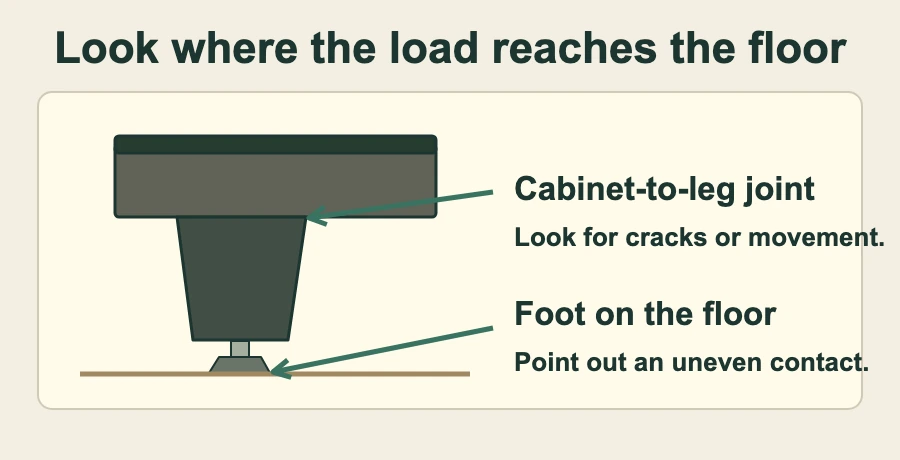
Check the load-bearing parts. Look where the legs meet the body and where feet contact the floor. Ask a fitter to inspect movement or splits at the joint. Check exposed slate where the seller can show it safely. Ask a fitter to inspect a suspected crack or uneven support before you make an offer.
Myth. A line on the cloth over a one-piece slate bed shows a seam.
Reality. One-piece slate has no joints between pieces. Note where you see a line or where a ball drifts so the fitter can check the cause.
Look at both contact points. Show the fitter any movement where the leg meets the cabinet or any gap at a foot.
Check each pocket and the return. Run the full paid-rack test and count every numbered ball after the second payment. During the test, send a ball into each pocket in turn so you can tell which path is affected if one jams. Watch for a broken liner that catches the ball. Confirm that the seller has the service keys and that they will transfer with the table.
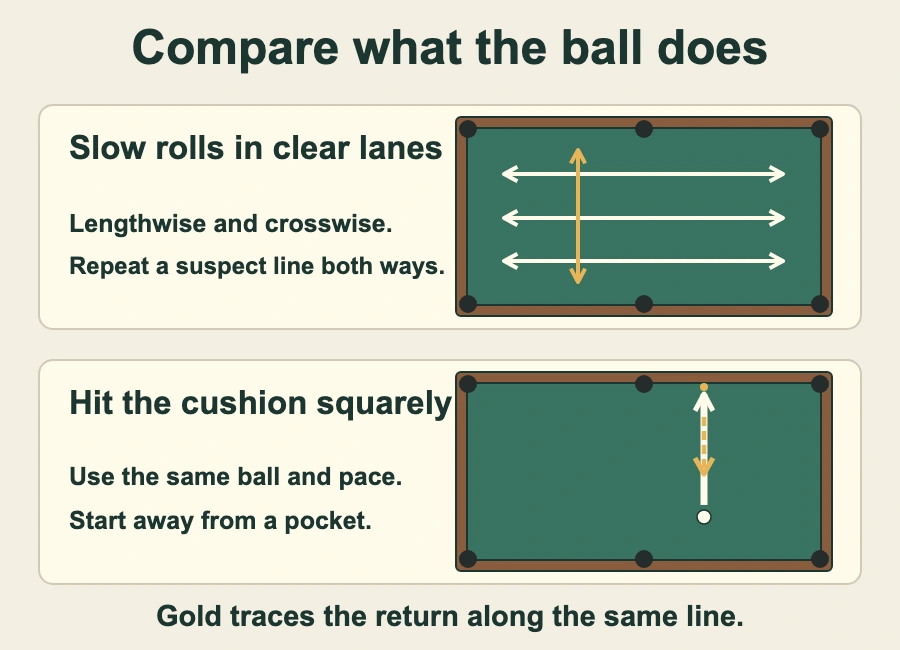
Check the playing surface. Roll a clean ball slowly along several lanes lengthwise and crosswise. Use the same straight approach and pace when you compare cushions. A repeatable drift, hop or weak rebound is something to show the fitter. Get the cost of fixing the cause separately from cosmetic work.
Roll in both directions along a suspect lane. Compare rebounds by sending the same ball straight into matching cushion sections away from the pockets. The gold arrow shows the return along the approach line.
Use the used pool table buying guide for a fuller look at condition and what to ask before paying.
How do you keep a bar table playable?
Give staff a short opening check and a clear way to take a table out of play when something breaks. Keep drinks off the rails and make sure the ball outlet and cabinet doors are easy to reach. A spill, split liner or failed return is easier to show to a technician when the staff can say which pocket, tray or part of the cloth they saw it on.
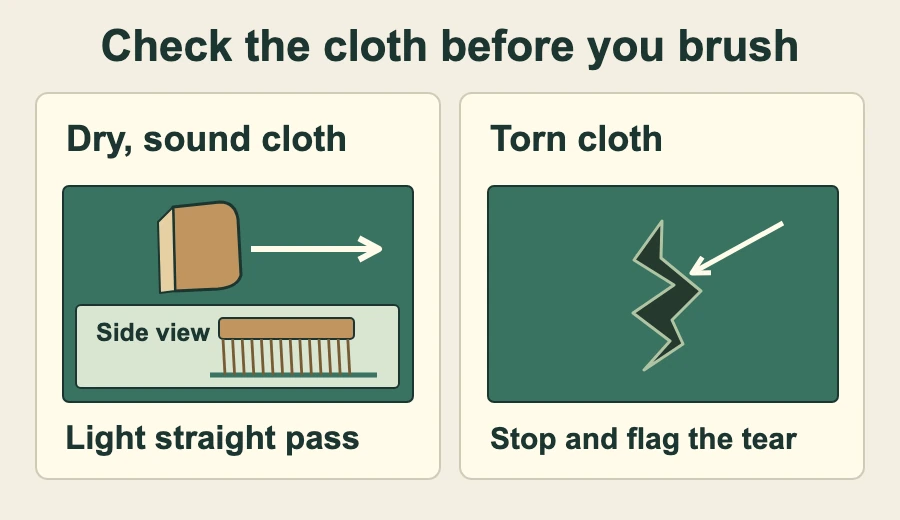
Look at the cloth before cleaning. Check for liquid, tears and loose edges before making any passes across the bed. Follow the maker's cleaning instructions for the actual cloth, including which table brush or cleaning tool it permits. Simonis publishes its own cloth-care options. Check the felt types guide when you want to compare the play and care of the replacement options. Put the cloth maker and product on the service ticket.If that cloth permits brushing, use light straight passes on the dry playing surface. Stop at a tear or lifted edge and show the installer where it is.
Test the start and ball release. Before service, have staff start a rack using the venue’s approved test procedure. Count the numbered balls in the tray. Keep the correct cue ball with the table and check the house cue tips. Store the triangle rack and chalk where guests can reach them without crossing a player's stroke. If the table takes a payment without releasing the balls, record the time, payment method and amount for whoever handles refunds. For a jammed ball, record which ball it was and where it stopped or failed to come out. Take the table out of paid play and call the service contact.
Schedule service by condition. Take an unstable cabinet out of play until a fitter checks it. Ask for a repair if cloth tears or a cushion consistently rebounds weakly. A mark by itself may leave play unaffected. Use the table maintenance schedule to set checks around your own use, and write down what changed before calling for help.
What should you check before opening?
Watch the installer or operator run the table in the actual room before you accept the handover. Use the stroke and walking route checks with the furniture in its working position. Ask for slow rolls and a ball through each pocket. Have staff start play in the mode guests will use. For paid racks, watch the scratch return and count the numbered balls after the next payment. Try free or timed play if staff are expected to switch to it.
Write down the model, which keys go with it, what the rate includes, who can change settings and which service contact to call if the table fails. Make sure staff know who can restart a failed game or issue a refund. List any fault the crew still has to fix and agree who will return. Have staff start a game and collect the balls themselves before you sign off.
Common Questions
Two new 7 ft Valley examples at Game Room Shop were $6,095 for the mechanical ZD-12 and $6,895 for the electronic ZD-12X, both in Black Frost with green cloth when checked November 24, 2026. Get an installed quote for the exact size and payment setup. Check who carries the table into the room, which options are included and who levels it before play.
Choose a playing size suited to the games people will play, with enough space for a normal stroke and a clear aisle. Check with the organizer if you host leagues. On a Valley 93-inch cabinet with a 40 × 80 in playing surface, a 58-inch cue needs a starting rectangle of 13 ft by 16 ft 4 in. Leave extra stroke room and test with the chairs pulled out.
A bar can ask a local route operator to place and maintain a table under a revenue-share agreement. Compare the contract with buying the same type of table yourself. Ask which payments count toward the split, who can see the meter, which repairs are included and how long you wait for service. Check who removes the table at the end of the agreement.
Some coin-operated tables can be set to free play, but the setting or hardware depends on the model. Have the seller show the relevant controls and let staff start a game and collect the balls without payment before you accept the table. If the venue will switch between paid and free sessions, ask who has access to the setting and when the table changes mode.
A paid-rack table can separate the cue ball from the numbered balls so play can continue after a scratch. A magnetic return needs the matching cue ball. Some tables, including the Diamond Smart Table, use optical detection instead. If the cue ball stops returning, tell the technician which pocket it went into. The technician can check the ball type and the return path.
Test the table assembled if possible. Check the leg joints, exposed slate and playing surface. On a paid-rack table, pay to start and pocket all the numbered balls, using every pocket. Scratch with the correct cue ball before the last numbered ball drops and check its outlet. Pay again and count the numbered balls in their tray. Get the keys, model identification and a quote for any repairs.
Have the cloth checked when damage affects play or the cloth cannot be kept tight and serviceable. A visible tear, a loose edge or a repeatable problem when the ball crosses a spot is worth showing a technician. The cause could be the cloth or another part of the table. Train staff to check the surface before play and clean it by the cloth maker's method.
About Tony P. I install, repair and move pool tables. I’ve worked with game tables since 2016. By my count, I’ve worked on more than 8,000 tables, about 90% of them pool tables. See my work gallery.
Gemini and Copilot copy the article for you to paste into the chat. The other shortcuts send its link. If a service cannot read the link, use the article text below.
Optional cookies help us improve Billiard Crown. Google Analytics measures visits; Microsoft Clarity replays clicks and scrolling. Google and Microsoft receive usage data. Privacy details. Change your choice in the footer.