Which Pocket Do You Aim For?
In bumper pool, each side starts with five balls and scores in the pocket across the table. The game uses a two-pocket bumper pool table with fixed rebound posts. The cups face each other at opposite ends. You strike your own balls directly with a pool cue. One player owns the white set.
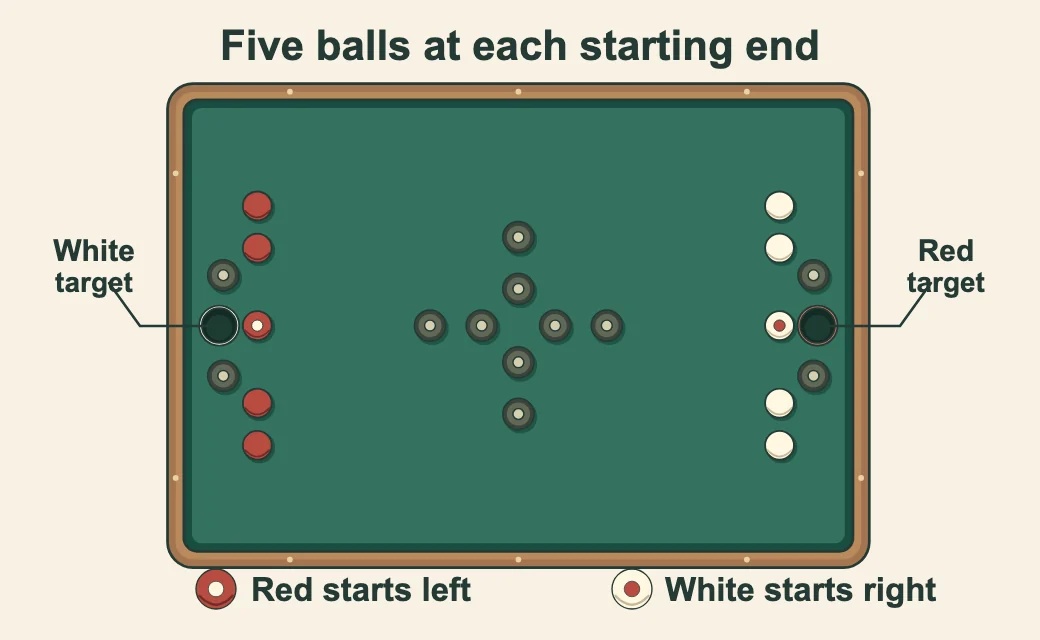
In a red-and-white set, the red side shoots toward the red target and the white side shoots toward the white target when the table marks the cups that way. Each player’s starting cup is the near cup beside their five balls. Their target cup is the far cup, the one in which their own balls score. The two labels remain useful even if the table has no color on the cups.
The walkthrough starts with the published table rules from Darting.com. It states the extra tie and restoration choices below so two players can use the same procedure. When a club has its own written rules, agree on which version governs before anyone plays.
Set the Five Balls at Each End
At each end, put the marked ball in front of the near cup. Put the other four beside it, two on each side, using the location marks on your table if it has them. The same arrangement faces back at you from the opposite end. The dot keeps the first scoring ball recognizable. Use a matched bumper pool ball set with that mark on one ball of each color.
Two people can play head-to-head, or four can play as two sides sharing the same ten balls. For doubles, choose one opener per side and alternate teammates when that side gets a new turn. Let the same teammate finish a scoring run. That is the doubles agreement used here. Check how a club rotates players if you join an existing game.
Use a cue you can draw back comfortably at both ends. Check the ball diameter before replacing a set. The Freetime Fun rules sheet specifies 2⅛-inch balls for its setup. Match the maker’s instructions for your table instead of assuming every set is the same size.
How the Simultaneous Start Works
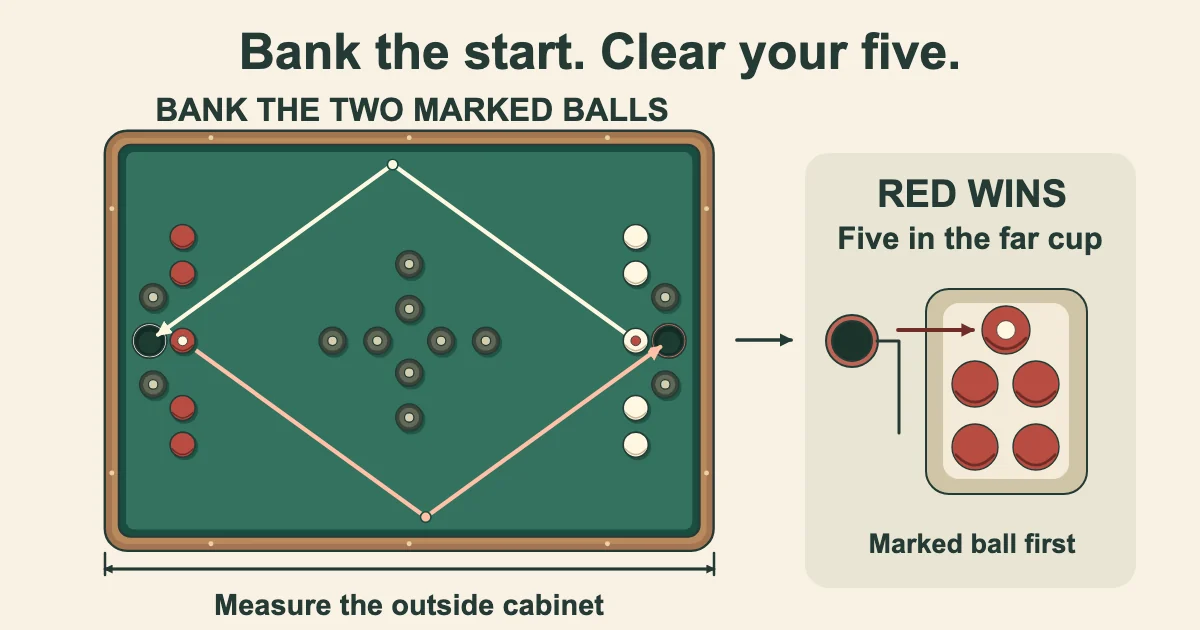
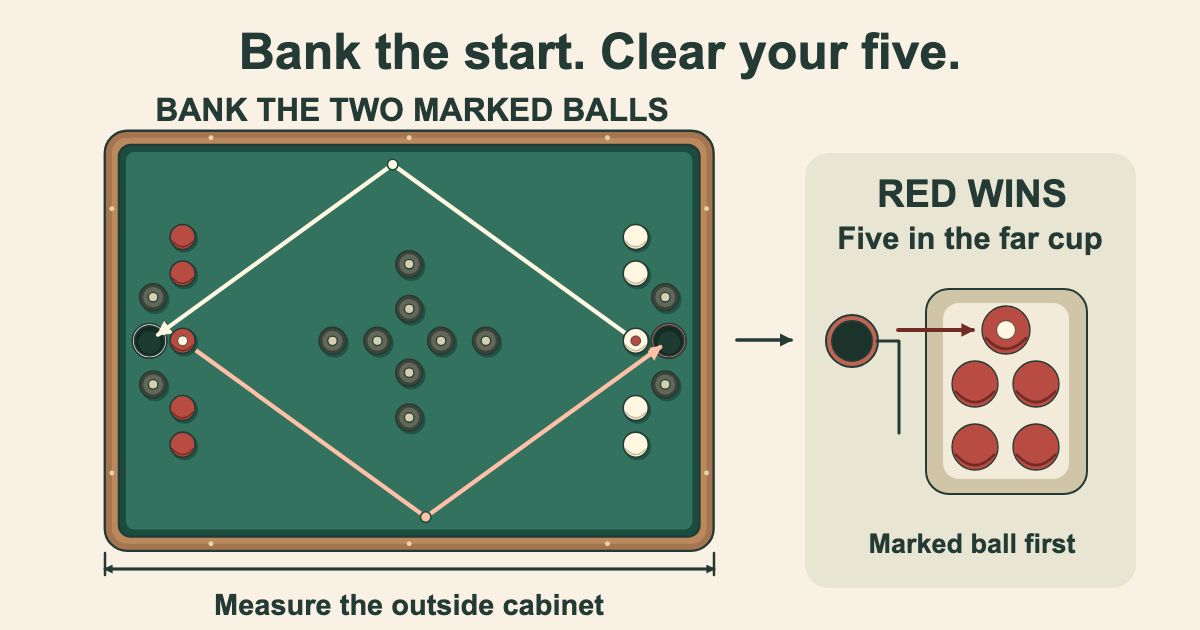
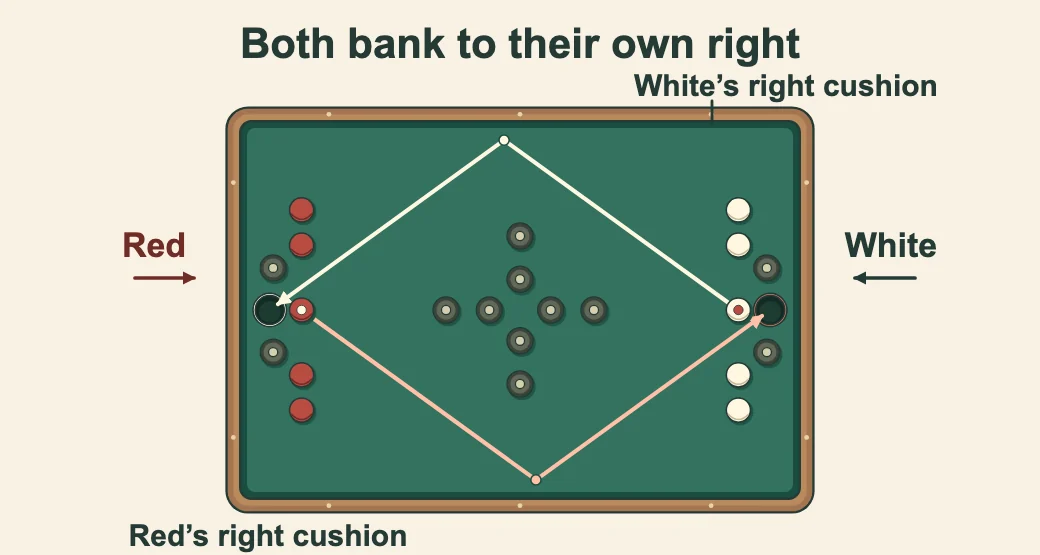
Both players bank their marked ball off the cushion to their own right at the same time. You stand at opposite ends. The cushion to your right is the other player’s left. Agree on a count so neither ball starts early. Aim at the cushion before the ball reaches the far cup.
- Wait for both balls to settle. If only one ball falls in its target on a legal opening shot, that player continues. If neither drops and both shots were legal, measure from the edge of each ball to the nearest rim of its own target. The closer one earns the turn. A marked ball still on the table has to score before any plain ball.
- Pick a replay ball if both go in. The Darting rules call for a second opening with the ball to the left of the hole. Keep both scores. Stand at your starting end and choose the nearest plain ball to the left of your starting cup. If both replay balls go in, do it again with the other plain ball on the left, then with the two on the right, nearest first. Use the same right-cushion bank and check for one score or the closer leave each time.
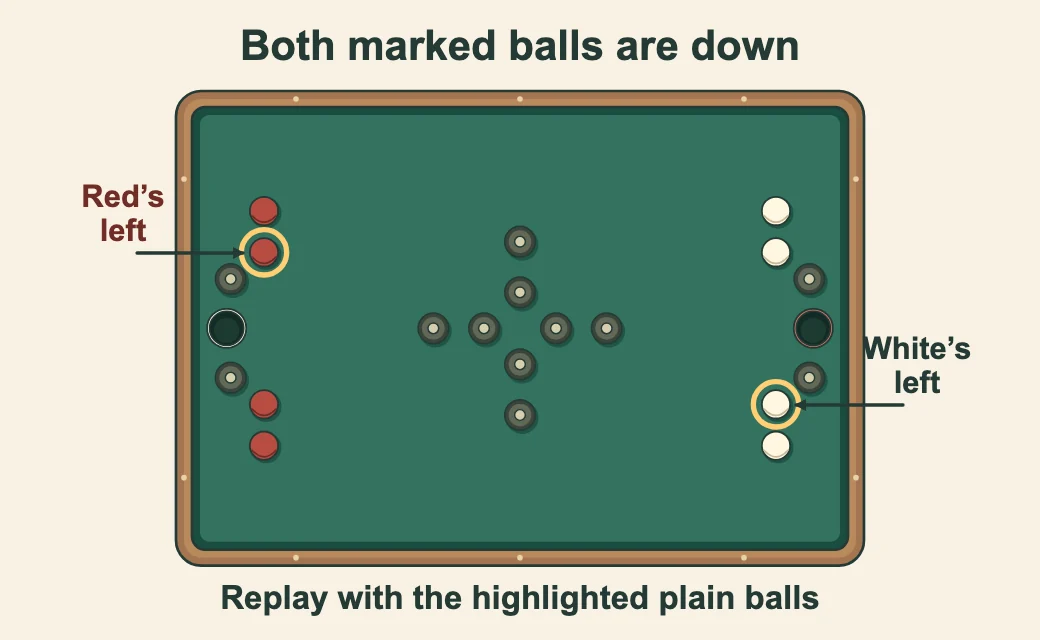
For the first replay, stand at your own starting end and use the highlighted ball. Red and white look at the table from opposite directions. - Replay an equal distance. If both shots are legal, neither ball drops and they finish equally far from their targets, return only the two balls shot that round to their pre-shot spots. Keep any earlier scores. If both sides clear together in simultaneous replays, start a fresh deciding game.
Settle fouls before awarding the first turn. If one player misses their right cushion, return their shot ball to where it started that round. If a player fouls in another way, use the foul table below. In this guide, the player who shot legally takes the turn. If both foul, put the balls back as they were at the start of that round and replay it. Keep scores from earlier rounds. A last ball in the wrong cup still ends play.
Play the Marked Ball First
Keep playing your marked ball until it falls in your target cup. After it scores, you can play any of your other balls in any order. A legal score of one of your own balls lets you shoot again. A legal miss or a shot that only scores for the other side ends your turn.
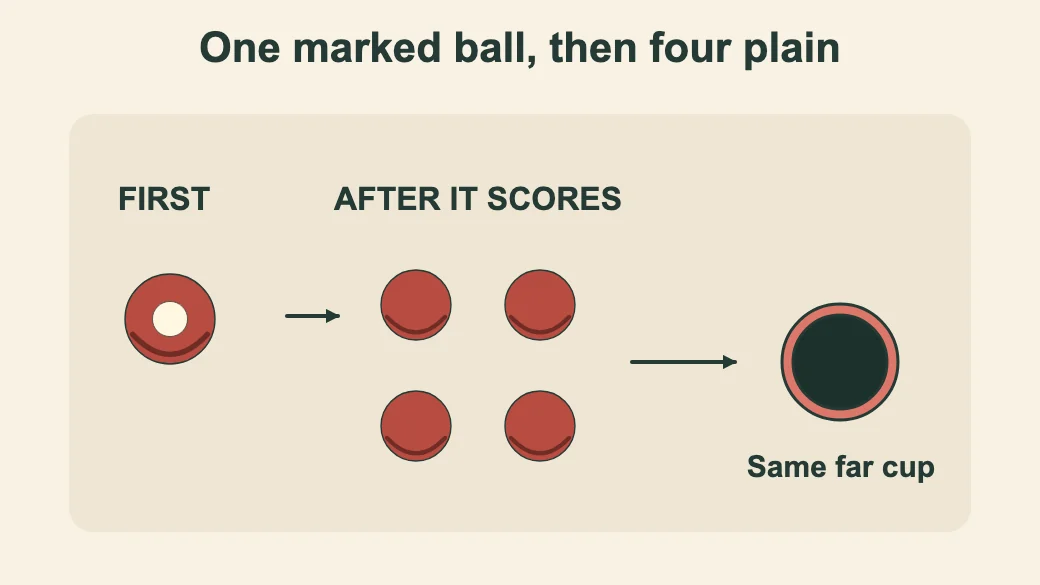
Start the shot with your marked ball until it scores. Under this guide’s agreement, if your marked ball and a plain ball drop into your target on the same shot, count the mark and put the plain ball back where it started. You can then shoot a plain ball. If the mark stayed up, use the plain-ball penalty in the foul table.
To move an opponent’s ball away from their cup, hit your own ball with the cue and send it into theirs. If their marked ball goes into their target, give them the score. A plain ball scores for them if their mark was already down at the start of the shot. If you make one of their plain balls too soon, return it to its previous spot.
Check the result before shooting again after a mixed shot. Suppose Red has two balls left and makes one, but the shot also sends White’s final ball into White’s target. White wins because one red ball is still up. If both sides clear on a single legal shot, use the same deciding-game agreement as at the simultaneous start.
What to Do After a Foul
Handle the ball that moved or fell before putting away any penalty balls. Use the table below as the agreement for this guide. The center-return rules come from the Darting sheet. The jump penalty and the return of a wrong-pocket ball are also stated in Freetime Fun’s technical rules. Some local games use different placement or bonus rules.
On a normal turn, a foul cancels any scores from that shot. Return the balls that fell before applying the penalty. If your last ball fell in the near cup, the game ends there.
| What happened | Restore the layout or apply the penalty |
|---|---|
| You strike a plain ball before your marked ball scores. | Restore the disturbed balls to where they were, including the one you struck. Pass the turn. |
| One of your plain balls falls in your target while your marked ball stays up. | Return that plain ball to its earlier position. The opponent may hand-pocket two of their own balls in their target. Pass the turn. |
| Your shot knocks your own ball off. | Place the escaped ball in the middle of the center bumpers. The opponent shoots next. |
| Your shot knocks an opponent’s ball off. | Put it back where it was. Move one of your own balls to the middle of the center bumpers. The opponent shoots next. |
| You attempt to jump your ball over a post or another ball. | The opponent sets the ball you tried to jump in an open spot on the bed and may hand-pocket two of their own balls in their target. Pass the turn. |
| You strike the opponent’s ball directly with the cue. | Restore the disturbed layout and let the opponent hand-pocket two of their own balls. Pass the turn. |
| One of your balls other than your last drops in the near cup. | Return it to its earlier position. The opponent may hand-pocket two of their own balls. Pass the turn. |
| You started the shot with one ball left and it drops in the near cup. | You lose immediately. |
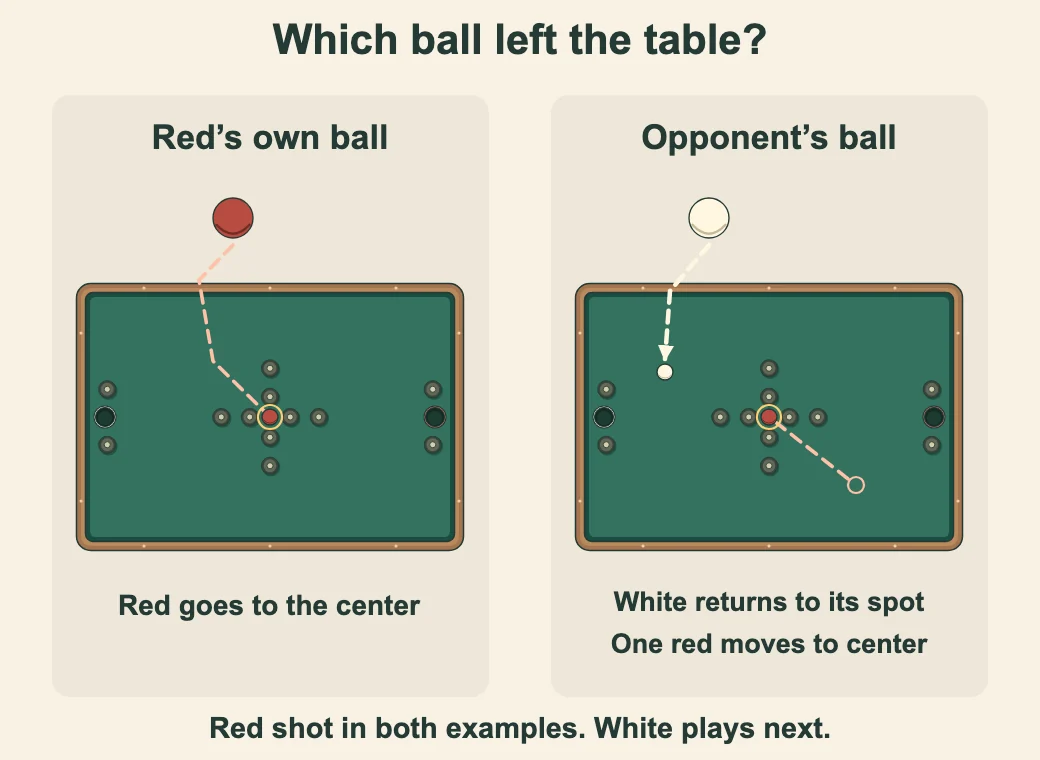
When both colors leave the table on one shot, restore the other side’s balls first. Use one of your off-table balls for the center move and put any other off-table balls back where they were. If the center between the posts is occupied, the incoming player puts the returned ball in the nearest open place where it touches neither a ball nor a bumper.
For a hand-pocket penalty, the other side picks up to two of their own remaining balls. They take the marked ball first if it is still up. If a shot triggers several penalties, restore or place the balls before taking the hand-pocket bonus. Take that bonus only once per shot. The other side shoots next unless their scores already won the game.
Finish With All Five in the Far Cup
Win by getting all five balls of your color into the cup across from your start. The marked ball needs to score first. Keep scored balls together or keep a tally for each player if the returns mix. Before you take the last shot, look at the intended cup and confirm which of your balls you’ll strike.
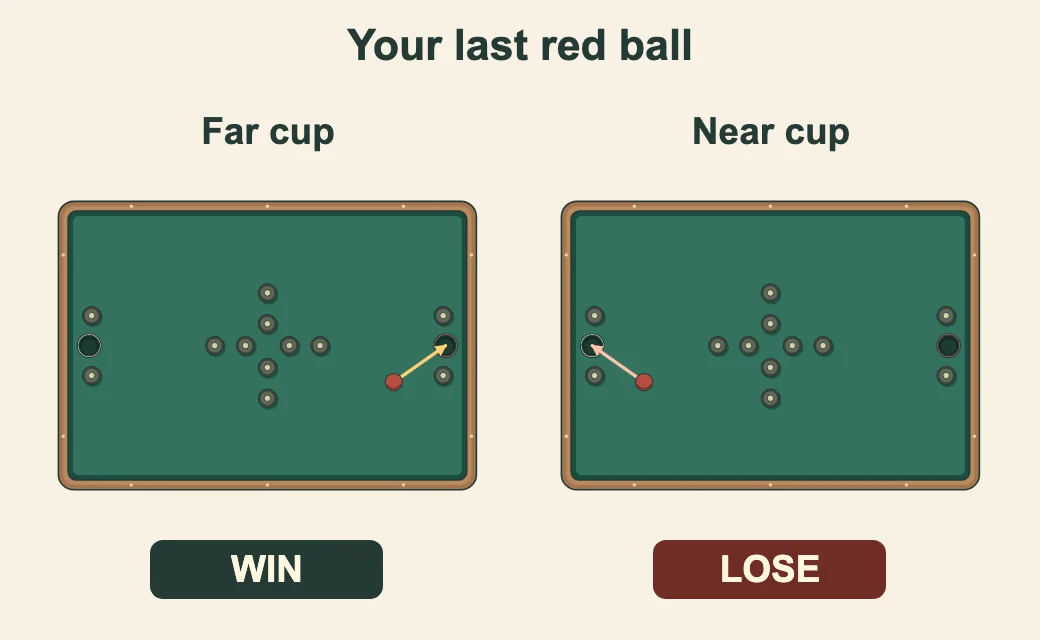
If your last ball is close to the near cup, look at moves sideways or away from the opening. When you try a bank from there, trace the whole path before committing. A ball you send into the near cup cannot be saved by the fact that you had four good scores.
Use a Rail or Leave a Block
Choose a path that helps even if you miss the cup. A controlled bank can put your ball close to its target. When the direct route is blocked, a shot off a side cushion can come at it from farther along the table.
- Look at the posts near the cup. Two bumpers may guard the opening. Trace a path with room for the whole ball. Leave more than half a ball’s width between the center of the path and the edge of the post.
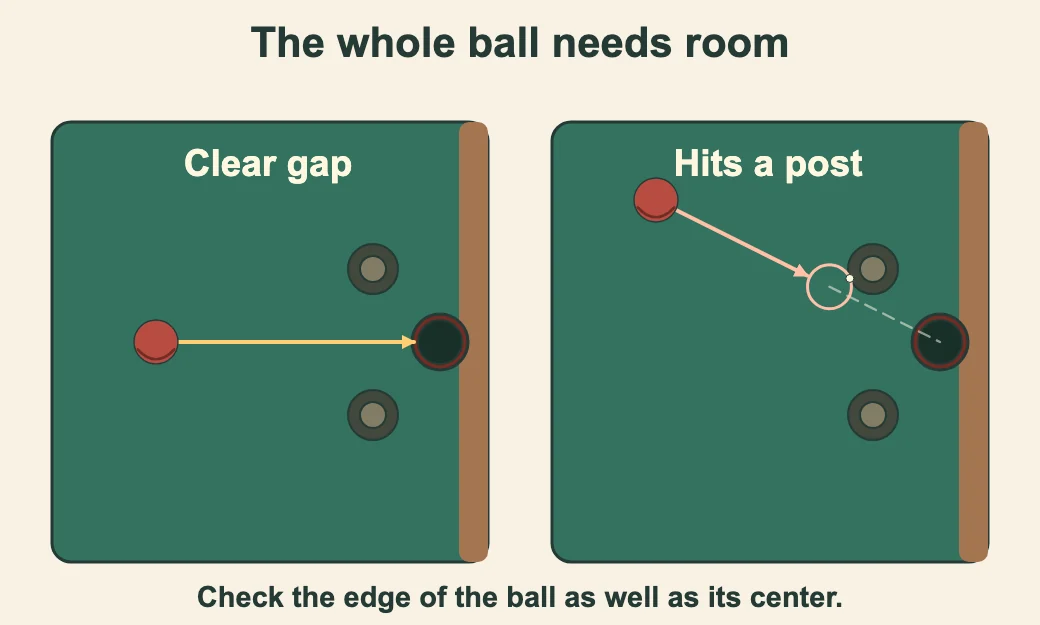
Look at the whole ball and the gap. A drawn line can fit through even when a real ball would strike the post. - Use a legal defensive contact. If your opponent has a simple pot, roll one of your balls into theirs at an angle that moves their ball away from the mouth. Avoid leaving the ball even closer.
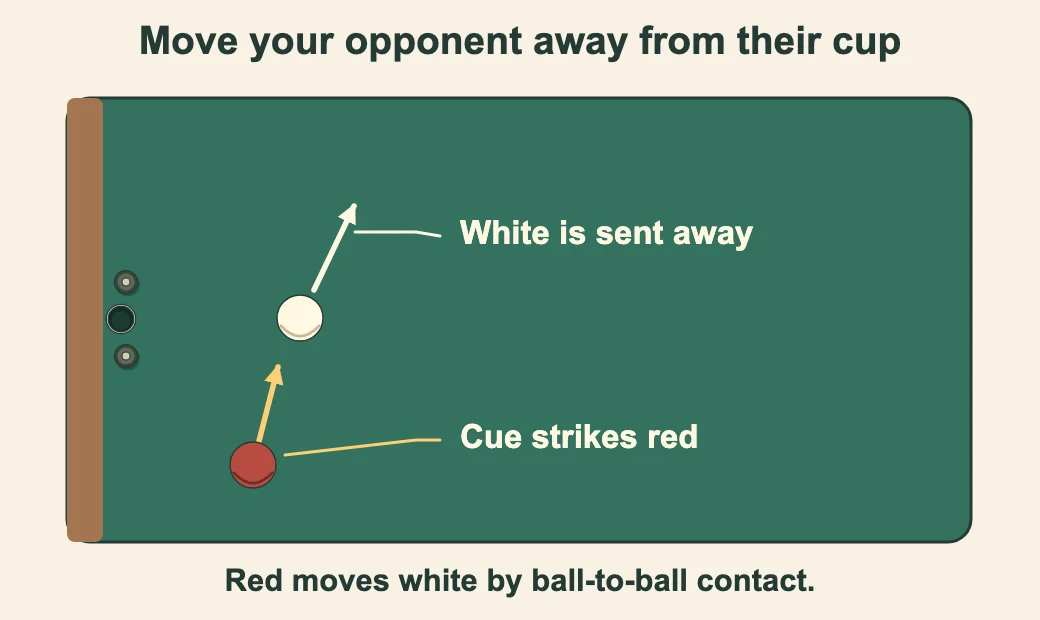
Red is the ball you strike with the cue. The angle of contact sends white away from its target cup. - Use speed you can repeat. Try a side-rail bank from the same place more than once. Compare where the ball stops when you change pace, then choose a speed that gives a useful miss. Post positions and rebound can differ among tables.
Like One-Pocket, bumper pool makes your scoring end and the position you leave matter. The geometry is different. In One-Pocket both corners sit on the same short rail and everyone uses the white cue ball. In bumper pool the cups face each other, and the cue tip acts directly on your own scoring ball.
When the Printed Rules Disagree
Settle the simultaneous start and off-table penalties before playing on a new table. The same game name can cover different answers. A copy of the house rules beside the table keeps one person from remembering a rebound rule and the other person from remembering a different penalty.
| Decision | Agreement used here | Another published version |
|---|---|---|
| Both marked balls go in on the opening | Keep the scores and replay with paired plain balls next to each starting cup. | Freetime Fun’s opening instructions give the turn to the player whose ball stopped first. Its later technical rules also give the left-ball replay option. Choose one before playing. |
| A ball leaves the table | Apply the separate own-ball and opponent-ball return rules. | Freetime Fun’s opening overview allows free placement and two hand-potted balls. Its detailed rules send your ball to the center. If you knocked the other player’s ball off, it goes back to where it was and one of yours goes to the center. |
| You knock a ball of the other color into its own target | Credit any eligible ball to that player and pass unless you also legally scored. | Ricochet’s venue rules let the shooter continue after making a ball of either color. |
| An earlier ball falls in the wrong cup | Return the ball that fell, then let the opponent take the hand-pocket penalty. | The Escalade G02251AW manual leaves the earlier ball down and also awards the opponent two balls. Under both versions, putting your last ball in the wrong cup loses. |
Check the Table Before You Buy
Compare the actual cabinet dimensions, the playing surface, the cue space and access to service parts. A rectangle and an octagon of similar advertised width can leave different aisles. Measure the outside of the cabinet, then try the stroke you’ll make around a wall, a chair or a post. The smaller playing area in a product specification does not give you the outside footprint.
Compare the same measurements on each table. The Legacy Ella lists a 45-by-30-inch cloth-covered MDF playing area and a 54-by-39-inch cabinet. The Great American BP commercial table lists a 44¾-by-28¾-inch playing area, a 48-by-32-inch sheet of ¾-inch slate, and a 57½-by-41½-inch cabinet. The Great American example has the smaller playing area but takes up more floor space.
Ask the seller for the actual cabinet measurements and the size of the largest piece or carton they’ll deliver. Check that piece against doors, stairs and tight turns. For the differences in weight, service and support, see the slate and non-slate comparison.
Sketch the outside footprint in the Game Room Layout Planner. Use Shapes → Rectangle and drag to the cabinet dimensions. For an octagon, draw a rectangle around the widest points. Then check the actual tightest stroke in the room with the cue you expect to use. Mark doors and furniture that can affect a corner stance. Leave more room where you need to draw the cue back.
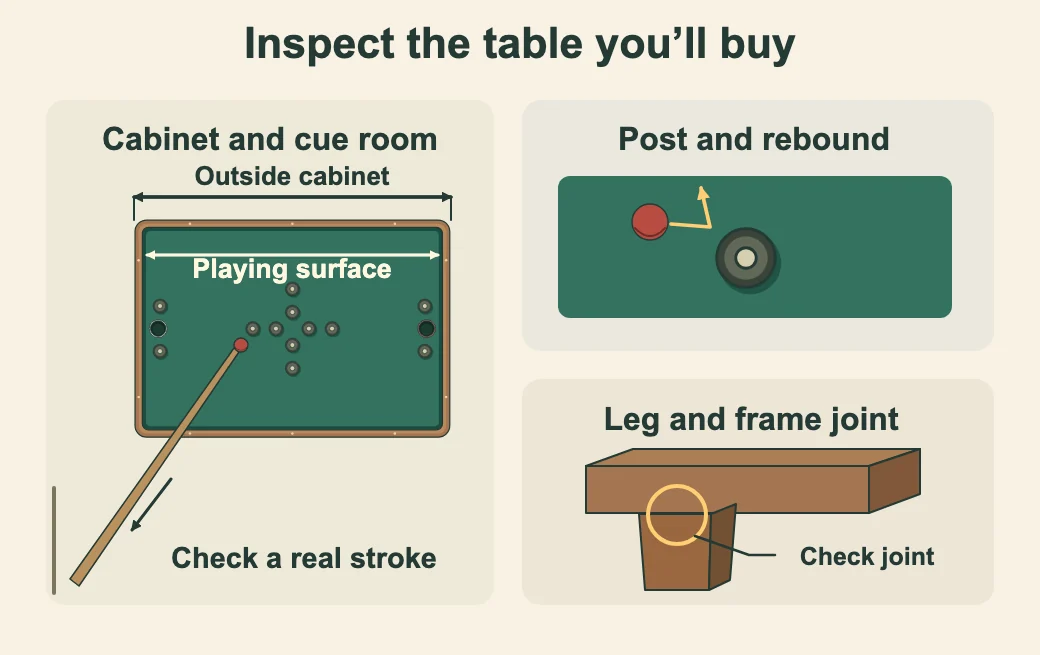
- Check the legs and frame. Look where the legs join the frame and where the frame supports the bed. Look for cracks, movement at the joints, stripped hardware and an unstable base. A decorative cabinet can hide loose legs. Use the maker’s transport and leveling instructions before committing to a used table.
- Check matching posts and rebound. Look for missing or loose bumpers and cushions pulling away. Roll the same ball into two matching posts from the same angle and at about the same speed. Compare how each one rebounds. Do the same for the cushions. If you find a problem, identify the model before looking for parts. The Valley parts notes describe fit differences among older and current tables.
- Watch the return and look for bed damage. Roll a ball into each cup and make sure it can be recovered. Look for visible damage around the opening and surface. A slow roll can reveal drift, but a single pass does not establish whether a bed, support or level adjustment is causing it.
Choose this game if you want the two-cup and obstacle challenge and have a clear place to cue around it. If your main goal is learning 8-ball, measure for a conventional six-pocket table and the cue clearance it needs. The games share angles and speed control, but they ask you to aim and score in different ways.