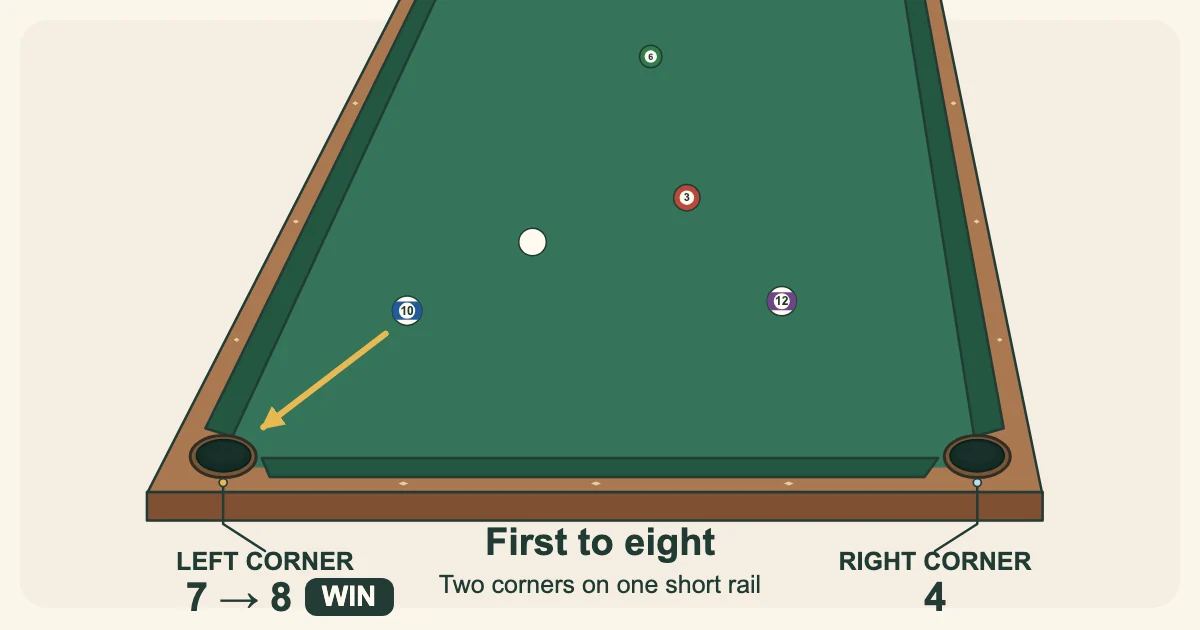
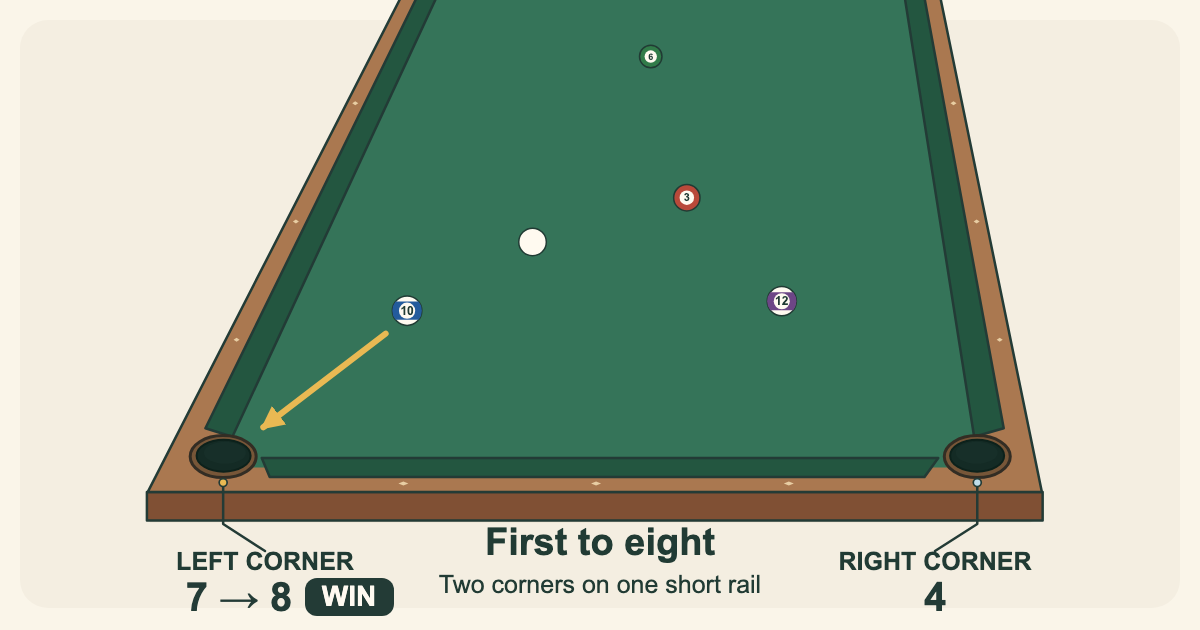
Choose the Two Scoring Pockets
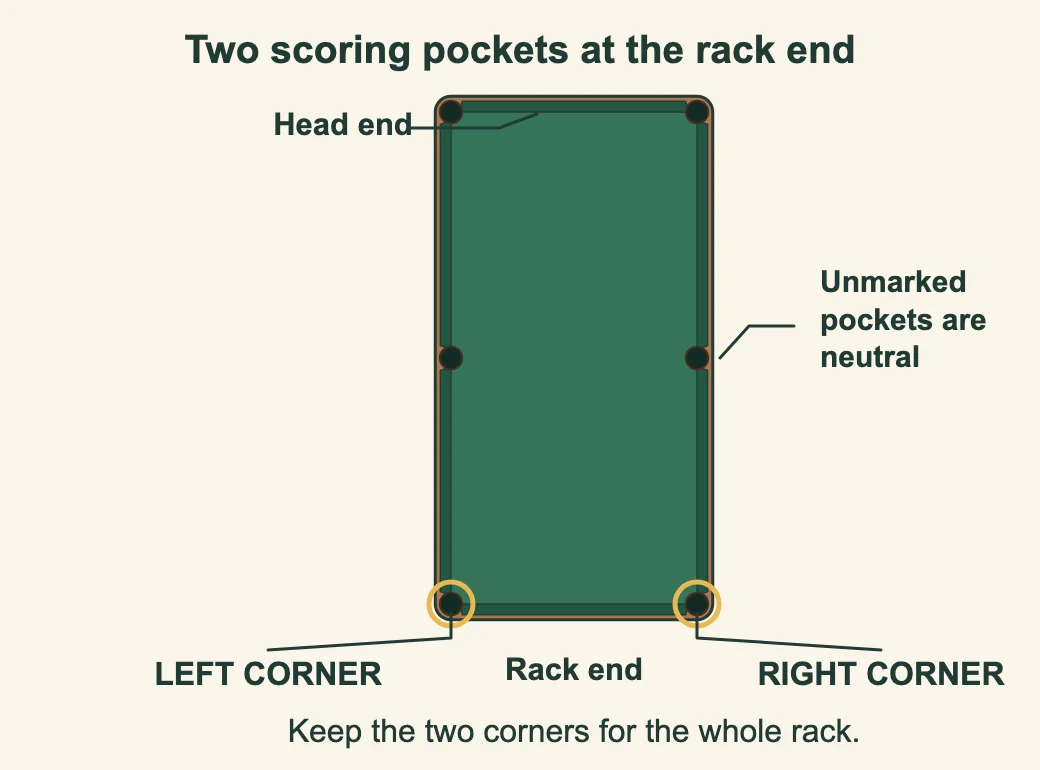
One-Pocket is a two-player pool game in which each player scores in one assigned corner. Both scoring pockets are beside the end where you rack the balls. Point to the breaker’s corner before the break. The corner at the other end of that same short cushion belongs to the opponent. Keep those assignments for the rack, even when you walk to the other side of the table.
A ball in either of those corners can earn a point for the player who owns that corner. The ball number has no bearing on the score, and the standard target is eight. The other four pockets are neutral. A ball that falls into one of them will come back onto the table. The white cue ball never scores.
The procedure here follows the World Pool-Billiards Association rules for One-Pocket. A pool room or tournament may announce different break or foul rules. When that happens, settle which rules you’re using before you rack.
How to Rack and Break
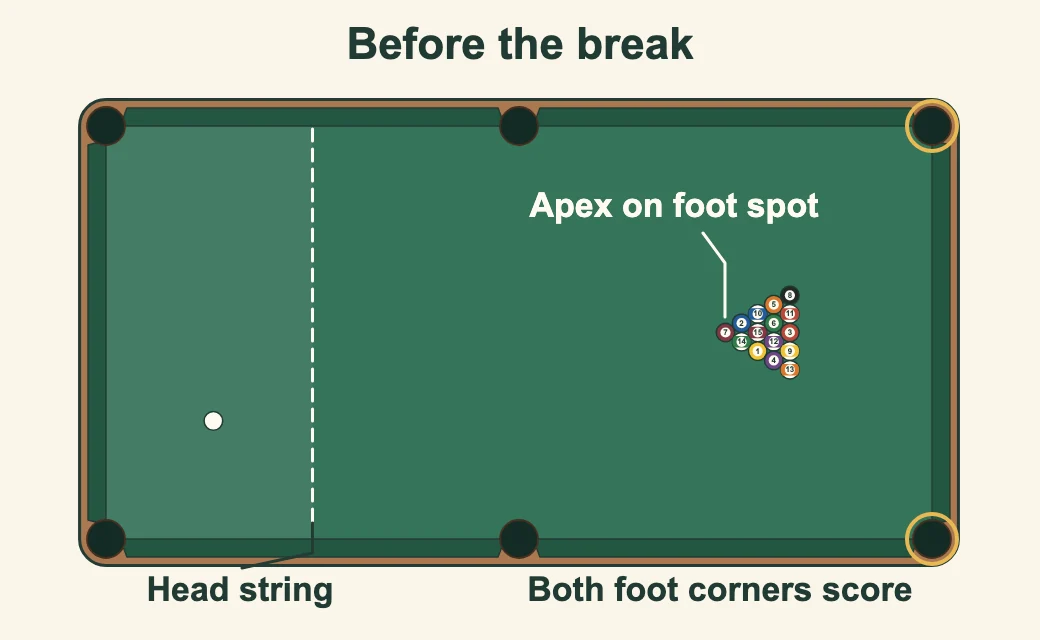
Rack all 15 numbered pool balls tightly in a triangle with the front ball over the foot spot. Mix the numbers without setting a pattern. You’ll also need the white cue ball, a pool cue and a triangle rack. The WPA rule excludes a flat rack template for this game. Pocketed balls must be accessible because some will need to go back on the table. Ask the operator first if a pay table holds balls out of reach.
- Decide who opens. To lag, shoot at about the same time from opposite sides behind the head string. Send each ball to the foot cushion once and back toward the head cushion. The closer legal ball wins. Keep your ball on your own half of the table and away from the side cushions and pockets. A ball that leaves the table or comes to rest in the corner jaws past the nose of the head cushion also loses the lag. If both lags are bad, no one can tell which finished closer, or the first ball hits the foot cushion before the other is struck, lag again. The lag winner chooses who breaks. Breaks alternate in subsequent racks.
- Assign the corners. The breaker names one of the two foot corners. If the choice wasn’t stated, WPA assigns the foot corner opposite the side where the breaker positioned the cue ball. Pointing to it is easier than sorting it out after a ball falls.
- Place the cue ball behind the head string. The head string is the line a quarter of the table length in from the head cushion, at the end away from the rack. The cue ball’s center must be behind the line.
- Break to give your corner the better position. A controlled break can move balls toward your side while leaving the opponent without a clear opening shot. The WPA applies the normal contact-and-rail rule and has no minimum number of balls that must reach a cushion for this break.
With a legal shot, a ball in your own corner scores and you shoot again unless you’ve reached eight. If you make a ball only in the opponent’s corner, they get the point and the next turn if the rack is still going. With no scoring ball for you and no foul, the other player plays the position the break leaves.
On the traditional controlled break shown by OnePocket.org, the cue ball catches the near edge of the front ball. Before trying the shot, stand where you can see both corners. Check where balls could move on your opponent’s side and where your cue ball might finish. As a beginner, use the layout you leave the other player as the test of the break, even when nothing drops.
If you’re setting up a table at home, use the Pool Table Room Fit tool to check room dimensions and cue length. Check any obstruction near the table so players can take a normal stroke from either side.
What Makes a Shot Legal?
You can start with any numbered ball. If nothing goes into a pocket, at least one ball must reach a cushion after the cue ball hits an object ball. The cue ball may supply that cushion contact. Hitting a cushion only on the way to the first object ball leaves the rail requirement unmet if nothing reaches one afterward.
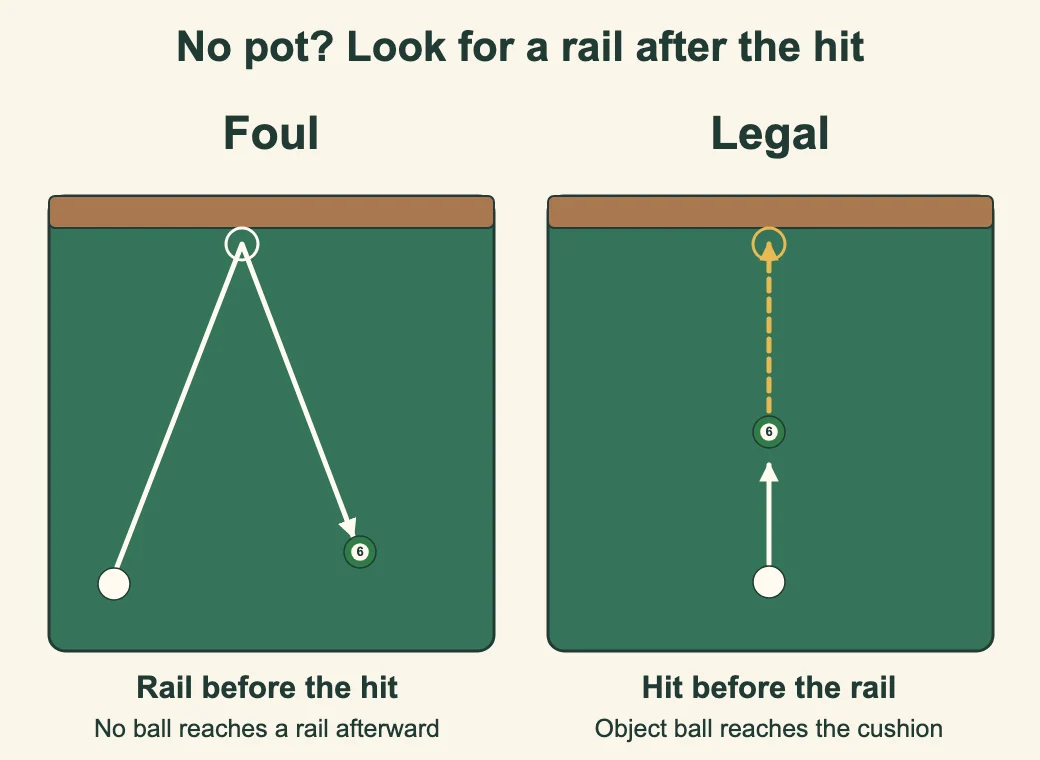
You don’t call a ball or pocket for an ordinary shot. Before walking away from a safety that sends a ball into your own corner, check what actually fell. If you legally scored and neither player has won, the next shot is still yours. Choose a different kind of safety when you need the other player to take over.
Ask about balls frozen to a cushion before you shoot. Under the WPA rail and frozen-ball definitions, a ball already touching a cushion does not satisfy the rail rule just by staying against it. A ball in any pocket or a fresh qualifying rail contact after the hit can satisfy this part of the rule. Under WPA rules, the frozen ball can reach a different cushion, or it can leave and return to that same cushion. Some One-Pocket house rules use a stricter rule for that same-rail safety. If two balls are nearly touching, take extra care to avoid two tip contacts. Let the other player or a referee see the position before you disturb it.
Which Balls Count, and Who Shoots?
Wait for the balls to stop, then resolve the shot before anyone picks up a ball or starts the next turn. On a clean shot, the pocket determines who gets the point. If both players are short of their winning totals, whether you made a ball in your own pocket determines whether you stay at the table.
| What falls on a legal shot | How to score it | Who shoots next if play continues |
|---|---|---|
| One or more in your scoring corner | Credit each ball to you. | You. |
| Only in the opponent’s corner | Credit each ball to the opponent. | The opponent. |
| A ball in each scoring corner | Credit both players. Check whether the rack has ended. | You, if neither player has won. |
| Only in one or more neutral pockets | No points. Spot those balls at the end of your turn. | The opponent. |
| One in your corner and one in a neutral pocket | Credit your ball. Hold the neutral ball to spot. | You. Spot the neutral ball when your turn ends. If no object balls are left and you are short of your target, spot the returns immediately and keep shooting. |
| No balls pocketed and the shot was legal | No points. | The opponent. |
For example, you’re at four and your opponent is at six. You make the 10 in your corner, and the 2 drifts into theirs. The score is now five to seven, and it’s your shot. If the 10 had stayed up, the opponent would still have seven and would shoot next. The numbers on the balls only help you identify what happened.
Keep each player’s scored balls in a separate tray or a place you both recognize. Keep balls from neutral pockets separate until they can be spotted. If the table sends all pockets to one return, agree who will take each ball out and call the score after a mixed shot. A written tally is useful when you can’t keep the two piles apart.
What Happens After a Foul?
In a normal WPA foul, you lose a point and your turn ends. A scratch means the cue ball dropped into a pocket. A scratch or an off-table cue ball gives the opponent ball in hand behind the head string. For most other fouls, the next player starts from where the cue ball stopped.
Check what fell on the foul. Your own pocketed object balls and anything that fell into a neutral pocket are spotted. The WPA has a separate rule for balls in the opponent’s scoring corner. They count for the opponent unless the cue ball being pocketed was the sole foul. If the cue ball went off the table instead, the opponent’s balls still count under the WPA wording. OnePocket.org uses a different rule for the off-table cue ball.
| Situation under WPA rules | Object balls to handle | Next cue-ball position |
|---|---|---|
| Cue ball drops and that is the sole foul | Spot all object balls made on the shot, plus the penalty ball when one is available. | Ball in hand behind the head string. |
| Cue ball leaves the table | Credit the opponent’s own-pocket balls. Spot your own or neutral pots, any off-table object balls and the penalty ball when available. | Ball in hand behind the head string. |
| Object ball leaves the table, cue ball stays up | Spot the off-table ball. Resolve the pots and the one-point penalty by the same foul rules. | Play the cue ball where it stopped, assuming no other placement foul. |
| Double hit, push, no rail after contact, or touched ball | Credit any balls in the opponent’s corner. Spot your own or neutral pots and the penalty ball when available. | Play the cue ball where it stopped, assuming no other placement foul. |
| With the cue ball in hand behind the line, it fails to cross the head string and fails to contact a ball on or beyond it | Resolve the object balls and one-point penalty under the foul rules. | The next player gets ball in hand behind the head string. |
If you’re at three, make a ball in each corner and pocket the cue ball with no other foul, return both new pots and one ball from your own earlier score. You drop to two. The opponent keeps the score they had and starts behind the head string. Run the same example with the cue ball off the table and the opponent keeps the new pot under WPA rules.
Other fouls include playing while balls are still moving, shooting out of turn, or making a shot with neither foot on the floor. A standard foul takes one point even if the shot or set of actions breaks more than one ordinary rule. The most serious foul on a shot determines the penalty. For deliberate interference with a moving ball, the referee decides the penalty for unsportsmanlike conduct. Pause to settle what happened if the pocket, penalty or placement is disputed.
How to Mark an Owed Ball
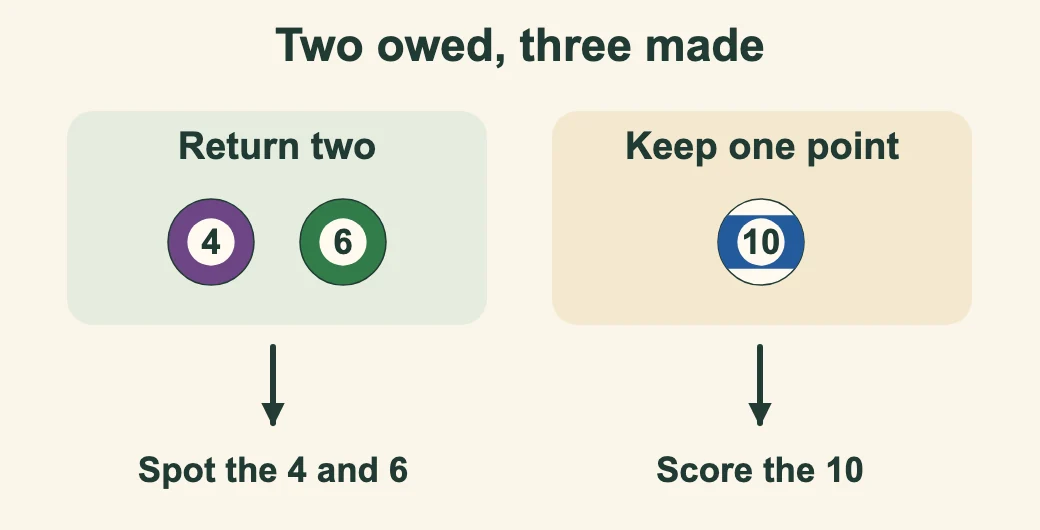
When you’ve already scored, put one ball from your scoring pile back on the table for the foul. When that pile is empty, mark that you owe a ball. At your next legal scoring shot, any amount you still owe comes off what you make before you add to your positive score. The repayment ball returns to the table at spotting time.
Suppose you foul twice at zero. You owe two. Later you make three balls in your corner without a foul. The first two settle the debt and will be spotted. The third leaves you at one. If you make only one, you still owe one, and since you legally made your own ball your turn continues unless the rack has already ended. Keep the owed mark visible until you pay it. A negative tally can be easier to track than trying to remember old fouls.
When Three Fouls Lose the Rack
Under WPA rules, three fouls in the same rack without a legal shot between them lose that rack. Warn the shooter when they come to the table on two fouls. Under the WPA playing regulations, a scoreboard with the foul count visible to both players also counts as a warning. Without the warning, the next foul is treated as the second for this rule. The earlier standard fouls still cost a point each.
Keep each player’s consecutive fouls separate from their score. A legal safety resets that player’s foul streak even if it earns no point and there is still an owed-ball mark. In a friendly game without a referee, agree before play that you’ll tell one another when a player is on two.
Where the Cue Ball Goes After a Scratch
Put the cue ball behind the head string, the quarter-table line at the end away from the rack. The area behind it is commonly called the kitchen. Place the cue ball with its center on the head-cushion side. Shooting with its center on the line or farther down the table is a placement foul. You can play a numbered ball whose center is on the line or farther toward the foot end.
If the first ball you want to hit is also in the kitchen, the cue ball must cross the head string before making contact with it. You can play a cushion route that leaves the kitchen and brings the cue ball back to the target. Check how the shot will meet the normal pocket-or-rail rule once you reach the target.
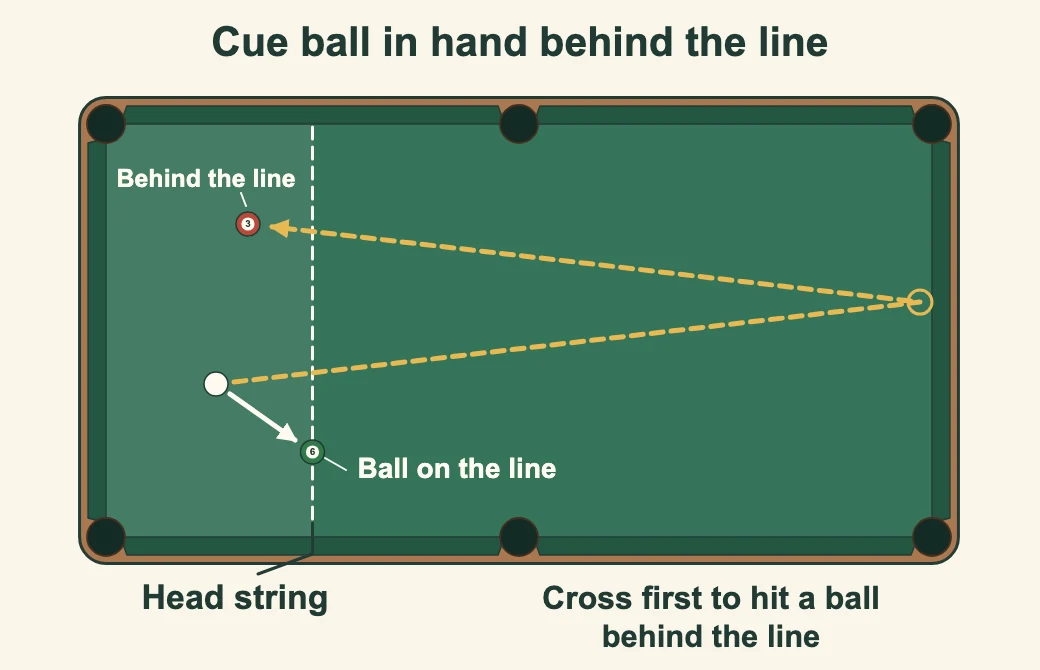
If a ball is close to the line, sight along the head string before moving another ball or assuming it’s outside. WPA uses the centers. If the first target sits behind the line, make sure there’s a cushion route with enough room to cross the line and come back. The drawing shows two possible first contacts from the same placement. Contacting a ball behind the line first and crossing afterward is still a foul. When the cue ball fails to cross at all and hits no ball on or beyond the line, the next player also gets ball in hand behind the line.
When every remaining legal target is in the kitchen, you can ask to have the object ball nearest the head string spotted at the opposite end. If several are equally close, you can choose among the tied balls. Make that request before you shoot. A ball already on the head string is playable and rules out this all-behind-the-line exception.
Where and When to Spot Balls
Spotting returns a ball to play near the foot spot. Do it after the turn when you have a neutral-pocket ball, a foul return or a ball to settle a debt. Don’t remove a scored ball from either player’s tally unless you are applying a scoring rule that calls for it.
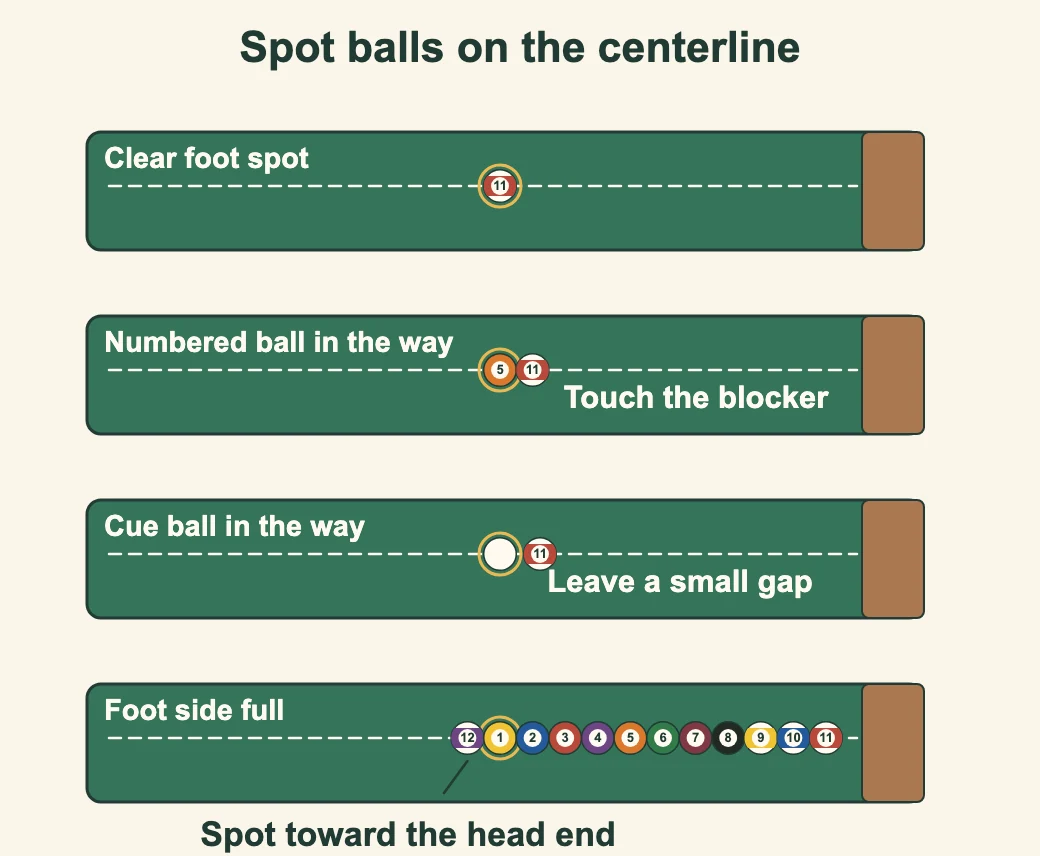
- Start on the foot spot. Set the first returning ball there if it fits. Think of the long string as a straight line through the middle of the table from short cushion to short cushion.
- Use the foot side first. If the spot is occupied, place the return on that centerline as close to the foot spot as space allows on the foot-cushion side. Do not shift any ball already there.
- Mind the obstruction. When possible, set the return against a blocking numbered ball. Leave a small gap if the cue ball is the blocker.
- Go toward the center if necessary. If there’s no room on the foot side of the centerline, spot on the same line on the head side of the foot spot, as near to the spot as space allows.
When no object balls remain on the table. If a legal scoring run clears the playing surface before the shooter reaches the winning score, spot all the balls currently due at once. The shooter continues. For instance, with two balls on the bed and three neutral pots already set aside, the player at five makes both remaining balls in their corner. They reach seven. Return all three neutral balls, then give that same player the next shot.
When a return was missed. If both players agree once they notice, put the forgotten ball back immediately. Otherwise the WPA rule gives both players one full turn after discovery before the return. If you notice during a turn, only count a turn that begins after you noticed. Keep the missing ball separate so it does not accidentally become a scored ball.
Pick a Shot You Can Leave
Before you commit to a shot, look at what your opponent sees from the likely finishing position of the cue ball. A bank that could win you a point may leave a straight shot into the other corner on a miss. A softer safety can be a better choice when the scoring route is narrow and the likely miss opens their pocket.
- Look at their corner first. Is a ball already close to their pocket, and can the cue ball reach it? If it’s open, moving that ball away or leaving a blocker in the direct path is worth considering.
- Pick the part of the table you want next. On offense, look for an easy follow-up into your corner. On defense, look for the side of an object ball or the cluster left from the rack that blocks their direct line.
- Check the rail and the speed. Plan for a ball to reach a cushion after contact if nothing drops. Think where your cue ball and the object ball will stop if you hit the intended line with too much or too little speed.
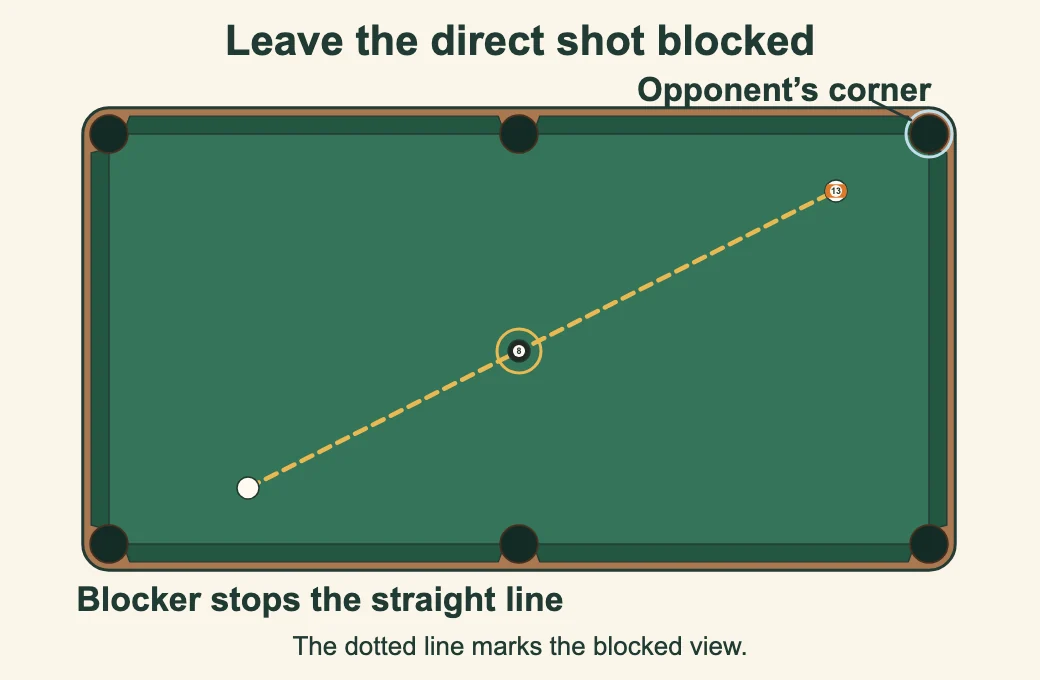
For a practice rack, try a safety in which you contact a ball and send it to the rail. See where your cue ball stops. Walk behind it at its new position to check what the other player would actually see. Try the same layout from the opposite corner. A good leave for one scoring pocket can leave an easy shot for the other.
A bank sends an object ball to a cushion on its way to a pocket. A kick sends the cue ball to a cushion before it reaches the target. Both can help when a straight path is blocked. When a kick makes first contact without pocketing a ball, plan a qualifying rail contact afterward. The shot examples collected by Dr. Dave Alciatore show how the same corner can be attacked or defended from different sides of the stack.
Finish the Rack and Start the Next
In a standard game, eight credited balls wins the rack. If you’re at seven with nothing owed and you legally make an eighth ball in your pocket, you’re done once the shot is resolved. If you foul, apply the foul scoring first. A foul cannot put your own apparent last ball on the score. On your legal shot, a ball in the other player’s corner can give them the win.
WPA also resolves the unusual case in which both players reach their winning targets on the same shot. The shooter wins. Eight plus eight exceeds the original 15-ball rack, so this requires a handicap or a stalemate rerack that has carried over points. If you’re learning with equal targets and an uninterrupted rack, finish by checking whose eighth point was earned.
If referee-led play stalls, WPA first gives each player three more turns unless both agree it’s a stalemate straight away. If the referee declares it, record the current scores and owed balls, put all 15 back, and lag to establish the next shot. Keep the earlier scores on paper because the balls that represented them are back in play. An old lead survives the rerack.
Before a fresh rack, empty the scoring piles and reset the foul marks. The next breaker can name either foot corner. Have the new breaker announce their choice before putting down the cue ball.
House Rules to Agree on First
Use one written set of rules throughout a rack. The OnePocket.org rules and options and the WPA code describe the same two-corner game, with different answers in a few situations that matter even in a first session.
| What to settle | WPA procedure used above | OnePocket.org version or option |
|---|---|---|
| Ball legally made in the breaker’s pocket | Score it and continue with the layout. | Traditional play scores it. The optional rack-your-own rule has the breaker rerack and break again. |
| Opponent’s ball is made and the cue ball leaves the table | The opponent gets the ball. The exception is a pocketed cue ball as the sole foul. | The normal rule returns the ball after a pocketed or off-table cue ball. Under the option that forbids intentionally jumping the cue ball off the table, the opponent keeps the ball on an off-table foul. |
| Accidentally disturbed object ball | Apply the WPA touched-ball rule. | With a referee, apply all-ball fouls. In some unrefereed matches, use the conditional cue-ball-fouls-only procedure. A single moved object ball that does not affect the shot can be restored at the opponent’s choice. It is a foul if the disturbed ball affects the shot or multiple balls were disturbed. |
| Where a ball sits relative to the head string | Use the ball’s center as the reference. | Place the entire cue ball behind the line. A direct first target must sit entirely beyond it. Leave the line clear of both balls. |
| The breaker misses the rack entirely | The normal foul applies, and the turn passes with the cue ball where it stopped if there is no placement foul. | The next player can require the breaker to rerack and try again in addition to the normal foul penalty. |
| Unequal skill levels | The standard game is a race to eight credited balls. | Players may agree on a handicap to change what each needs. At eight to six, agree which player needs eight and which needs six before the break. |
For your first rack, a short conversation is enough. Decide how you’ll handle a ball made on the break, an accidental touch, and a scratched or jumped cue ball when another ball goes in. If there’s a handicap, say both target scores aloud. Postponing these decisions until the first disputed shot gives both players a different reason to remember the old rule.
If the cue ball and an object ball are close and a double hit might be hard to judge, ask an official to watch before you shoot. Agree on the position of any disturbed ball before resuming. Before calling a winner or moving balls, confirm the winning score. Those decisions are easier to make with the layout undisturbed.
If players want another way to use the same pool equipment, 8-ball rules give each side a numbered group and a final called 8. The 9-ball rules require contact with the lowest numbered ball first. A third player changes the problem, so use the three-player Cutthroat rules when all three want to share one rack.