What Is the Goal of Cutthroat?
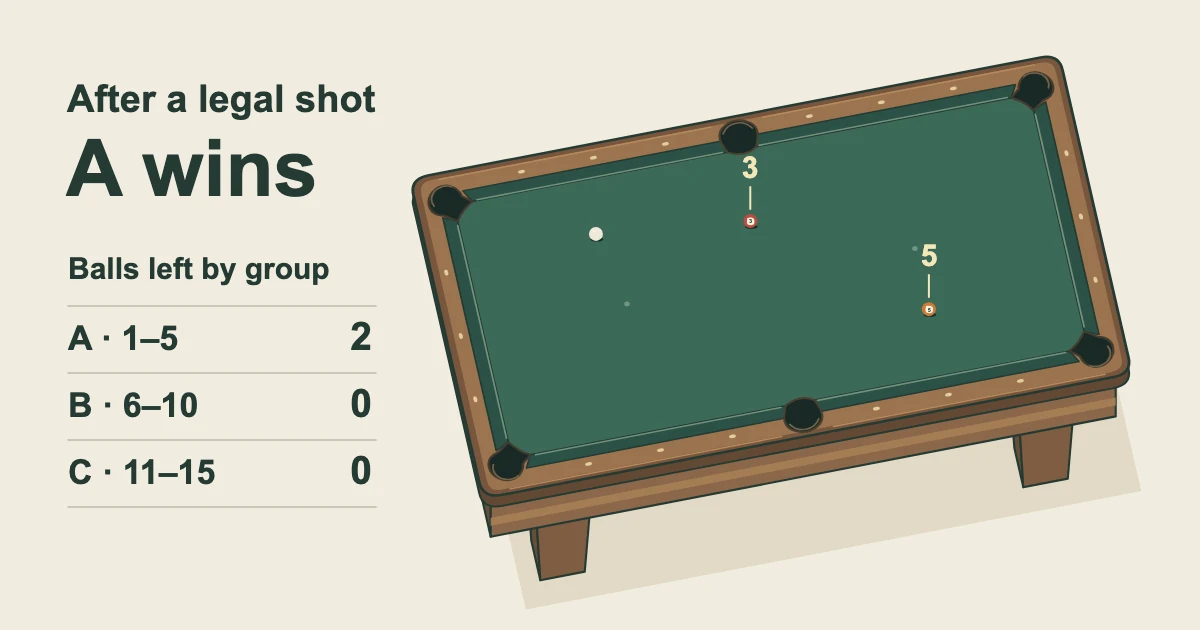
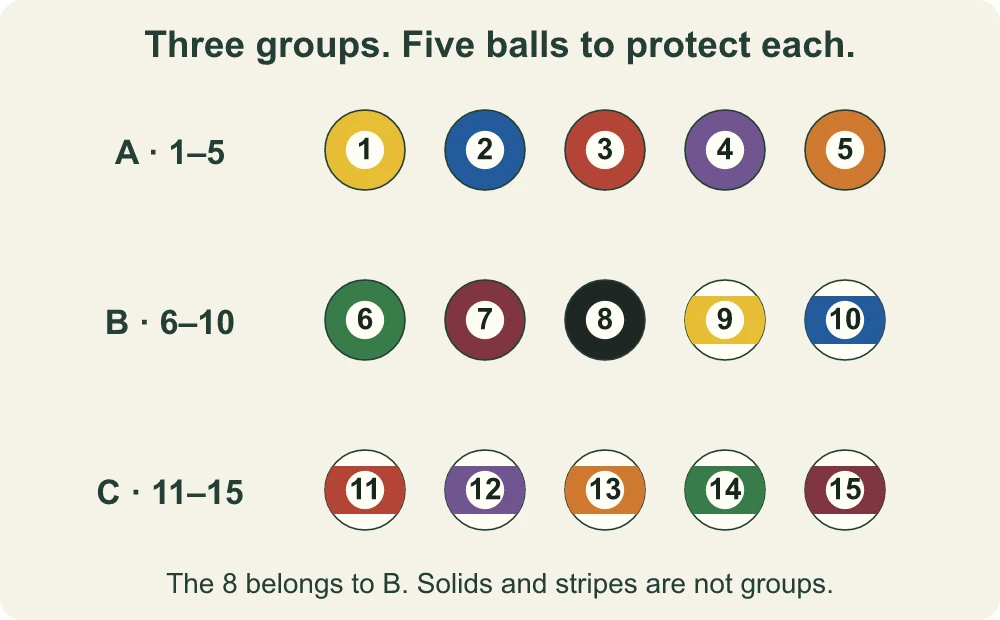
To play cutthroat pool, give each of three players five numbered balls to protect: 1-5, 6-10 and 11-15. Pocket the other two players’ balls while keeping yours on the table. In the starter game below, you win when you are the only player with a surviving group after the shot and its penalties are resolved.
The numbers identify each player’s balls. They carry no points. Ball 8 belongs to the middle group. It is not a special winning or losing ball. Solids and stripes do not divide the players: the 6-10 group contains both.
Ask how your group learned to play. Dr. Dave’s casual rules let you hit any numbered ball first and end your turn if you pocket your last ball. The BCA Cut-Throat rules reproduced by Billiards.com require you to hit an opponent’s ball first. Pick one version before the break.
Agree on These Rules Before Playing
You can use the agreements below for your first rack. A turn, also called an inning, can last several shots. Dr. Dave’s version lets you hit any group first without calling a shot and ends your turn if you sink your own last ball. We also use the comeback penalty in Bob Jewett’s Cutthroat explanation. The table spells out the choices for this game.
| Decision | Our starter agreement |
|---|---|
| Groups and order | Decide who goes first, second and third. Assign the first player (A) 1-5, the second (B) 6-10 and the third (C) 11-15. |
| Contact and calls | You can hit any numbered ball first. Play without calling balls or pockets. After you hit an object ball, a numbered ball must go in or a ball must reach a cushion. |
| Foul restoration | Set aside every opponent’s ball pocketed on the foul and every numbered ball knocked off the table. Then add one eligible ball from each opponent’s remaining pocketed balls. Your own pocketed balls stay down. |
| Which penalty ball | For consistency, use the lowest-numbered available pocketed ball in each opponent’s group. This selection is our table agreement, not a universal Cutthroat rule. |
| Cue-ball placement | After a scratch or an off-table cue ball, the next player places it behind the head string. After other fouls it stays where it stopped. |
| Own last ball | Pocketing your own last ball ends your inning. If a legal shot leaves no group alive, replay the rack with the same order and breaker. This rare-case replay is our agreed house resolution. |
| Next rack | Of the two losing players, the one eliminated for good first breaks next. The other goes second and the winner goes last. Draw between the two if they went out for good on the same shot. |
If your group prefers another published version, agree on the changes now. Use the same contact rule, foul penalty and own-last-ball rule through the entire rack.
What You Need and Who Shoots
Use a numbered pool ball set with all 15 object balls and one cue ball, a pool cue, and a triangle rack. These links are equipment examples, not required brands or claims that a purchase improves your game.
Write down each player’s name beside A, B or C and the range they own. A breaks, B is next and then C. After a legal miss, skip any player with no balls left and keep the original order for the others.
Check that you can draw the cue back without hitting walls or furniture. Enter your room measurements and cue length in the Pool Table Room Size Calculator to find tight spots before you play.
Make sure you can get pocketed balls back. Some coin-operated tables hold the numbered balls until the next payment. Ask the operator about ball access before choosing a rule that returns them.
How Do You Rack and Break?
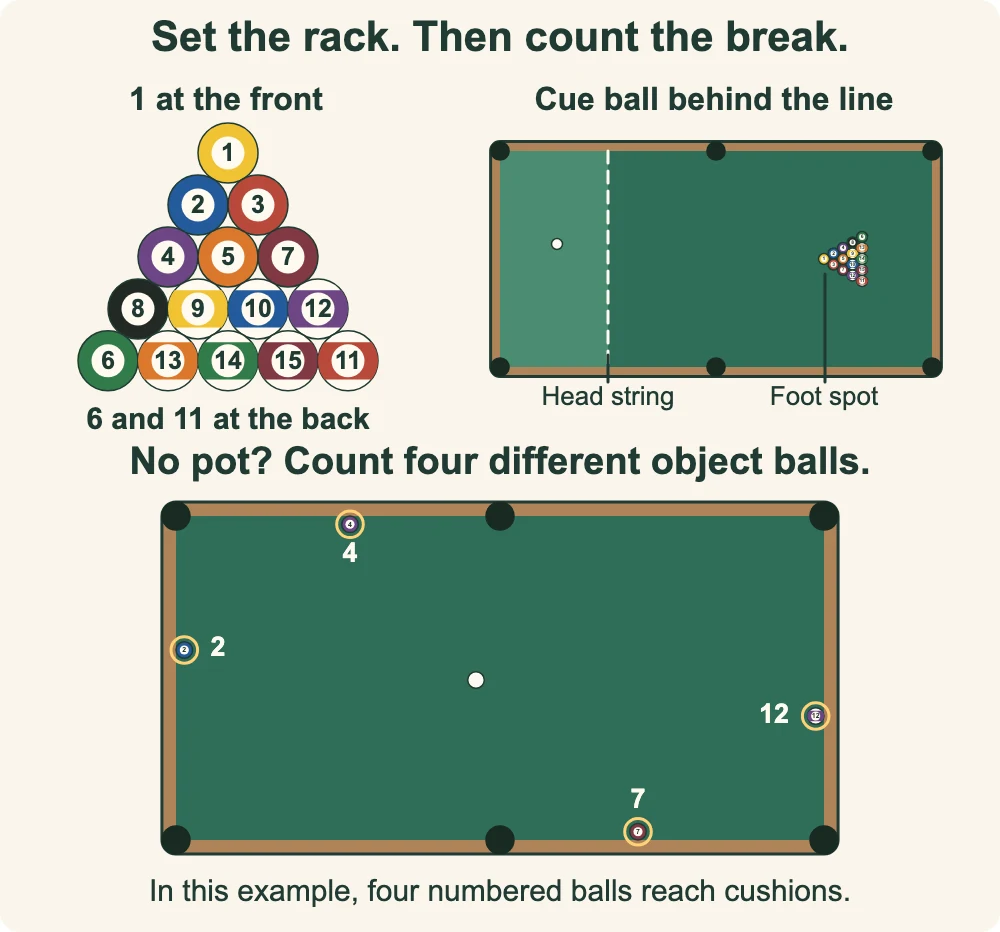
- Build a tight triangle. Place the 1 at the front, centered over the foot spot. Put the 6 and 11 in the two back corners. Fill the rest of the triangle with the other twelve balls in any order.
- Start from the kitchen. The head string crosses the playing surface one quarter of its length from the head cushion. Put the center of the cue ball between that line and the head cushion, at the end opposite the rack.
- Make an open break. For this game, pocket a numbered ball or send at least four different numbered balls to cushions. A ball that hits two cushions still counts once. Leave the cue ball out of the count. The break must also be free of fouls. This is the open-break convention described in Dr. Dave’s terminology glossary.
After a legal break. Leave all pocketed balls down. If you made a ball, check whether the rack is over. You get another shot only if play continues and you still have one of your own balls up. On a legal break with no ball pocketed, the next active player shoots from the position left by the break.
When the break falls short. If you made no ball and fewer than four numbered balls reached a cushion, the next player can accept the table or rerack all 15 balls and break. Apply the foul returns first if the next player accepts. On a rerack, all the balls start in the triangle again. Keep each player’s group and the original turn order.
When there’s a foul on the break. If at least one numbered ball went in or four different numbered balls touched cushions, the next player takes over after the usual foul returns. Use the same penalty if they accept a short break. A scratch or cue ball off the table gives them ball in hand in the kitchen. On another foul they play the cue ball where it stopped. If they choose to rerack a short break, they break from the kitchen with all 15 numbered balls back in the triangle.
What Makes a Shot Legal?
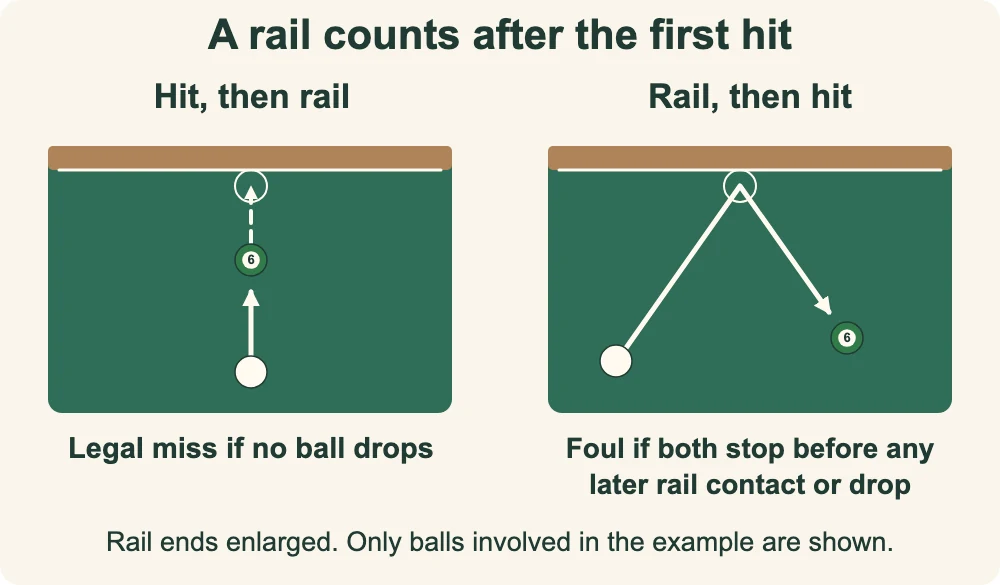
To make a legal shot. Strike the cue ball with the tip and hit a numbered ball. From that contact onward, a numbered ball must drop or some ball must reach a cushion. Your cue ball can touch a cushion before it hits a numbered ball. If no ball drops, you still need a cushion contact after the hit.
If you own 1-5, you normally aim to pocket 6-15. You may also pocket one of your own balls to keep a useful inning going, provided the shot is otherwise legal. That costs one of your remaining balls. Pocketing your own last ball ends the inning under the version taught here.
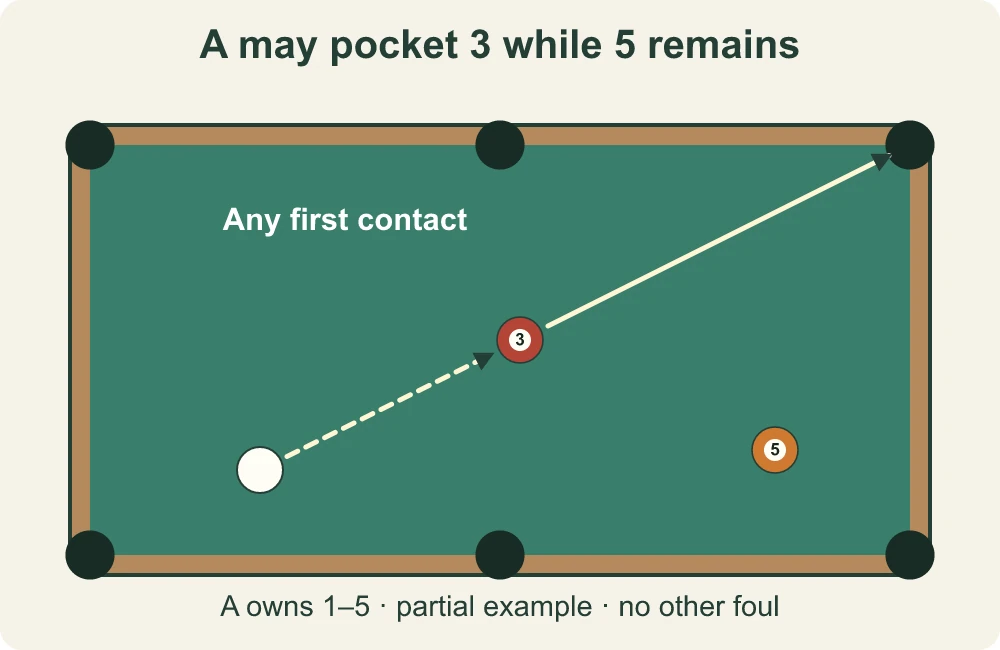
| Shot result | What happens next |
|---|---|
| Any numbered ball pocketed, no foul | Leave it down. Check for a winner or the agreed replay first. If the rack continues, you shoot again only if you still have one of your own balls on the table. |
| No pot, but legal contact and a later rail | Legal miss. Your turn ends. No penalty ball returns and the cue ball stays in place. |
| No object-ball contact, or no pot and no rail afterward | Foul. End the turn and apply the return procedure. |
| Legal pot leaves an awkward next shot | Poor position alone does not pass the turn. Take the next shot if the rack continues and you still have one of your own balls up. |
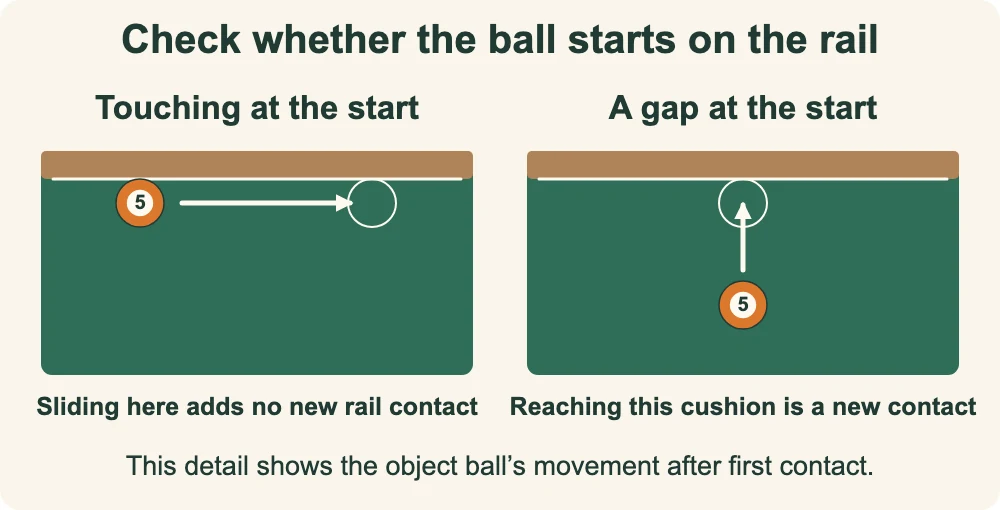
You can play a legal defensive shot without pocketing anything. A numbered ball already touching a cushion does not meet the rail requirement by sliding along that same cushion. Ask someone to confirm the ball is touching before you shoot. One option is to hit it and send the cue ball to a different cushion.
What Happens When Someone Fouls?
A foul ends your turn and can bring back several numbered balls. Return any opponents’ balls you pocketed, any numbered balls knocked off the table, and one more eligible ball per opponent. A scratch happens when the cue ball goes in a pocket. It’s also a foul to miss all numbered balls, fail the pot-or-rail test, knock a ball off the table, hit the cue ball twice, push it with the tip or shoot while balls are moving. In this game it is a foul to bump a ball in play with your hand, sleeve or cue. The incoming player may place their cue ball when they have ball in hand.
Wait for the balls to stop. Decide which numbered balls come back before you place any of them.
- Identify the shot’s returns. Set aside any opponents’ balls you pocketed during the foul and any numbered balls knocked off the table. Leave your own pocketed balls down.
- Identify the comeback penalty. For each opponent, look at the pocketed balls you haven’t already set aside. Take the lowest number still available in that opponent’s group. If none are left in the pockets, that opponent gets no extra ball. There is nothing to carry over to a later turn.
- Spot the complete set and take the next turn. Put the whole set back in number order using the spotting steps below. If an opponent has a ball up again, they rejoin in their original place. Work out who shoots next before placing the cue ball.
The BCA game separates balls that come back from that shot from the extra foul penalty. Jewett’s version also lets a foul bring back a player who sat out. If your group plays a simpler penalty, such as one ball per opponent on a scratch, use that agreement for the whole rack.
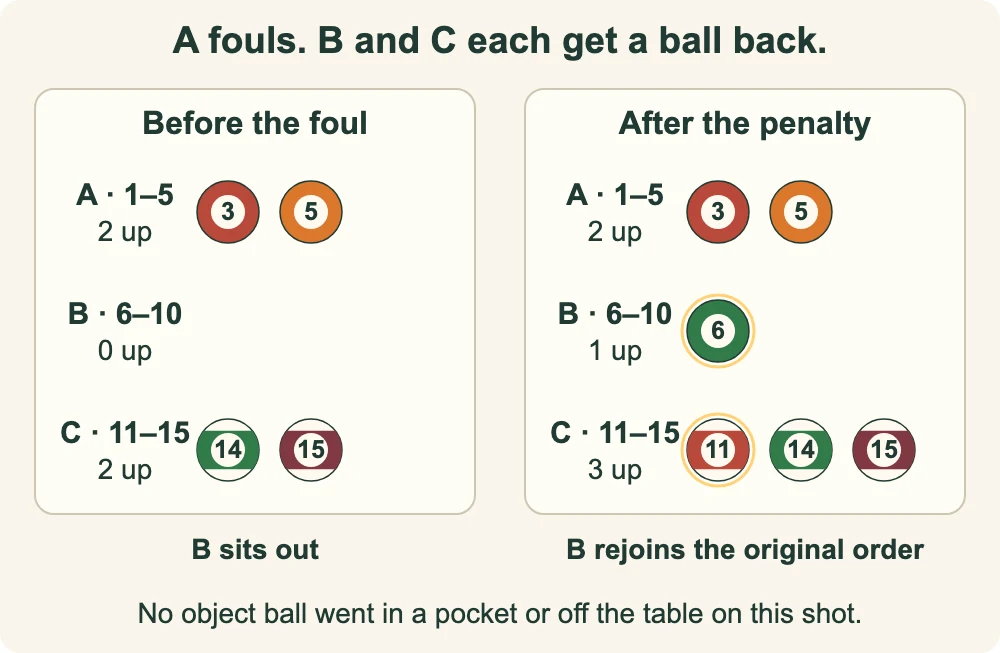
Try the return count. A owns 1-5. Before a shot, B has already lost the 6, 7 and 8. C has lost the 11 and 12. A pockets the 9 and scratches. Set aside the 9 because B lost it during the foul. From the balls still in the pockets, add B’s 6 and C’s 11. Spot 6, 9 and 11 in that order. B now has 6, 9 and 10 on the table. C has 11, 13, 14 and 15. A gets no ball back as a penalty for their own foul.
| Step | Balls | Why |
|---|---|---|
| Set aside the shot return | 9 | A pocketed B’s 9 during the foul. |
| Pick the two extra balls | 6, 11 | Lowest unused pocketed numbers for B and C. |
| Spot the full set | 6, 9, 11 | Place all three in number order. |
If A pockets B’s 6 on a scratch and B’s 7 was already down, set aside the 6 for the shot. Pick the 7 as B’s extra return. Each ball can be selected once.
Apply the extra penalty once per shot, even if the shooter commits two fouls at once. Still set aside each ball that needs to come back from the shot itself.
Where Do Returned Balls Go?
Spotting means placing a returned object ball at the foot end, not choosing a convenient position for the next shot. This walkthrough adopts the numbered-order placement procedure in the published BCA general pocket-billiards rules.
- Place a single returned ball on the foot spot when it is clear.
- For several returns, use ascending number order along the table’s long centerline: start at the foot spot and continue toward the foot cushion.
- If existing balls block a position, use the closest space available along the line toward the foot cushion. Leave those existing balls where they are. If there is room for some of the returns on that side, put those down in number order first. Place the rest on the center side of the foot spot, with the lowest of those remaining numbers closest to the spot.
- Set returned balls close together on the line. If a return sits beside the cue ball, leave a small gap between the two. The cue ball and the spotted ball must not touch.
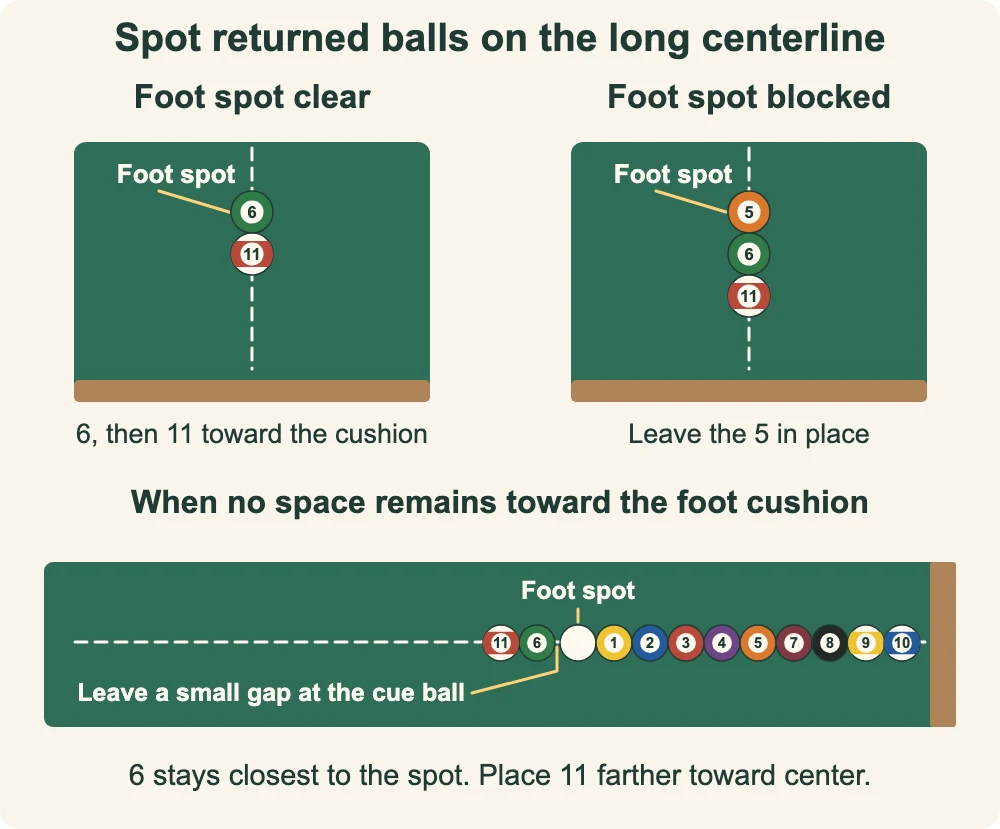
Once you’ve spotted the balls, say which groups are back in play and who shoots next. That tells the revived player when to take their turn.
Where Is the Cue Ball After Scratching?
In this starter game, the incoming player receives the cue ball in hand behind the head string after a scratch or an off-table cue ball. “In hand” means you may place and readjust it there before shooting. It does not mean anywhere on the table. An ordinary foul that leaves the cue ball on the bed does not grant this placement.
Judge which side of the head string a ball is on by its center. In this version, a numbered ball centered on the line or beyond it is available for direct contact. To hit a ball still behind the line, send the cue ball out of the kitchen, off a cushion, then back to the target. That is the BCA-style route used here. If no ball drops, another rail contact is still needed after the cue ball hits the target.
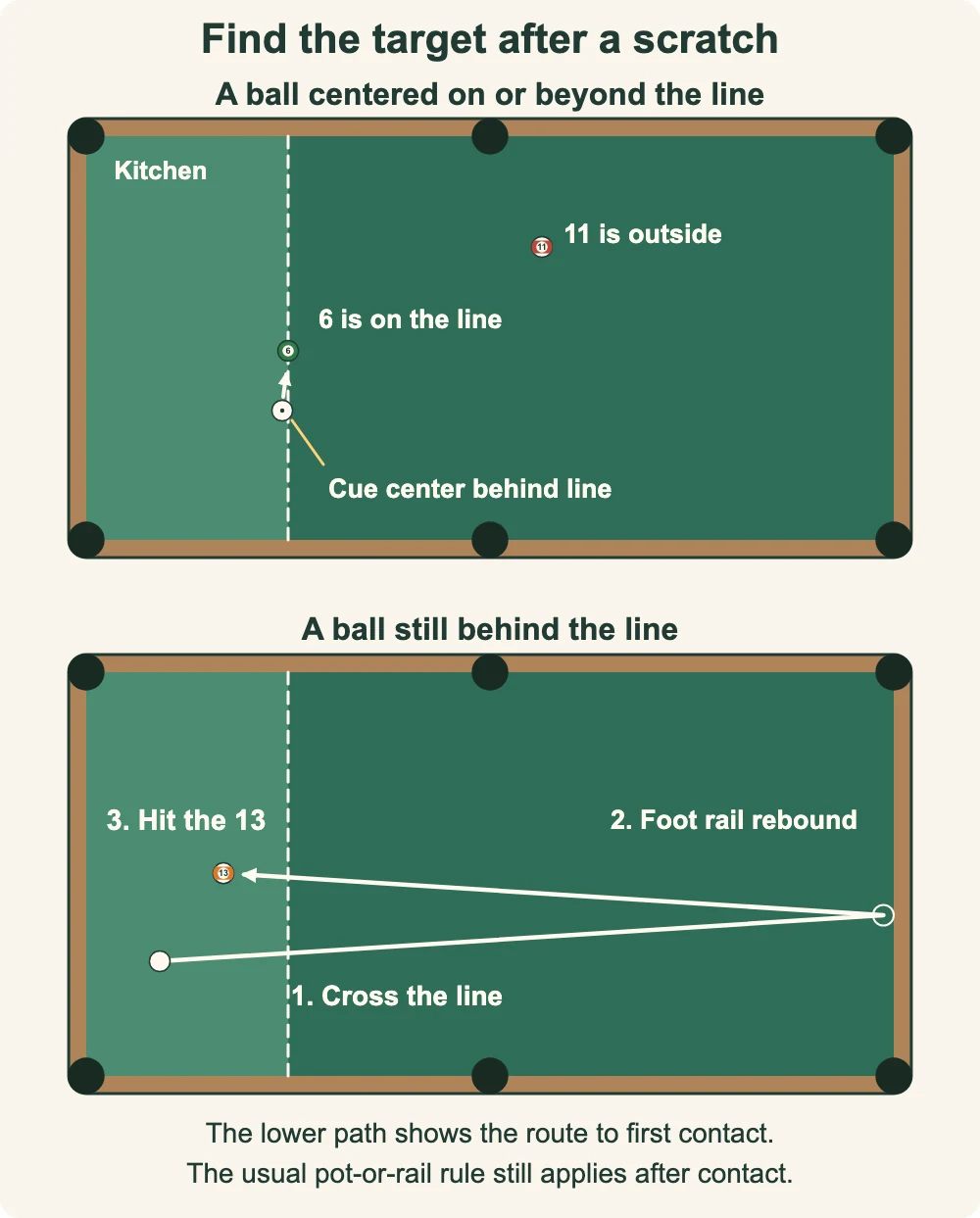
If all your opponents’ remaining balls are behind the head string, you can ask to have the opponent ball nearest the line spotted at the foot end. For a tie, choose one of the closest balls. You can make that request even if one of your own balls is beyond the line. Hitting that own ball directly is another option under this game’s any-ball-first rule.
Spot the object balls, check who is back in the game, and call the next player in the original order. That player places the cue ball when the foul grants ball in hand. Touching a numbered ball with the cue ball during placement is a foul here.
Elimination, Comebacks and the Winning Shot
Anyone with no balls left sits out while the other groups continue. A later foul can restore a ball and bring that player back, but not after the rack has already ended. Keep the original order rather than giving every returning player an immediate turn.
| Original order A → B → C | Who shoots next? |
|---|---|
| B is out. A fouls and returns one B ball. | B is active again and is next after A. |
| B is out. C fouls and returns one B ball. | A is next after C. B follows A when its turn comes. |
| B is out. A makes a legal miss. | C shoots. No foul means B receives no return. |
Declare the winner after the complete shot. Let every ball stop and apply any foul restoration before counting survivors. Pocketing the apparent last opponent ball is not a win if the same shot scratches and restores opponents.
| Final situation | Result in this starter game |
|---|---|
| A retains 3 and 5. A legally pockets B’s and C’s last balls. | A wins. Both opponents reaching zero does not create a tie. |
| A retains a ball but scratches while pocketing the last opponent ball. | No one wins on that shot. Bring back the pocketed opponent ball and apply the rest of the penalty. The next active player shoots from the kitchen. |
| A pockets its own last ball but B still has a ball. | A’s inning ends. If C is already out, B is the sole survivor and wins. |
| A legal shot leaves all three groups at zero. | Use the pre-agreed replay: same order and breaker. This is different from a third group surviving. |
Jewett describes another published house rule: a shooter who pockets their own last ball can continue trying to clear the others and win. That is an additional exception to the own-last rule, so agree to it before playing. It is not the version used for this walkthrough or its outcome table.
For the next rack, look at when each losing player went out for good. Whoever went out earlier breaks, the other losing player goes second and the winner shoots last. A player who came back and won is still last. Draw for the first two spots if both losses happened on the same shot. Assign A, B and C to that new order and write down their groups. If your group prefers winner breaks, agree to that before the series. For a friendly session you can count racks won. Agree separately on any points for balls remaining.
How Do You Protect Your Group?
Protect your group by leaving opponents awkward shots on your balls and avoiding fouls that bring their balls back. More balls remaining generally means more chances to survive, not fewer. If A has four, B one and C two, A has the largest reserve. Layout still matters: four balls near open pockets may be more exposed than a single awkward ball. Count the balls and examine their actual routes before choosing a target.
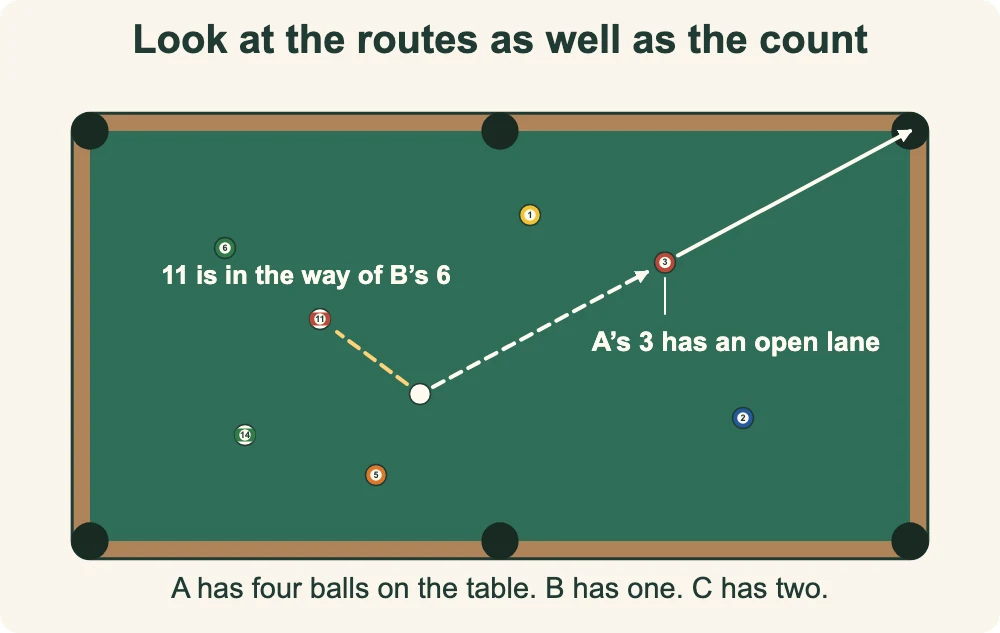
- Compare both opponents. Removing one group can simplify the table, but it may leave the remaining opponent an easy run at your balls. Look at the next player’s available shots before choosing which ball to remove.
- Move a ball away from an easy pocket. If your ball is near an opening, consider moving it out of the next player’s path. Check what they can still reach from where the cue ball will stop. Make sure your shot still satisfies the contact and rail rules.
- Weigh a legal sacrifice. Giving up one own-group ball may keep an inning going, but it reduces your reserve. Check that another of yours remains and that a useful follow-up actually exists.
- Avoid donating a comeback. Before a difficult shot, count what a foul would return. If the pot is risky and the extra balls would revive a player, look for a legal defensive shot that leaves the next player without an easy pot.
Try two separate cases. Start each with four balls for A, none for B and one for C. Assume the foul pockets no numbered balls and knocks none off. If A fouls, who shoots next after B gets a ball back? Reset to the same starting counts and ask who shoots next if C fouls. The earlier turn table has both answers.
Friendly alliances and table talk are part of some social versions, as Jewett describes. They are not permission to distract someone during a stroke or move a ball. Agree whether advice is welcome, and give the shooter quiet room to play.
How Does Cutthroat Compare With Other Games?
Cutthroat asks you to keep a group on the table. Eight-ball and nine-ball have their own winning ball and first-contact requirements.
| Game | Main task | Important distinction |
|---|---|---|
| Three-player Cutthroat | Keep your group while pocketing both opponents’ groups. | The 8 is an ordinary member of 6-10. Fouls can revive opponents in the chosen return version. |
| Eight-ball | Clear your assigned group, then legally pocket the 8. | Two players or teams, with a separate final 8-ball requirement. |
| Nine-ball | Contact the lowest number first and legally pocket the 9. | The 9 may win before the other numbers are cleared. No five-ball ownership groups. |
For those separate games, the 8-ball rules guide explains groups and the final called 8. The 9-ball guide explains lowest-first contact, the push out and legal early 9-ball wins. Their foul remedies should not be imported into Cutthroat.
Other Ways to Play Cutthroat
You can change when players claim a group, divide the balls for five players or set a handicap for mixed abilities. Give everyone the same rules before the break.
Choosing groups during play. If you start with unclaimed groups, a published casual rule lets the first player to make a qualifying legal pot choose any unclaimed group, including one different from the ball pocketed. The second such player chooses from the two remaining groups and the third receives the last. Agree whether selection is immediate or at the end of that inning. A legal break pot may qualify if that is the agreed selection method. Our starter game avoids that open-group period by assigning all three before the break.
Five players: an equal 15-ball division is 1-3, 4-6, 7-9, 10-12 and 13-15. If you extend the starter penalty, each foul can restore one available pocketed ball for each of four opponents. Decide the order, rack and return choices for that five-player game rather than assuming the three-group corner arrangement represents all five equally.
Four players. Split into two teams for a game like 8-ball, or agree on a four-player version before breaking. A full set of 15 balls won’t divide into four equal groups. For mixed abilities, Dr. Dave describes handicaps that give players unequal groups or require a stronger player to hit opponents’ balls in rotation. Agree on those changes before racking.
Before you break, say who owns each range, which ball you can hit first, what comes back after a foul, where the cue ball goes and what happens if you pocket your last ball. Keep the group key beside the table through the final shot.