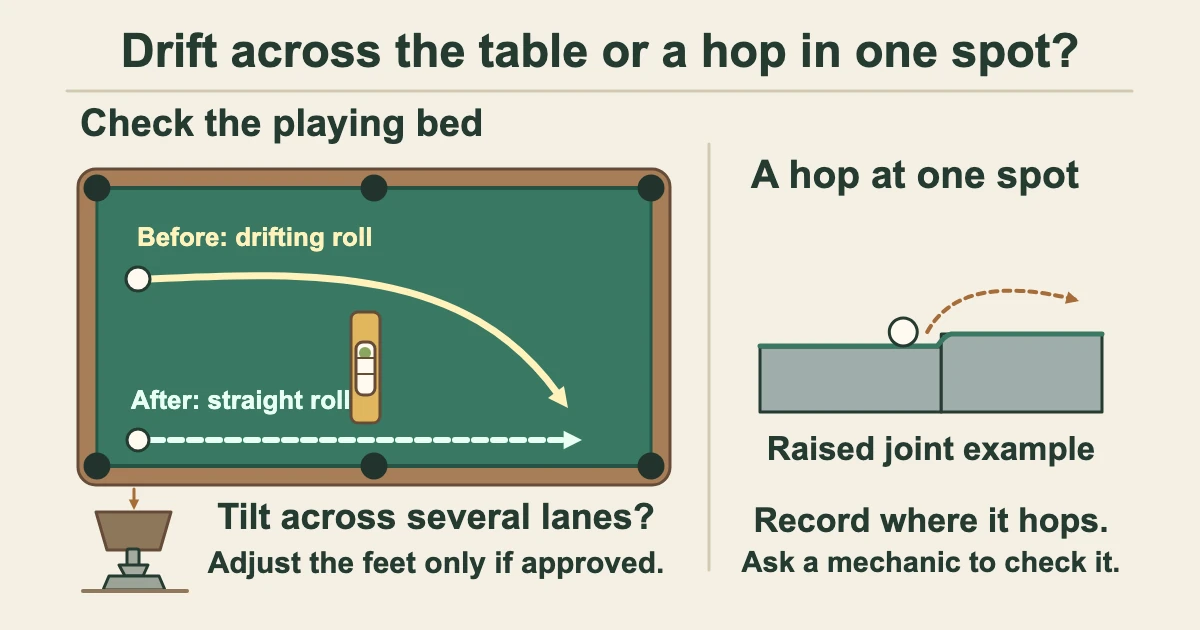
How to tell if a pool table is out of level
Start by repeating each problem in the lane where you saw it. Roll a clean ball slowly from each end of the lane, and repeat with another ball. Try the center and both lanes near the long cushions. If rolls bend toward the same room side across several lanes, check whether the bed tilts that way. If both balls hop in one spot, look for debris, a raised adhesive spot or loose cloth. If the hop persists, have a mechanic check that area even if you also find a tilt.
| What you see | What to check first |
|---|---|
| Both clean balls drift toward the same rail in several lanes. | Check the crosswise slope on the playing bed and look at how the feet meet the floor. |
| A ball jumps or changes line at one point. | Look for debris, a raised adhesive spot or loose cloth. If a hop repeats there, note where it happens for the mechanic. |
| Only one ball rolls off line. | Clean it as its maker directs and repeat the same roll with another ball. |
| One cushion rebounds weakly. | Have the cushion and rail attachment checked separately. Use rolls that stay away from the rails to check the bed. |
Repeating the same path makes the comparison easier. In Joe Waldron’s roll trials, a guide made each ball start on a consistent line. Simonis’s care notes describe how loose cloth may bunch in front of a rolling ball.
What to check before adjusting the table
Find the model label and confirm how the feet work. A threaded floor pad, a bolt that holds a leg to the cabinet and a screw that adjusts slate support do different jobs. The Valley Panther Home is one example of a one-piece slate table with wrench-adjustable feet. On another table, a visible bolt may hold the leg on. Use the model instructions to identify the hardware. If you can’t confirm it, take readings and leave the feet where they are.
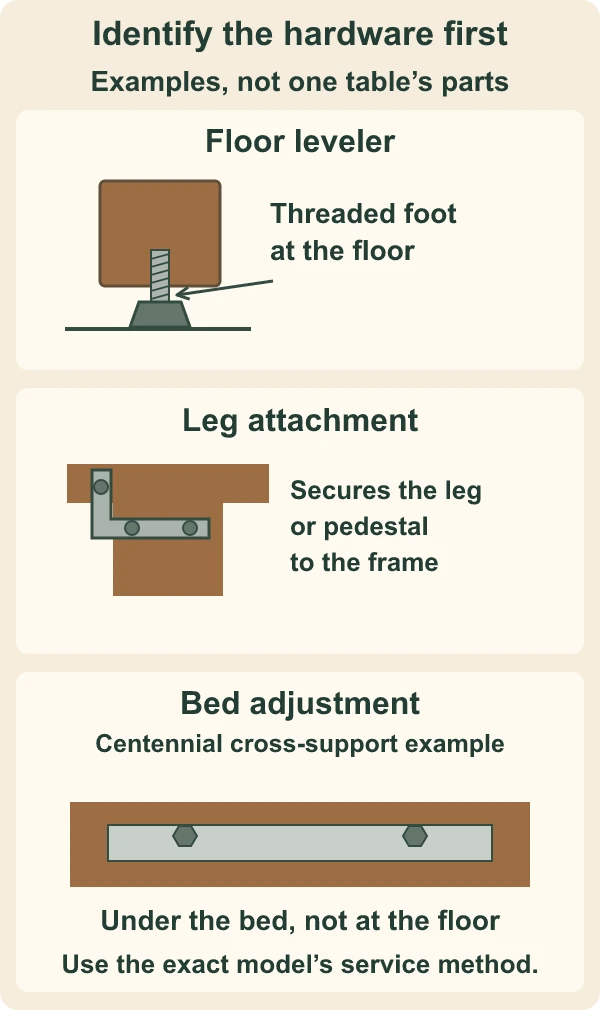
Clear the bed and look at each floor contact. If a pad is slipping, a leg is loose, the cabinet is cracked or the floor moves underfoot, stop before trying to correct the bubble. Use the manual to determine which parts an owner can adjust. For a heavy table that needs lifting, call a billiard mechanic. If the table also needs to change rooms, see what a mechanic checks before moving a pool table.
What level and tools do you need?
Use a spirit level with a clean base and clear markings for a broad check. A precision machinist level detects smaller slopes. Pick a length whose base can sit fully on the area you are checking. Have the specified wrench for approved levelers, a clean ball and a way to record the reading and location.
- Keep one reference position. Put the level on a separate flat, stable surface and note where the bubble settles. Mark where the two ends of the tool sit. Those marks stay in place when you turn the tool.
- Reverse the tool, not the surface. Rotate it 180 degrees end for end, keeping the measuring base down. Return it to the same line and let the bubble settle.
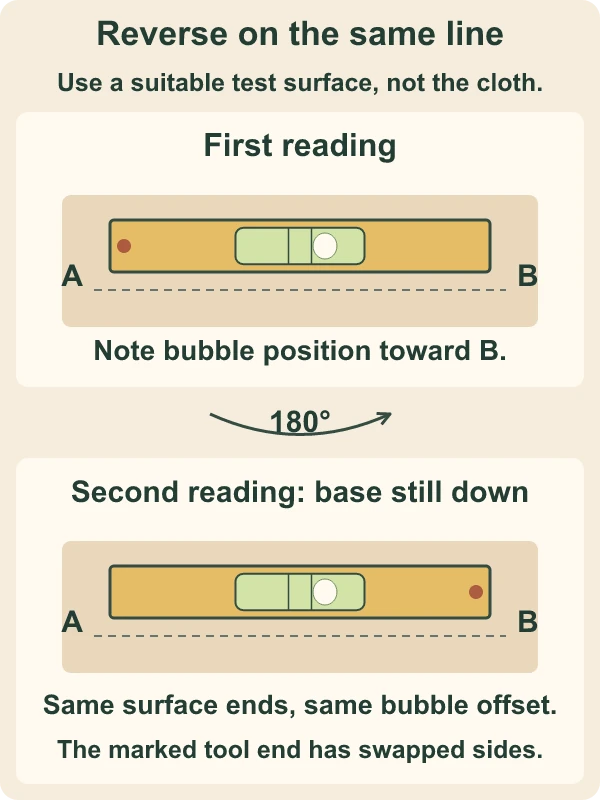
A and B mark where the two ends of the level first sat. The red mark identifies one end of the tool, which changes sides. Compare the bubble against the same surface end, with the measuring base down in both readings. - Compare the same physical ends. The bubble should stay centered in both positions or favor the same end of the surface by the same amount. If the readings disagree, follow the maker’s reversing check or use a verified level.
How to level a pool table with adjustable feet
You can take readings on a stable table without changing anything. Use the adjustment steps only if several readings agree with the repeated drift and the manual allows those feet to turn with the table assembled. If the feet are fixed, need lifting or remain unidentified, give your readings to a mechanic.
- Take readings on the playing bed. Place the level on clean cloth near the center, parallel to the long cushions. Let the bubble settle. It moves toward the higher end, so the end opposite an off-center bubble is low. Rotate the tool 90 degrees for a crosswise reading. Keep both ends of its base on the bed, clear of the table spots, cushions and pocket openings.
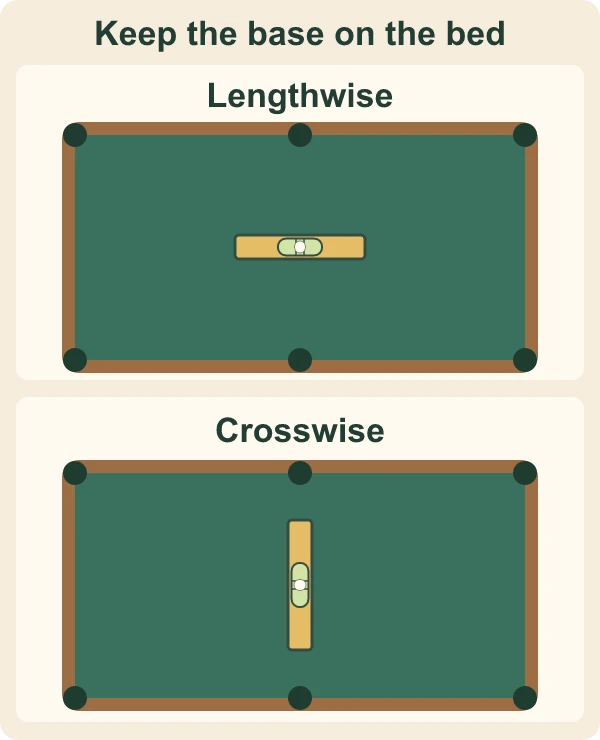
Keep the base on clean cloth, clear of spots, cushions and pocket openings. Turning 90 degrees checks the other axis. It is a different action from the 180-degree reversing check. 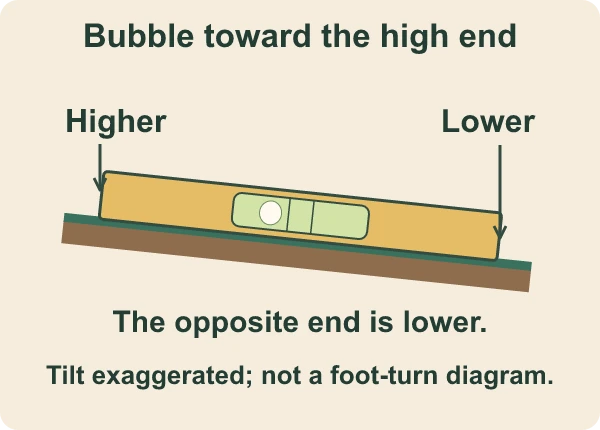
The bubble favors the higher end. The opposite end is lower. The slope is exaggerated to make the direction visible. It gives no universal foot-turning direction. - Check more than the middle. Repeat lengthwise in lanes near both long cushions. Repeat crosswise near both ends. Check both diagonal axes where the base can sit fully on the bed. Think of those as the two slanting lines of an X, a different check from turning the tool end for end. Compare readings taken in the same direction. If several crosswise readings point to the same low side, that suggests a broad tilt. If one area reads differently from nearby points checked in the same direction, have a closer look there.
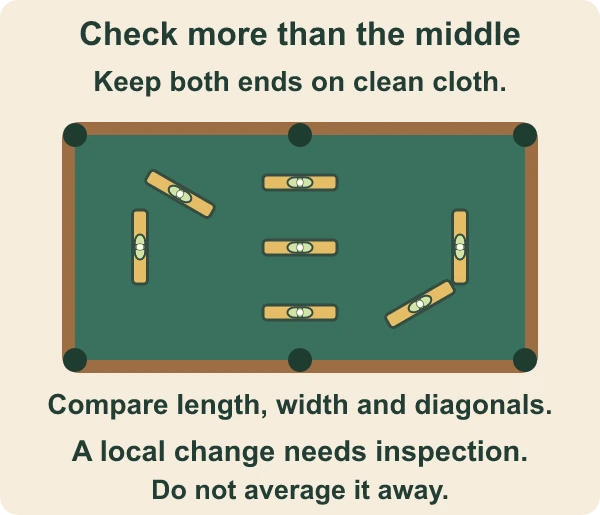
Move the level between these example locations. Do not leave several tools on the bed. Record the position, direction and low physical side each time. A local change needs inspection rather than averaging the readings. - Make one small adjustment. Follow the instructions for which foot to change, the direction to turn and any locknut. Note where it started and stay within its allowed travel. On a low side, the maker may have you adjust both feet in small increments. The Valley Home Pool instructions give a large adjustable wrench or tongue-and-groove pliers as options for their levelers. If the table rocks or a foot comes off the floor, stop and contact an installer.
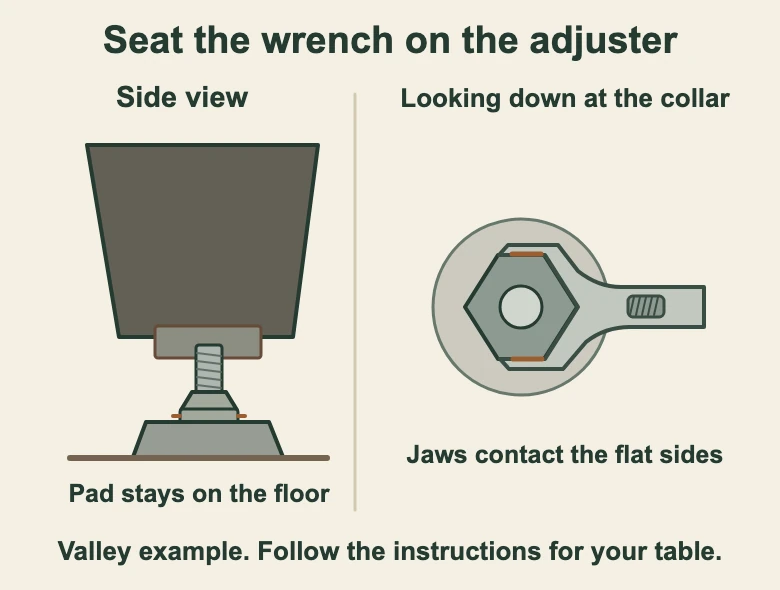
This Valley-style foot has a flat-sided adjuster above the floor pad. An adjustable wrench grips those flats. Follow your own model’s tool, turning direction and support instructions. - Check both directions again. After each adjustment, check that every foot still makes firm contact. Take readings in the same spots and write down the new results. Check again after securing a locknut if the model uses one. Once the bubble reads centered at the check points and the table is steady, do the slow-roll test. If an adjustment levels one area but another stays low, have the bed support checked.
How level does a home pool table need to be?
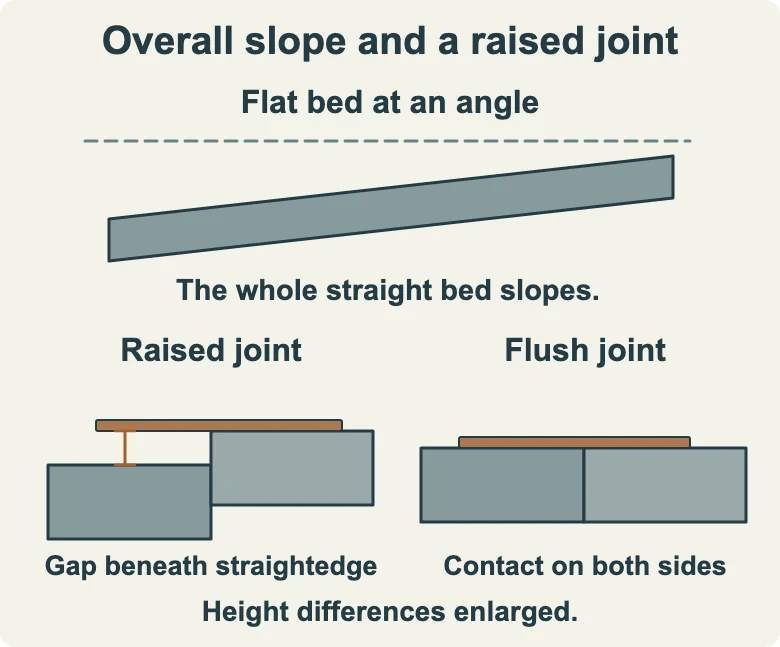
Look for stable support, centered readings at several points and straight, repeatable rolls. Starrett’s 98-series FAQ lists a 0.005 in per foot graduation for its longer 98-series levels. That number describes how much tilt moves the bubble by one graduation. The WPA equipment specs separately address bed flatness and joint alignment for competition equipment. Those figures do not establish a home-table leveling target. A flat bed can tilt as a whole. A centered bubble in another part of the table can miss a local lip. On a three-piece bed, an installer can check across the uncovered joint when the job calls for opening the bed.
How to test the table with a slow roll
Repeat the same lanes from both ends and watch where the ball drifts or hops each time.
- Pick a lane clear of pockets and spots. Start with a clean ball. Roll it by hand at a pace that lets you watch it slow down, with no sidespin and without touching a cushion.
- Roll back along the same lane. Use roughly the same pace. Try the center and both side lanes, then repeat with a second clean ball. Compare the room side the ball drifts toward each time.
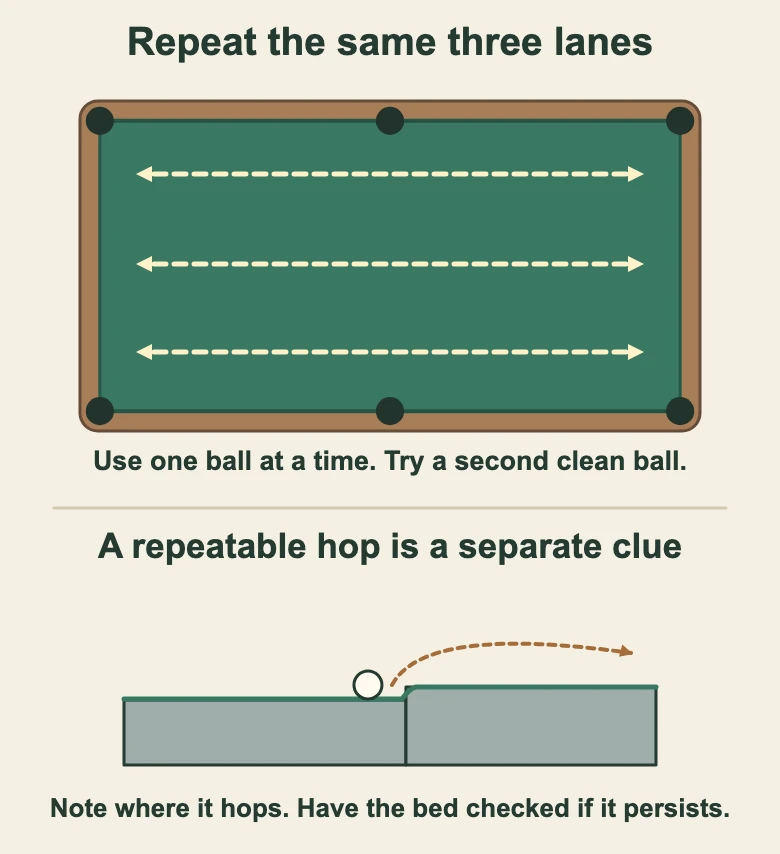
Try the center and both side lanes without touching a cushion. Shift the center path a little if it crosses a spot. The side drawing gives one possible cause of a hop. If it repeats at one spot, record where it happens. 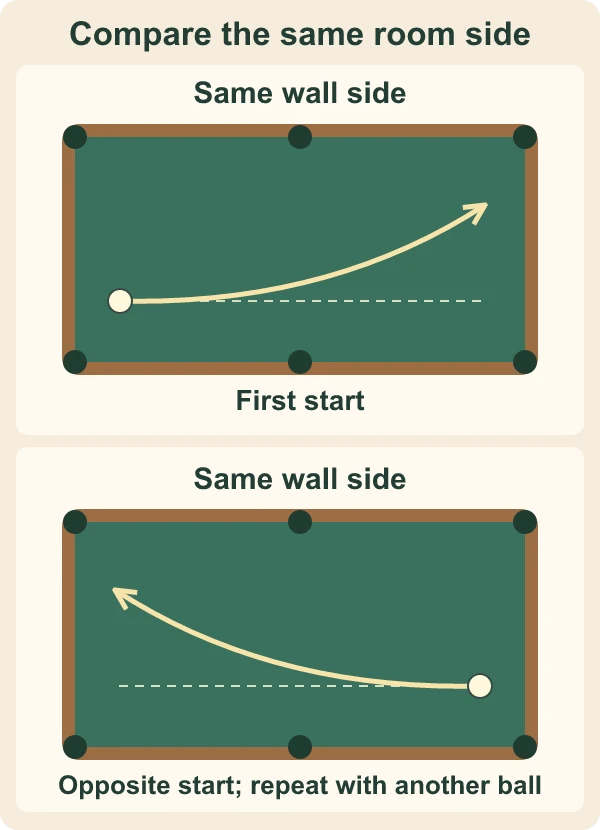
Keep the same table orientation when comparing the paths. These example rolls curve toward the same wall side from opposite starts. Repeat with a second clean ball and confirm the slope with the level before an approved foot adjustment. - Record what repeats. If several lanes drift toward the same room side and matching level readings confirm a low side, use the foot steps if your model permits them. If a ball also hops at one point, record that point separately and have the mechanic check it. A short video taken from the end of that lane gives the installer something to reproduce.
A hand release can add spin, and cloth or ball condition can affect a slow roll. One curve is not a diagnosis. Pool Table Portfolio’s sign-off checks also use several paths and repeated tests with clean balls.
Suppose two balls drift toward the wall side in all three lanes, and the crosswise readings agree. That supports a foot adjustment on a model that allows it. If both balls hop at the same spot near the middle, record that location even if other lanes roll straight. A raised joint needs its own inspection.
When to recheck after installation or on carpet
Check the finished table after an install or move. On carpet, the pile or pad can compress unevenly. If the table is steady, recheck if a foot settles into the carpet or the roll changes. If it rocks, stop and call a mechanic. Use the model’s follow-up instructions and watch for changes in your room. The Playcraft Copenhagen manual describes releveling as maintenance that may be needed over time. Ask your installer about any follow-up visit and its cost.
For fixed legs, ask what shimming method the model uses. The Brunswick Centennial instructions show shims at the pedestal foot pads during assembly. The manual separately shows under-slate wedges and cross-support bed levelers. Have an installer handle any change that requires lifting an assembled slate table. Choose Pool in Table Care Schedule to generate a printable checklist that includes a slow-roll check. Inspect a changed roll or support sooner than a routine reminder.
When to call a pool table mechanic
Call if the table rocks, an adjuster has reached its limit, or two balls still hop at the same point after you check the cloth and clear away debris. On a three-piece slate table, ask the mechanic to check support and whether the slate meets flush at both joints.
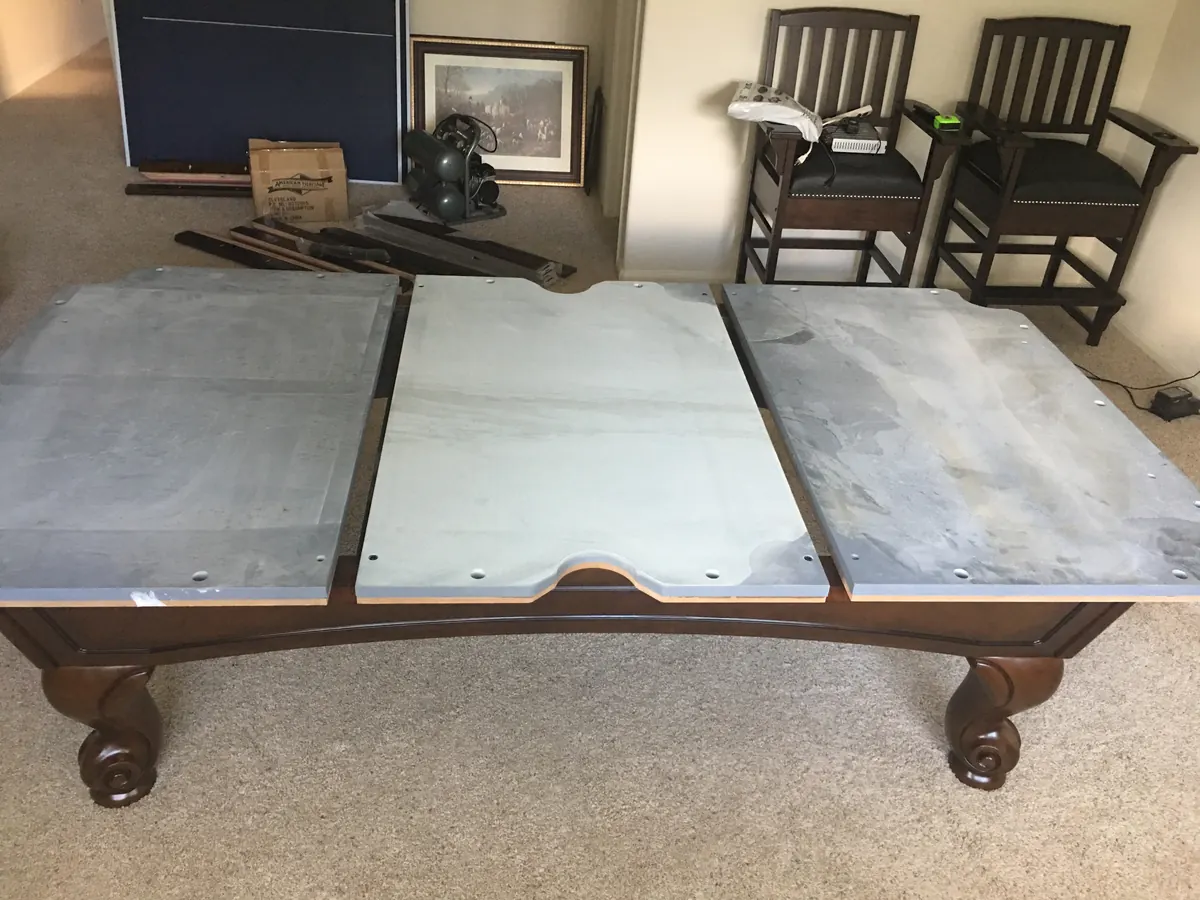
One-piece slate has no joints between slabs. Some models have their own bed or foot adjustments. Diamond’s Pro-Am information shows why the method depends on the model.
On a non-slate bed, a repeatable curve through one band while the ends test well can point to the top or its support. Ask the maker whether it can be supported, serviced or replaced before paying for more foot adjustment.
Ask what the price covers. Atlanta Quality Billiards lists level and repair from $175, with extra labor if dismantling and slate resetting are required. Pool Table Ninjaz in Dallas-Fort Worth lists $100 to $175 for precision leveling with slate adjustment and $150 to $225 with rail or seam tightening. These are local published examples checked November 18, 2026. Send the model, photos of the feet and a roll video. Ask which adjustments, travel, cloth work, finished tests and return visits the written quote includes.
For a table that is already apart, see how the installer checks the slate during assembly. After any adjustment, ask the mechanic to roll a ball along the troublesome lane again with the table ready to play.